
Why Most CEOs Don’t Trust Their Numbers (And What It’s Costing Them)
By TED ROSE, ROSE FINANCIAL SOLUTIONS
Most CEOs won’t say it, but it shows up in how they operate.
They double-check reports. They ask for “one more version” of the forecast. They rely on instinct instead of financial data when making big decisions.
It’s not that they don’t value finance. It’s that they don’t fully trust it.
And that lack of trust is more than a frustration, it’s a hidden cost that slows growth, weakens execution, and creates decision paralysis.
The Real Problem: It’s Not Just a System Failure, It’s Become a Confidence Failure
Most companies assume the issue is their accounting system.
“We need a new ERP.” “We need better dashboards.” “We need more reports.”
But here’s the reality:
Your reporting problem has become a confidence problem.
Even with modern tools, CEOs still ask:
- Are these numbers complete?
- Are they accurate?
- Are they current enough to act on?
If the answer to any of those is “not sure,” the data becomes unusable for decision-making. And when data isn’t trusted, it gets ignored.
The Hidden Cost of “Almost Right” Numbers
“Almost right” sounds acceptable until you look at what it actually does to a business. When numbers are slightly off, slightly delayed, or slightly inconsistent, leaders:
- Hesitate on investments
- Delay hiring decisions
- Miss pricing adjustments
- Underestimate or overestimate cash risks
- Overreact to incomplete information
Over time, this creates a dangerous pattern: Decisions become slower, more reactive, and less confident. The cost isn’t just operational inefficiency, it’s missed opportunity. In growth-stage companies especially, the biggest risk isn’t making the wrong decision. It’s waiting too long to make the right one.
Why Delayed Reporting Kills Decision-Making
Many organizations still operate on a backward-looking model:
- Close the books weeks after month-end
- Reconcile data across multiple systems
- Build reports manually in spreadsheets
- Deliver insights long after the moment has passed
By the time leadership sees the numbers, they’re already outdated. This creates a critical disconnect: The business is moving in real time. Finance is reporting in hindsight. When that gap exists:
- Cash issues are discovered too late
- Margin erosion goes unnoticed
- Operational inefficiencies compound
- Strategic opportunities are missed
Speed matters, but relevance matters more. If finance can’t keep pace with the business, it can’t guide it.
The “Trust Gap” in Finance
At the core of all of this is what we call the trust gap. It’s the space between:
- What the numbers say
- And what leadership believes
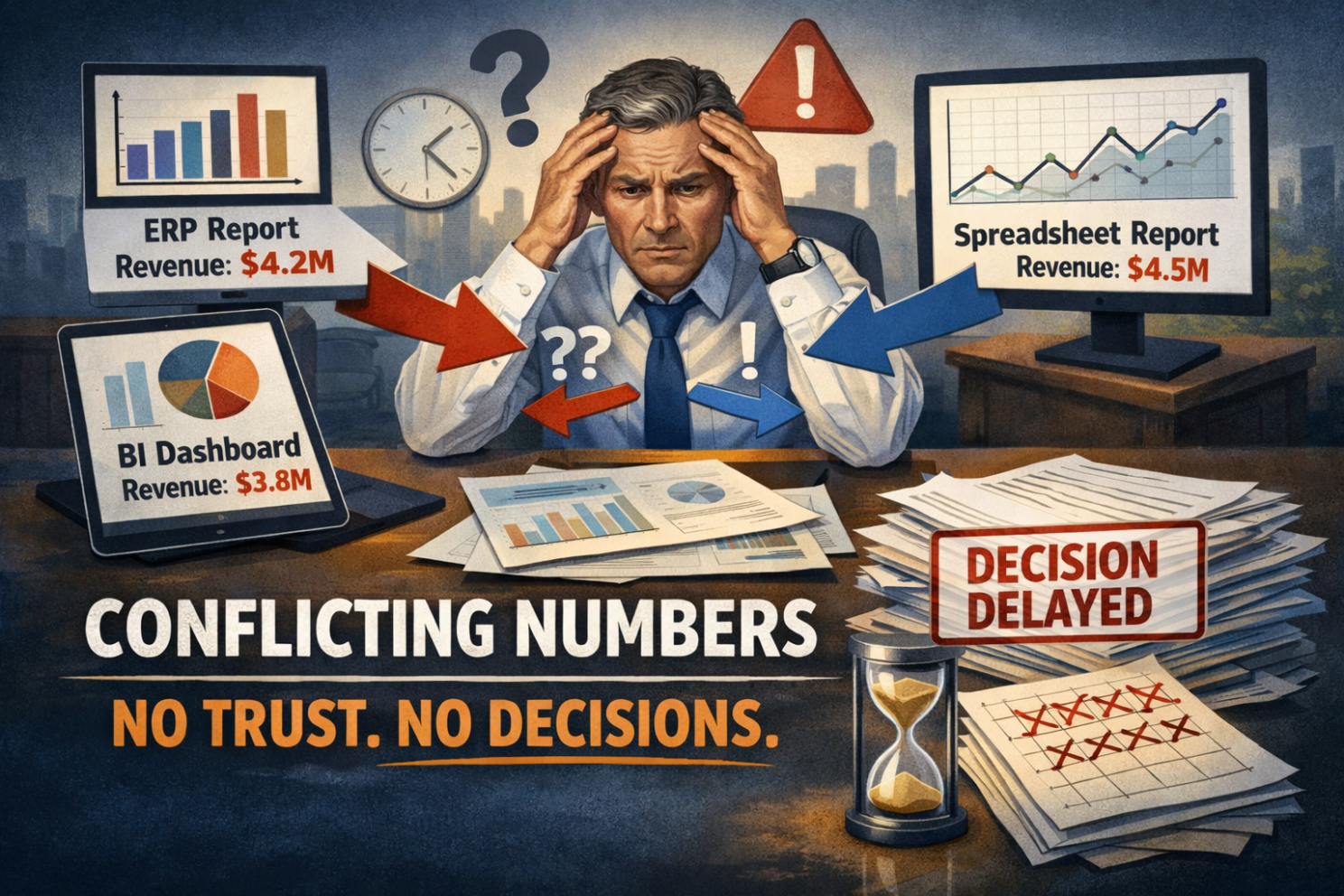
When that gap exists, CEOs don’t rely on financial data, they work around it. They:
- Ask multiple people for the same answer
- Build shadow reports
- Depend on gut feel instead of metrics
- Delay decisions until they feel “comfortable”
This creates friction across the organization. Finance becomes a reporting function, not a strategic one. And leadership operates without a single source of truth.
How Decision-Ready Leaders Operate Differently
In companies where finance is working the way it should, the dynamic is completely different.
Leaders don’t question the numbers. They use them.
These organizations have built decision-ready financial infrastructure, where:
- Data Is Connected:
Financial data flows automatically from across systems: ERP, CRM, payroll, operations without manual intervention.
- Data Is Standardized:
Chart of accounts, reporting logic, and definitions are consistent across the organization.
- Workflows Are Structured:
Approvals, reconciliations, and processes follow clear, rule-based workflows, not email threads and spreadsheets.
- Reporting Is Timely: Leaders have access to current, reliable data, not reports that are weeks old.
- Finance Is Forward-Looking:
Instead of explaining the past, finance helps model scenarios and guide decisions.
The result: Confidence replaces hesitation. Decisions happen faster. Risks are identified earlier. Opportunities are acted on sooner.
The Bottom Line
Most CEOs don’t trust their numbers, not because of their team, and not because they lack tools. They don’t trust them because the financial infrastructure wasn’t designed for decision-making. And until that changes, the business will continue to operate with:
- Slower decisions
- Higher risk
- Missed opportunities
The goal isn’t just better reports. It’s trusted, decision-ready data that leaders can act on with confidence.
Where to Start
If you’re questioning your numbers or finding yourself hesitating on key decisions, it’s worth understanding where the gaps actually are.
👉 Take the Financial Systems Readiness Assessment (FSRA)
It will help you identify:
- Where your trust gaps exist
- What’s slowing your financial visibility
- And what’s required to become truly decision-ready
Because the companies that win aren’t the ones with the most data. They’re the ones that
trust it enough to act.

Ted Rose
In 1994 Ted Rose founded Rose Financial Solutions (ROSE), the Premier U.S. Based Finance and Accounting Outsourcing Firm. In 2010, the Blackbook of Outsourcing named ROSE the #1 FAO firm in the world based on client satisfaction. As the president and CEO of ROSE, he provides executives with financial clarity. Ted has also acted as the CFO for a number of growth companies and assisted with various rounds of financing and M&A transactions.
Share this article:
Visit Us On: