
The Small Business GovCon Earthquake
By WALLY ANGEL, ROSE FINANCIAL SOLUTIONS
Part 1: When Survival Meets Revolution
A year ago, the small business government contracting world was thrown into crisis mode by the USAID elimination.
Firms scrambled to scrub the word "consulting" from their company names as USAID contracts were terminated overnight. Corporate Websites and LinkedIn profiles got emergency rewrites removing "advisory" from job titles. Marketing teams worked weekends purging DEI language from capability statements and websites.
But USAID was just the beginning. The DOGE efficiency initiatives that followed brought widespread contract terminations and descoping across federal agencies. Small businesses found themselves fighting to preserve existing revenue streams while navigating sudden contract modifications and cancellations.
Firms were focused on survival, preserving business and navigating contract terminations.
Meanwhile, the federal government was quietly rewriting the entire rule book. While everyone was consumed with immediate crisis management, protecting existing contracts from DOGE cuts, scrubbing problematic language, and pivoting away from terminated work, the federal government simultaneously implemented the most comprehensive overhaul of small business contracting since the FAR was created in 1984.
The firms that missed the bigger picture are still playing by 2023 rules in a 2026 market.
Two Crises, One Market: Immediate vs. Structural
The DOGE-driven contract terminations and descoping created immediate revenue disruption for hundreds of small businesses across multiple agencies. The impact was real, significant, and demanded urgent attention. But while firms were managing the crisis in front of them, structural changes were reshaping the entire market behind them.
The Immediate Crisis (DOGE Impact):
- USAID contractor elimination
- Widespread contract terminations across agencies
- Descoping of existing contracts
- Emergency pivoting away from affected work streams
- Revenue protection and business preservation focus
The Structural Revolution (Regulatory Overhaul):
- 1,245 firms suspended or eliminated from the 8(a) program (29% of all participants)
- $7.5M → $35M: CAS coverage threshold increased by 367%
- $2.5M → $10M: TINA threshold increased by 300%
- 42+ class deviations issued across DoD alone
- $16+ billion in OTA obligations bypassing traditional FAR entirely
- DEI contract language eliminated across federal agencies
The Strategic Miss: Firms that spent 2025 focused entirely on surviving DOGE cuts missed the opportunity to position for the new contracting environment that was simultaneously being built.
The 8(a) Program: From Socioeconomic Preferences to Capabilities Competition
While small businesses were dealing with contract cancellations and modifications, the SBA was conducting the most aggressive audit in 8(a) program history.
The SBA terminated or suspended 1,245 firms from the 8(a) program.
But this isn't just about reducing numbers, it's about fundamentally changing how the program works.
The Timeline:
- December 5, 2025: SBA ordered all 4,300 active firms to produce three years of financial records
- January 22, 2026: SBA eliminated automatic racial presumption of social disadvantage
- January 28, 2026: 1,091 firms suspended for failing to comply with documentation requirements
- February 11, 2026: 154 Washington D.C. area firms terminated for exceeding economic disadvantage thresholds
- March 4, 2026: 628 additional firms moved to termination for refusing document submission
The Math: The 8(a) program went from 4,300 active participants to under 3,500, a 25-30% reduction. With only 65 new firms accepted in FY2025 (compared to 550/year under the prior administration), the effective program population is heading toward 3,000 or lower.
The Strategic Shift: The 8(a) program is transitioning from socioeconomic preference-based awards to capabilities-driven competition within the set-aside framework. Surviving firms must compete on technical merit, past performance, and cost effectiveness, not just certification status.
The Dual Impact: While DOGE cuts eliminated existing revenue, 8(a) program restructuring eliminated future competition. Firms dealing with both simultaneously faced the challenge of preserving current business while positioning for a fundamentally different competitive landscape.
What This Means: Less Competition, More Capability Focus
If you're still in the 8(a) program: Congratulations. You survived both DOGE cuts and the most aggressive audit in program history. Your competition decreased by nearly 30% overnight.
But the game has changed. The compliance scrutiny that eliminated your competitors is now permanent, and competitions are increasingly won on technical capability and performance delivery rather than just meeting set-aside requirements.
If you're in other set-asides (WOSB, SDVOSB, HUBZone): Get ready. Agencies still need to hit their small business contracting goals. With 1,200+ fewer 8(a) firms to award contracts to, that work is getting redirected. WOSB and SDVOSB set-asides are about to get more competitive, but also more valuable.
Prepare now for the same audit standards that just hit the 8(a) program, and expect capability-based evaluation criteria similar to what's happening in the restructured 8(a) competition.
If you compete against 8(a) firms for small business set-aside opportunities: The landscape just shifted dramatically in your favor. Firms that built their strategy around 8(a) sole-source work now need to compete in a competitive market, often for the first time in years.
If you survived DOGE cuts: You demonstrated resilience and adaptability during crisis. That operational experience becomes valuable as evaluation criteria shift toward performance delivery and capability demonstration.
Action Required: Every socioeconomic set-aside program could get the same treatment. The SBA's message is clear: prove your eligibility or lose your certification. Get your financial documentation audit-ready now, before the review cycle hits your program.
The New Math: Reduced Administrative Burden
While firms were navigating contract terminations and descoping, the government implemented the most significant reduction in compliance administrative burden for small and mid-size contractors in 40 years.
Critical Threshold Changes (Effective for contracts awarded after June 30, 2026)
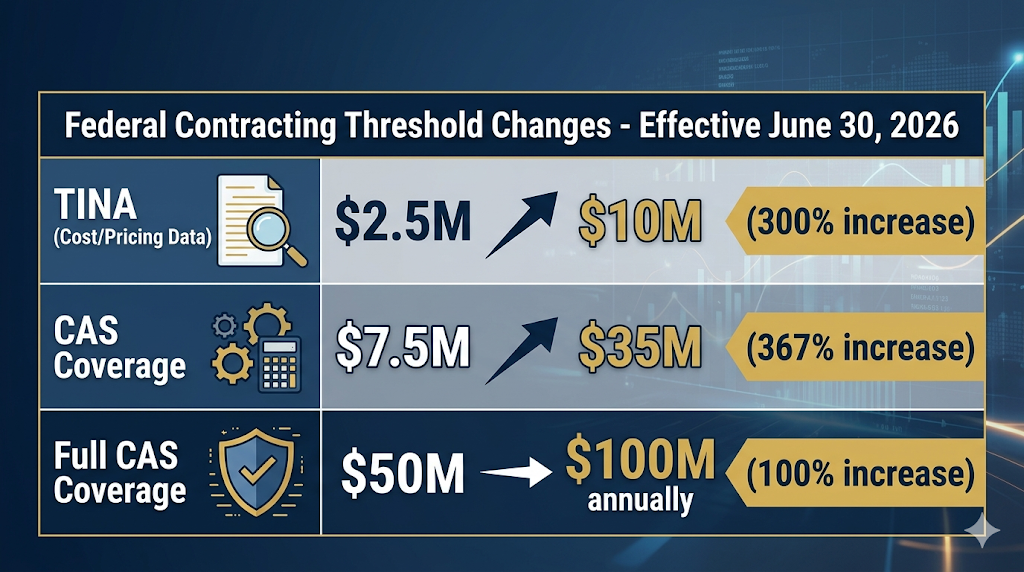
Let's translate this into real operational impact:
Scenario: $15M annual contractor
- Old rules: CAS Coverage triggered at $7.5M threshold for a single contract
- New rules: Not subject to CAS coverage
- Impact: Reduced administrative costs
- Benefit: Resources redirected from compliance administration to business development
Scenario: $8M single contract
- Old rules: TINA and detailed cost/pricing data submission requirements
- New rules: TINA exemption, simplified pricing documentation
- Impact: Reduced proposal preparation burden
- Benefit: Faster proposal turnaround, reduced bid costs
The Recovery Opportunity: For firms that survived DOGE cuts with reduced revenue, these threshold changes offer a path to rebuild margins. Lower administrative burden means higher profitability on new contracts, helping offset revenue losses from terminated work.
The Strategic Window: You have 102 days until June 30, 2026 to restructure your compliance administration processes to take advantage of these thresholds. Firms that optimize early will have lower G&A rates from reduced administrative burden while maintaining full compliance readiness.
Critical Note: These threshold increases reduce administrative burden and reporting requirements, they don't eliminate compliance obligations. Contracts above the new thresholds still require full compliance, and the standards for those larger contracts remain unchanged. The relief comes from reduced administrative requirements for smaller work that historically triggered extensive reporting obligations.
Beyond Crisis Management: The Real Changes
A year ago, contractors focused on crisis management, preserving revenue streams threatened by DOGE cuts while removing problematic language from marketing materials. Now the changes go to the core of how business gets done:
Evaluation Criteria Transformation:
- Technical capability and past performance weighted higher in source selections
- Cost competitiveness becomes more important as social factors are de-emphasized
- Capability-based competition emphasized even within set-aside programs
Positioning Strategy Shift:
- Update capability statements to emphasize technical expertise and performance delivery
- Revise past performance narratives to focus on delivery results and technical achievements
- Restructure teaming strategies based on technical complementarity and capability gaps
- Reframe set-aside positioning around competitive advantage within capability-focused competitions
Crisis Experience as Competitive Advantage: Firms that successfully navigated DOGE cuts demonstrated operational resilience, crisis management capability, and adaptability, exactly the qualities that matter in capability-based evaluation criteria.
Strategic Repositioning: Firms that spent 2025 in crisis mode now need to rebuild their value propositions around technical capability, cost competitiveness, and performance delivery. The evaluation criteria that matter have fundamentally shifted toward merit-based competition.
The Survival Test: Documentation Audit
Here's what the DOGE cuts taught us: when the government gets serious about efficiency and program changes, they act decisively across multiple areas simultaneously.
The 8(a) purge followed a similar pattern:
- New requirement announced (three years of financial records)
- Short compliance window (60 days)
- Mass elimination (1,091 firms suspended immediately)
Every other set-aside program is watching this playbook. Companies who survived DOGE cuts should audit their set-aside documentation now, before their program gets the 8(a) treatment. The firms that pass future audits will be the ones that prepare like an audit is coming, not the ones that wait for the notice.
The Documentation Checklist:
- ☐ Financial records: Three years of tax returns, audited financials, bank statements
- ☐ Ownership documentation: Current cap table, ownership percentages, control structures
- ☐ Size certification: NAICS codes, average annual receipts, affiliate relationships
- ☐ Performance history: Contract deliverables, CPARS ratings, reference letters
Timeline: Update and organize this documentation in Q2 2026. Don't wait for the audit notice. Remember: reduced administrative burden doesn't mean reduced compliance standards. The requirements that remain are being more strictly enforced and audited.
The Competitive Advantage Window
A year ago, firms that moved fastest to adapt after DOGE cuts, finding new revenue streams, repositioning capabilities, strengthening operations, captured opportunities while their competitors were still in crisis mode. The same dynamic is happening now with regulatory changes, but bigger.
Your competitors are still operating under the old rules. They're submitting proposals not reflecting the new environment. They're maintaining unnecessarily burdensome administrative processes for contracts with reduced requirements. They're competing for 8(a) set-asides using socioeconomic positioning rather than capability-focused approaches that now drive evaluation scores.
The early-mover advantage window is open right now. What early movers are doing:
- Streamlining compliance administration to reduce burden while maintaining full audit readiness
- Updating proposal templates with new clause references and threshold requirements
- Repositioning capability statements around technical expertise and performance delivery
- Preparing documentation for inevitable set-aside audits using 8(a) standards as the baseline
- Using crisis management experience as demonstration of operational capability
Window timeline: By Q4 2026, these new rules will be standard knowledge. The competitive advantage disappears when everyone else catches up.
What's Coming in Part 2
The small business changes we just covered are dramatic, but they're only half the story.
Next week: How the federal government is bypassing the traditional FAR entirely through Other Transaction Authorities (OTAs) and Commercial Solutions Openings (CSOs). Plus: the holy grail of government contracting, moving from prototype directly into production without further competition.
The question: Are you ready to compete in a market where commercial speed beats compliance rigor?
Three Types of Contractors
In my experience, I'm seeing three distinct responses to these dual challenges:
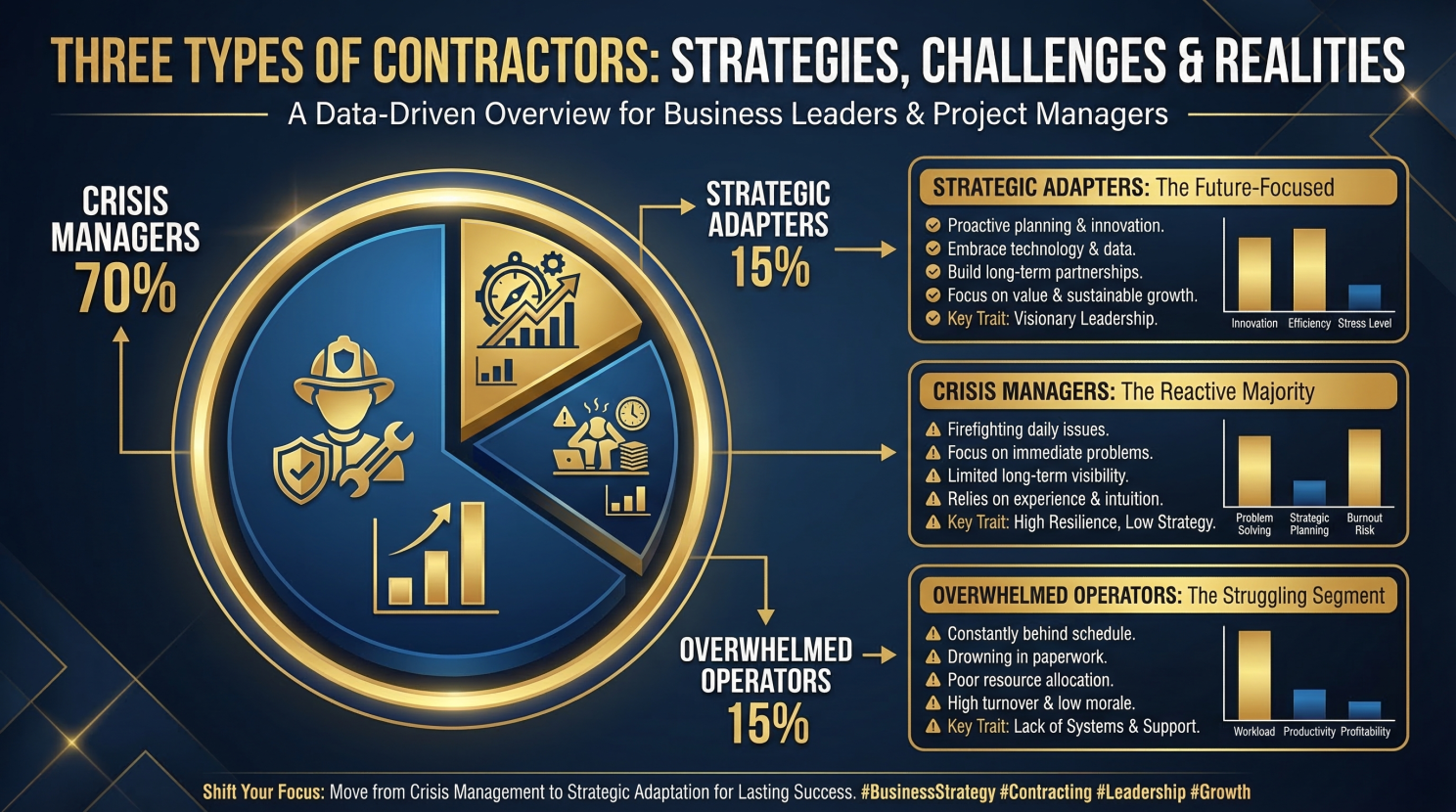
Type 1: Strategic Adapters. Successfully navigated DOGE cuts while simultaneously positioning for regulatory changes. Streamlining administrative processes, updating templates, repositioning capabilities for merit-based competition. These firms are capturing market share.
Type 2: Crisis Managers. Focused entirely on surviving DOGE cuts and immediate revenue preservation. Aware regulatory changes are happening but haven't had bandwidth to adapt. These firms are now playing catch-up.
Type 3: Overwhelmed Operators. Struggled with both DOGE impact and regulatory adaptation. Still operating like it's 2023. These firms face existential risk.
The gap between Type 1 and Type 3 is now permanent. By the time the Overwhelmed Operators recover from crisis mode, the Strategic Adapters will have locked up opportunities in the new market structure.

Wallace Angel
Wallace “Wally” Angel is a strategic CPA with more than 20 years of experience in the government contracting and consulting environments with companies ranging from start-ups to $800M. His government contracting expertise includes FAR and DCAA compliance, indirect rate calculation, forward pricing, proposal writing, pricing, and cradle to grave contracts management and system design and implementation. In his position as Partner, Financial Operations, Wally serves as a trusted advisor to the C-suite in controllership and cash management, revenue recognition, system design and implementation, and full financial planning and analysis.
Share this article:
Visit Us On: