
The Complete Picture: What It Actually Takes to Build a Finance Function That Scales
By TED ROSE, ROSE FINANCIAL SOLUTIONS
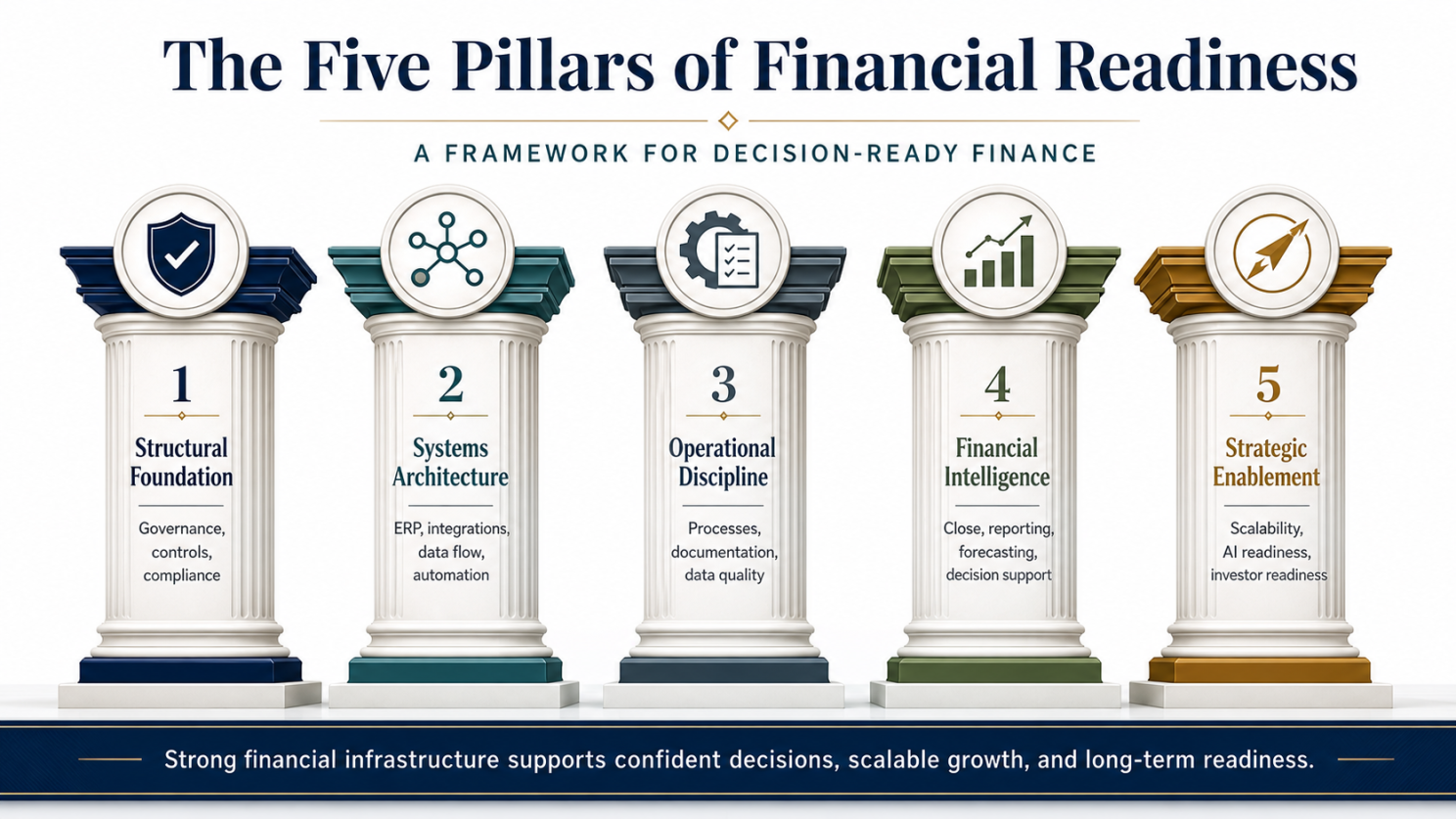
Over the past several months, we have worked through the five pillars of financial infrastructure one by one: the foundation that keeps the house standing, the systems that either connect or collide, the discipline that separates a finance team from a finance function, the intelligence that makes numbers actually trustworthy, and the strategic posture that determines whether finance helps you scale or quietly holds you back.
This issue ties all of it together.
Not as a summary. As a framework you can use.

The Diagnosis Most Companies Are Missing
Growth-stage companies rarely fail because of the market. They fail, or fall far short of their potential, because the financial infrastructure underneath the business was never built to handle the weight of scale.
They hire. They sell. They land customers, win contracts, raise capital. And somewhere along the way, the finance function stops keeping up.
Reports take longer. Close is a scramble. Forecasts are unreliable. The CEO starts making calls based on feel because the numbers aren't ready, aren't trusted, or aren't clear enough to act on. The CFO is buried in the close instead of guiding strategy. And everyone is too busy to fix the system because they're too busy running the system. This is not a people problem. It is an infrastructure problem. The business scaled. The finance function didn't.
Why Piecemeal Fixes Don't Hold
When companies feel this kind of friction, the usual instinct is to patch it. Add a tool. Hire someone. Clean up the data. Push the team harder.
Those moves can relieve pressure in the short term. They rarely fix the underlying problem, because the underlying problem isn't any single thing. It's the accumulated weight of five interconnected weaknesses, each one making the others harder to solve.
Weak governance erodes the data. Bad data corrupts the reports. Unreliable reports undermine confidence. Low confidence forces workarounds. Workarounds become process. Process becomes culture.
By the time most companies ask for help, they're not dealing with one problem. They're dealing with five. That's exactly what the Financial System Readiness Assessment was designed to surface.
The Five Pillars: What Each One Actually Measures
The FSRA is organized around five dimensions of financial infrastructure maturity. Not five items on a checklist. Five interconnected pillars, each one assessed on depth and reliability, not just presence.
Pillar 1: Structural Foundation
This is the compliance layer. Governance. Role clarity. Internal controls. Audit posture. Tax compliance risk. It's the unglamorous part of financial infrastructure. Nobody wants to talk about it until an audit is scheduled, a deal is in diligence, or an investor asks a question you can't answer cleanly.
Structural Foundation isn't a nice-to-have. It's the base everything else is built on. A fragile foundation doesn't just create compliance risk. It limits how far you can build.
The question here isn't "do you have controls?" The question is: "are those controls documented, tested, and reliable enough to hold under scrutiny?"
Pillar 2: Systems Architecture
This is where technology either earns its keep or creates drag. ERP integrity. Integration quality. Data flow. Automation depth. AI and technical readiness.
Most growing companies have accumulated systems over time, each one added to solve a specific problem, rarely designed to work together. The result is a finance team spending significant time moving data between platforms, reconciling discrepancies, and producing reports that require manual assembly.
That's not a technology problem. It's an architecture problem. Systems Architecture measures whether your technology stack works as an integrated infrastructure or as a collection of disconnected tools. The gap between those two states is where most of the hidden labor in finance lives.
Pillar 3: Operational Discipline
This pillar doesn't get enough credit. Data quality. Process documentation. Budget and performance management. Cash management rigor.
Operational Discipline measures whether your finance function runs as a system or depends on specific people doing specific things in specific ways that nobody has ever written down. Key-person dependency is one of the most underestimated risks in growth-stage finance. When the person who knows how close works, or who maintains the model, or who manages the reconciliation process leaves, the organization discovers what it doesn't have documented. Operational Discipline is the difference between a finance team and a finance function. One runs on people. The other runs on process.
Pillar 4: Financial Intelligence
This is the pillar most directly connected to the questions leadership is actually asking. Close speed and accuracy. Reporting usability. Forecasting reliability. Decision support capability.
The question Financial Intelligence answers is simple: do you trust your numbers? Not "do you have numbers?" Every company has numbers. The question is whether those numbers are produced quickly enough, accurately enough, and in a format useful enough to actually inform decisions.
When the answer is no, it doesn't stay contained to finance. It spreads. Executives start making calls on intuition rather than data. Finance teams build shadow models to compensate for unreliable reporting. The trust gap between leadership and the finance function widens until finance is producing reports that nobody is fully using. Financial Intelligence measures the quality of what finance produces, not just the volume.
Pillar 5: Strategic Enablement
This is where financial infrastructure either becomes a competitive asset or a growth constraint. Automation scalability. AI readiness. M&A and investor preparedness. Growth scalability.
Strategic Enablement asks whether your finance function is built to support the company you are becoming, or only the company you already are. A lot of companies reach a meaningful inflection point. A new funding round. A serious acquisition target. A major contract. A new market. And they discover that their financial infrastructure wasn't designed for that moment. The close is too slow, the data too fragmented, the reporting too manual to move at the speed the opportunity requires.
Strategic Enablement is the forward-looking pillar. It measures readiness for what's next, not just fitness for what's now.
The FSRA and the FSRR: Understanding the Difference
People often ask me how the FSRA and the FSRR relate to each other. The answer matters, so let me be direct about it.
The FSRA is a self-assessment. A CEO or CFO works through it in roughly 15 minutes and receives a Financial System Readiness Index score across all five pillars. It's designed to surface the gap between where your financial infrastructure is today and where it needs to be. Many leaders complete it and see, clearly for the first time, exactly where the fragility lives.
The FSRR is a different tool entirely. It's a professional engagement. A ROSE advisor works through 80 documented indicators with your team, requiring evidence rather than assertion, scoring maturity rather than presence, and rounding down when documentation is missing or incomplete. The result isn't a second opinion on the FSRA score. It's an implementation-grade diagnosis that produces a specific, phased remediation roadmap.
The sequence matters. The FSRA opens the conversation. The FSRR builds the plan. Together, they create a consistent model: understand the baseline, build the roadmap, measure improvement against that same baseline over time.
The FSRR also serves as the entry point for every FaaS engagement. Before we build anything, we diagnose. Before we automate anything, we stabilize the foundation. The sequence isn't optional. Automation built on fragile infrastructure doesn't create scale. It creates faster fragility.
What "Decision-Ready" Actually Means
I have used the phrase "decision-ready finance" throughout this newsletter series. Let me be precise about what it means.
Decision-ready finance is not a reporting style. It's not a technology configuration. It's not a faster close.
It's the condition in which your financial infrastructure reliably produces accurate, timely, and trustworthy information that leadership can act on with confidence. That condition requires all five pillars to be functioning at a sufficient level of maturity. You can't get to decision-ready through Financial Intelligence alone if the Structural Foundation is shaky and the Systems Architecture is fragmented. You can't automate your way to Strategic Enablement if Operational Discipline is missing and key-person dependency is high.
That's the core argument of this newsletter. The pillars are interdependent. The whole system either works or it doesn't. Most growth-stage companies have pockets of strength scattered across the five pillars. The FSRA is useful precisely because it shows you the complete picture, not just the area where you've already invested.
The Cost of Waiting
The companies that move on this don't wait for a crisis to force it. They don't wait for the audit to find the control gap. They don't wait for the deal to stall in diligence because the financials aren't clean. They don't wait for the CFO to quit before asking whether the close process is documented anywhere.
They assess. They see the gaps clearly. They build the roadmap. They start with the foundation. The companies that wait tend to pay more, in time, in dollars, and in missed opportunity, than the companies that get ahead of it. The most expensive infrastructure isn't the kind you invest in. It's the kind you neglect until it breaks at the worst possible moment.
Where to Go From Here
If you've been reading this newsletter, you now have a clear framework for thinking about financial infrastructure. Five pillars. A diagnostic tool. A methodology for building the roadmap.
The next step is to see where you actually stand. The FSRA takes about 15 minutes. It's free. It will show you your RFSI score across all five pillars and give you a clear picture of where your financial infrastructure is strong, where it's fragile, and what the business consequences of those gaps are likely to be.
If what you find warrants a deeper look, the FSRR is where we go from assessment to roadmap. That conversation starts with a call.
Ted Rose is the founder and CEO of Rose Financial Solutions. Decision-Ready Finance publishes weekly for CEOs, CFOs, and growth-stage leaders who want finance to work smarter for their organizations.

Ted Rose
In 1994 Ted Rose founded Rose Financial Solutions (ROSE), the Premier U.S. Based Finance and Accounting Outsourcing Firm. In 2010, the Blackbook of Outsourcing named ROSE the #1 FAO firm in the world based on client satisfaction. As the president and CEO of ROSE, he provides executives with financial clarity. Ted has also acted as the CFO for a number of growth companies and assisted with various rounds of financing and M&A transactions.
Share this article:
Visit Us On: