Choosing the Best Accounting Software for Government Contractors
A 2026 Buyer's Guide
BY TED ROSE, ROSE FINANCIAL SOLUTIONS (UPDATED 9/23/2026)
Selecting accounting software is one of the highest-stakes decisions a government contractor makes. Get it right, and your finance function scales in the background while you chase bigger contracts. Get it wrong, and you are re-implementing a new system in eighteen months, or worse, failing a pre-award survey right when a major award is on the table.
This guide breaks down what "DCAA compliant" actually means, compares the five accounting platforms most commonly used by government contractors, and gives you a framework for matching the right system to your stage of growth.
The Short Answer
There is no single best accounting system for government contractors. There is only the right system for your contract mix and compliance burden. Revenue is a rough proxy. The real drivers are contract type, Cost Accounting Standards (CAS) applicability, and how many cost-reimbursement or CAS-covered contracts you run at once.
For most contractors, the progression looks like this: QuickBooks with a compliant add-on in the early days, PROCAS or Unanet when you take on your first cost-plus or T&M work, and Unanet, JAMIS Prime or Deltek Costpoint once you are managing multiple complex cost-type contracts with complex cost pool structures. The most expensive mistake is not picking the "wrong" platform. It is staying on an outgrown accounting software too long.
The Biggest Misconception: There Is No "DCAA-Approved" Software
Let's clear this up first, because it trips up nearly every first-time government contractor: the DCAA does not approve, certify, or endorse any accounting software. No vendor can put a "DCAA-Approved" seal on a product, because that seal does not exist.

What the Defense Contract Audit Agency (DCAA) actually evaluates is whether your accounting system, meaning your software plus your documented policies and procedures plus how consistently you follow them, meets the criteria in Standard Form 1408 (SF-1408), the Preaward Survey of Prospective Contractor Accounting System. It is worth being precise about who does what here. DCAA performs the audit and issues its findings, but the actual adequacy determination is made by the contracting officer, typically with input from DCMA (the Defense Contract Management Agency), who administers the contract day to day. DCAA's report is the evidence. The contracting officer's determination is the decision.
At a minimum, SF-1408 expects your accounting system to:
- Operate on an accrual basis, in accordance with GAAP (a cash-basis system will not pass)
- Properly segregate direct costs from indirect costs, with indirect costs grouped into logical pools (overhead, fringe, G&A) and allocated consistently
- Identify and exclude unallowable costs per FAR Part 31
- Track costs by contract, using job-cost and project accounting rather than a single general ledger bucket
- Support a compliant timekeeping system with daily time entry, supervisor approval, and a full audit trail of any changes
- Produce reliable labor distribution and billing that ties back to job cost records
- Generate the reports needed for interim billing and incurred cost submissions
In other words, the software is necessary but not sufficient. ROSE Financial Solutions' clients have a 100% pass rate on DCAA audits and pre-award surveys, and that track record comes as much from the policies, procedures, and internal controls wrapped around the software as from the software itself. We have seen contractors pass with configured QuickBooks and others face failure with a six-figure ERP, because compliance is a system of people and process, not software alone.
Timekeeping: Where Most Audit Findings Actually Happen
If there is one area where software selection alone will not save you, it is timekeeping. DCAA's most common findings trace back to a handful of recurring issues: employees not recording their own time in real time, missing or informal correction procedures, and inadequate segregation between who enters time and who approves it.
A compliant system needs employees to record their own hours daily (not at the end of the week, and not through a supervisor entering time on their behalf), a documented approval workflow, and a formal correction process that requires both the employee's and supervisor's sign-off along with a written explanation for any change.
DCAA also conducts floor checks: unannounced site visits where an auditor verifies that employees are physically doing, and charging to, what their timesheet says. A system that looks compliant on paper but is not reinforced by consistent day-to-day habits will not survive a floor check. This is one of the clearest examples of why "DCAA-compliant software" is really shorthand for "software plus disciplined process."
Cost Accounting Standards and the Business Systems Rule
Revenue is a useful rough guide for software selection, but it is not what actually triggers heavier compliance requirements. The real trigger is Cost Accounting Standards (CAS) applicability, along with CAS-covered contract value, which determines whether you fall under Modified or Full CAS coverage. A contractor with a single CAS-covered cost-reimbursement award has meaningfully different system obligations than one running only firm-fixed-price work, regardless of which one has higher revenue.
Once a contract is CAS-covered, DFARS 252.242-7005 (Contractor Business Systems) and 252.242-7006 (Accounting System Administration) come into play. Under this rule, if a contracting officer makes a final determination that your accounting system has a significant deficiency, the government can withhold 5% of payments on cost-reimbursement, labor-hour, and T&M billings for that system (up to 10% in aggregate across multiple deficient business systems) until the deficiency is corrected. This is real cash-flow risk, not just an audit inconvenience, and it is a major reason contractors accelerate a system upgrade well before they would otherwise consider it on revenue alone.
For contractors on larger DoD programs, Earned Value Management System (EVMS) requirements add another layer, typically required on contracts above roughly $20M. EVMS reporting depth is one of the real, if underappreciated, reasons contractors move to Deltek Costpoint specifically. Its project reporting was built to support EVM in a way that lighter platforms generally are not.
What to Evaluate Before You Buy
1. DCAA and FAR readiness. Can the system segregate direct and indirect costs, track time by contract and task, and produce an audit trail auditors can follow without a translator? This matters more for cost-reimbursement and T&M work than for firm-fixed-price contracts with no cost-reimbursable line items, where the bar is lower.
2. Cloud vs. on-premise. Cloud-based systems have become the default for good reason: real-time visibility from anywhere, automatic updates, and no server infrastructure to maintain. If you are still running desktop software, moving to the cloud is usually one of the highest-ROI changes you can make, especially with distributed and remote teams now standard in the GovCon workforce.
3. Scalability. The system that works at $2M in revenue often cannot handle $20M with five active cost-plus contracts. Buying for where you are today, without a plan for where you are headed, is the single most common and expensive mistake we see.
4. Integration. Disconnected point solutions, meaning separate systems for timekeeping, CRM, procurement, and the general ledger, create reconciliation headaches and open the door to compliance gaps. The fewer systems your team has to keep in sync manually, the lower your audit risk and the more time your team spends on analysis instead of data entry.
5. Total cost of ownership. Look beyond the license fee. Factor in implementation cost, the learning curve, ongoing administration, and the cost of the next migration if you outgrow the platform in two years.
The Top 5 GovCon Accounting Platforms at a Glance
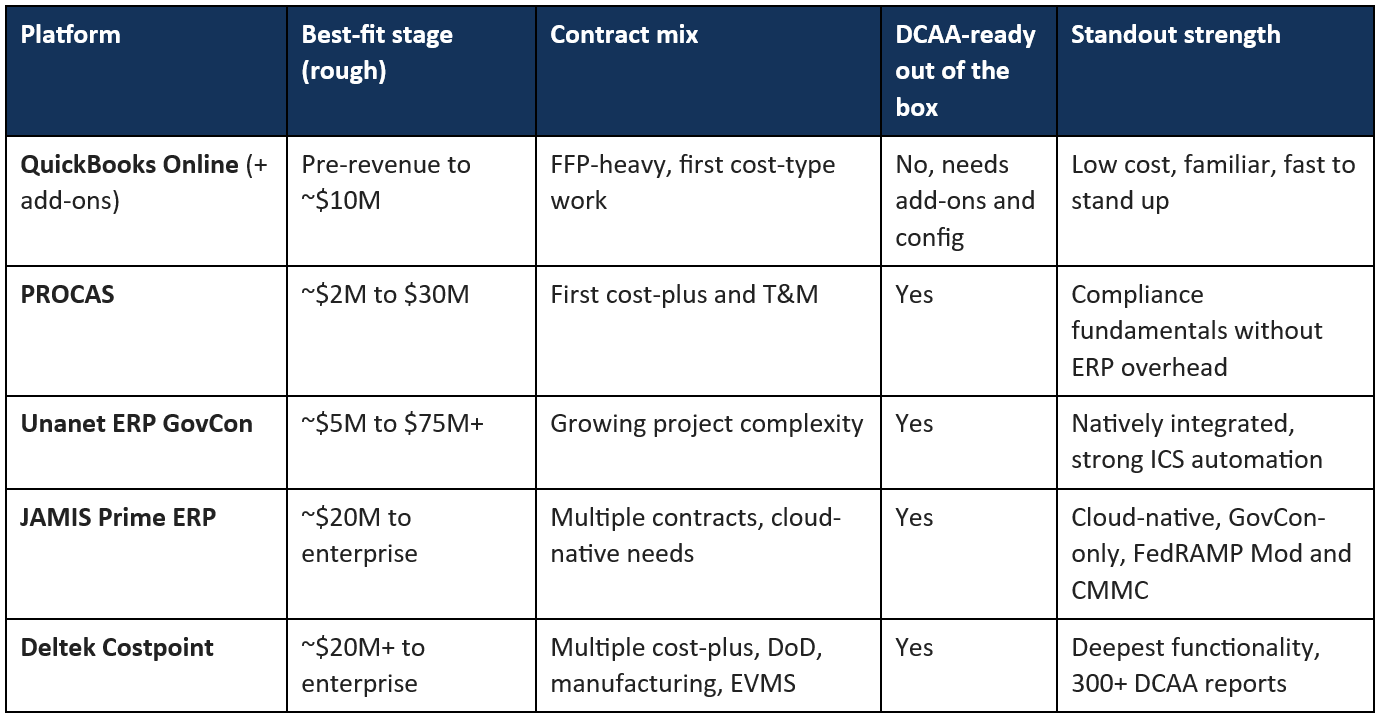
Revenue ranges are general guidance, not hard cutoffs. The right platform depends more on contract mix and compliance complexity than on revenue alone. The profiles below run from simplest to most complex.
QuickBooks: The Right Starting Point for Many New Contractors
QuickBooks remains a good option for early-stage government contractors, generally from pre-revenue up to around $10M. It is user-friendly, inexpensive, and handles routine functions (accounts payable, accounts receivable, payroll, and financial statements) well.
The catch runs deeper than "no native timekeeping." QuickBooks' general ledger structure makes it easy to reclassify costs between direct and indirect after the fact with no enforced audit trail (unless properly configured), which is precisely the kind of gap DCAA auditors are trained to test for. To use it compliantly, you will need to pair it with a dedicated time-tracking and job-costing add-on, configure your chart of accounts to segregate direct and indirect costs, and put in place, and actually enforce, the change-control procedures that keep that segregation and auditability intact.
PROCAS: The Compliance-First Middle Ground
PROCAS was built specifically for government contractors and covers the compliance fundamentals, including timekeeping, job costing, and indirect cost tracking, without the cost or complexity of a full ERP. It is a strong fit for small to mid-sized contractors, roughly $2M to $30M in revenue, who have outgrown QuickBooks but do not yet need the program management depth of a larger platform.
Unanet ERP GovCon: Built DCAA-First, All in One System
Unanet's advantage is architectural. Timekeeping, expense reporting, and project accounting live natively in one system rather than as separately synced modules. That reduces reconciliation work and shortens month-end close.
Unanet also automates indirect cost pool calculations and includes tools built specifically to speed up incurred cost submissions, a task that otherwise eats dozens of hours a year. It is a common landing spot, typically in the $5M to $75M+ range, for contractors moving off QuickBooks or PROCAS once project complexity and contract volume increase.
JAMIS Prime ERP: The Cloud-Native Enterprise Option Built Only for GovCon
JAMIS Prime is a cloud-native ERP built from the ground up for government contractors, and JAMIS focuses exclusively on the GovCon and project-based market. That single-market focus is the point. Where general-purpose ERPs need expensive customization to meet federal standards, JAMIS Prime handles DCAA, FAR, and CAS requirements as core functionality rather than bolt-ons.
The platform tracks direct, indirect, and overhead costs at the contract, project, and task level, automates the exclusion of unallowable costs under FAR Part 31, and enforces total time accounting with immutable audit trails on labor and timecard changes. It supports all major contract types (cost-type, T&M, firm-fixed-price, and performance-based), and its continuously reconciled, project-level data is designed to make the annual Incurred Cost Submission a routine task rather than a scramble.
On security, JAMIS Prime runs in a FedRAMP Moderate cloud environment and supports NIST 800-171 and CMMC 2.0 requirements, which matters as more DoD contracts push cybersecurity mandates down to cloud service providers.
JAMIS is typically the right fit for mid-sized to large contractors, roughly $20M and up, that want enterprise-grade cloud architecture and multi-entity, intercompany, and international capabilities without the full implementation weight of Costpoint. For many contractors, the real decision at the enterprise tier is JAMIS versus Costpoint, and it usually comes down to cloud-native design and single-market focus on one side against maximum functional depth and program complexity on the other.
Deltek Costpoint: The Enterprise Standard for Complex, Multi-Contract Programs
Costpoint is the platform most large and rapidly scaling contractors eventually grow into, particularly those managing multiple cost-plus contracts, DoD work, or manufacturing operations. It integrates project accounting, contracts, HR, payroll, procurement, and compliance in a single system, backed by 300+ pre-built DCAA-ready reports.
Costpoint has also evolved meaningfully in the past year. The platform now runs on Harmony, a redesigned interface, and includes Dela, Deltek's embedded AI assistant. Dela adds natural-language queries through Ask Dela, along with Dela Agents that automate routine tasks like timesheet entry, expense creation, and contract record setup. On the compliance side, Costpoint GovCon Cloud Moderate (GCCM) meets FedRAMP Moderate Equivalency and supports DFARS 252.204-7012 and CMMC Level 2 and 3 requirements, which is increasingly important as more DoD contracts require cloud service providers to meet these standards.
Costpoint is generally the right move once a contractor is managing multiple large cost-plus contracts, has crossed roughly $20M in revenue, or needs manufacturing and complex program capabilities.
Matching Software to Your Growth Stage
There is no single best system, only the right system for your current contract mix and compliance burden. Revenue is a useful rough proxy, but the real drivers are contract type, CAS applicability, and how many CAS-covered or cost-reimbursement contracts you are running at once.
- Pre-revenue to early-stage, primarily FFP work with no cost-reimbursable line items: QuickBooks configured with a compliant timekeeping add-on is often sufficient, as long as your policies and procedures are documented from day one.
- Taking on your first cost-plus or T&M contracts, not yet CAS-covered: This is where most contractors move to PROCAS or Unanet, systems built for DCAA compliance out of the box, without the overhead of an enterprise ERP.
- Multiple active contracts, growing project complexity, approaching Modified CAS coverage: Unanet or JAMIS typically provide the project management depth needed to keep cost, schedule, and compliance data in sync across programs.
- CAS-covered, multiple cost-plus contracts, DoD or manufacturing work, possibly subject to EVMS or the DFARS Business Systems Rule: JAMIS Prime or Deltek Costpoint's enterprise depth, along with FedRAMP and CMMC support, becomes worth the investment. At this stage, a business system deficiency is not just an audit finding. It can mean the government withholding payments under DFARS 252.242-7005 until it is corrected, so the cost of under-investing in your system rises sharply.
The most expensive mistake in this progression is not picking the "wrong" platform. It is staying on an outgrown system for too long, forcing your team into manual workarounds and spreadsheet reconciliations that increase audit risk with every passing month.
Frequently Asked Questions
Is there a DCAA-approved accounting software list?
No. The DCAA does not approve, certify, or endorse any specific software product. What matters is whether your accounting system, meaning software plus documented policies and procedures, satisfies the criteria in SF-1408, the government's Preaward Survey of Prospective Contractor Accounting System.
Can QuickBooks be DCAA compliant?
Yes, with the right configuration. QuickBooks itself does not include DCAA-compliant timekeeping or native job costing, so it needs to be paired with a compliant time-tracking add-on and configured with a chart of accounts that properly segregates direct and indirect costs, backed by written policies and procedures.
What is the difference between Unanet, JAMIS, and Deltek Costpoint?
All three are purpose-built GovCon systems with strong DCAA compliance capabilities. Unanet is generally the better fit for small to mid-sized contractors that want an all-in-one, natively integrated system without enterprise-level complexity. JAMIS Prime is a cloud-native ERP focused exclusively on government contractors, a strong fit for mid-to-large firms that want enterprise cloud architecture. Costpoint offers the deepest functionality across HR, payroll, procurement, and manufacturing, and is typically the better fit for larger contractors ($20M+) with multiple complex, multi-contract programs.
Do I need a cost-plus-specific accounting system if I only hold firm-fixed-price contracts?
Not necessarily to the same degree. DCAA scrutiny is generally lighter on firm-fixed-price contracts with no cost-reimbursable line items. However, most contractors eventually pursue a mix of contract types, and building compliant habits early avoids a disruptive system change later.
What happens if my accounting system is found deficient on a CAS-covered contract?
If a contracting officer makes a final determination that your accounting system has a significant deficiency under DFARS 252.242-7005 (the Contractor Business Systems clause), the government can withhold 5% of payments on cost-reimbursement, labor-hour, and T&M billings tied to that system, up to 10% in aggregate if multiple business systems are deficient. Payments resume once the deficiency is corrected and verified. This only applies to CAS-covered contracts, which is why CAS applicability, not revenue, is the real trigger for tightening up your system.
What is an Incurred Cost Submission and how does it relate to my accounting system?
Contractors with cost-reimbursement contracts must submit an annual Incurred Cost Submission (commonly filed through DCAA's ICE, or Incurred Cost Electronically, model) within six months of their fiscal year-end, per FAR 52.216-7. Your accounting system needs to produce the supporting schedules, direct and indirect cost detail, and rate calculations this submission requires. Systems with weak cost segregation or indirect rate tracking make this an annual scramble. Systems built for it (PROCAS, Unanet, JAMIS, and Costpoint all include ICS support) turn it into a routine close-out task.
How much does DCAA-compliant accounting software cost?
Costs vary widely by platform and company size, ranging from a few hundred dollars a month for QuickBooks plus a compliant add-on, up to six figures annually for an enterprise Costpoint implementation at a large contractor. The right comparison is not license cost alone. It is total cost of ownership against the cost of failing an audit or re-implementing a system you have outgrown.
Can I switch accounting systems mid-contract without jeopardizing compliance?
Yes, with proper planning. A well-managed migration, including a clear data conversion plan, updated policies and procedures, and testing before go-live, can be done without disrupting active contracts or ongoing audits. Rushed, undocumented migrations are where compliance risk creeps in.
How ROSE Can Help
ROSE Financial Solutions has spent over 30 years building financial systems and best practices specifically for government contractors. Our team has hands-on implementation experience across QuickBooks, PROCAS, Unanet, JAMIS, and Deltek Costpoint, and our clients have a 100% pass rate on DCAA audits and pre-award surveys, regardless of which platform they run.
The software is only one piece. Before you select or switch systems, it helps to know where your finance function actually stands. Our Financial System Readiness Assessment gives you a clear diagnostic across The software is only one piece. Before you select or switch systems, it helps to know where your finance function actually stands. Our Financial System Readiness Assessment gives you a clear diagnostic across the foundations that determine whether your system will pass an audit, support automation, and scale with your next award. [FSRA landing page URL to be confirmed]
Whether you are selecting your first system, outgrowing your current one, or need an implementation partner, we can help you build a DCAA-compliant foundation that scales with your next contract award.
This content is for informational purposes only and should not be considered legal, accounting, or tax advice, or a substitute for advice specific to your business.

Ted Rose
In 1994 Ted Rose founded Rose Financial Solutions (ROSE), the Premier U.S. Based Finance and Accounting Outsourcing Firm. In 2010, the Blackbook of Outsourcing named ROSE the #1 FAO firm in the world based on client satisfaction. As the president and CEO of ROSE, he provides executives with financial clarity. Ted has also acted as the CFO for a number of growth companies and assisted with various rounds of financing and M&A transactions.
Share this article:
Visit Us On: