
Why Most Financial Systems Fail Leaders
By TED ROSE, ROSE FINANCIAL SOLUTIONS
As organizations grow, leaders assume their financial systems will naturally evolve with them. In reality, most companies outgrow their financial infrastructure long before they realize it.

The result is a frustrating paradox: the company may be growing, but the financial systems designed to support that growth are actually slowing it down. CEOs and CFOs often find themselves asking the same questions:
- Why don’t we fully trust the numbers?
- Why does it take weeks to close the books?
- Why are we constantly surprised by cash flow?
- Why does every major decision feel like an educated guess?
These challenges rarely stem from poor leadership or weak accounting teams. Instead, they are symptoms of a deeper issue: financial systems that were never designed to support strategic decision-making. Understanding why financial systems fail is the first step toward building one that actually supports growth.
The Hidden Role of Financial Infrastructure
Every organization runs on infrastructure. There is sales infrastructure, technology infrastructure, and operational infrastructure. But one of the most critical, and most overlooked, is financial infrastructure. Financial infrastructure includes the people, processes, systems, and data responsible for:
- Recording transactions
- Ensuring compliance
- Producing financial reports
- Monitoring profitability
- Forecasting performance
- Supporting leadership decisions
When this infrastructure is weak, leaders operate with limited visibility. When it is strong, finance becomes a strategic advantage. Unfortunately, many organizations unknowingly build fragile financial systems that break under pressure.
The Five Reasons Financial Systems Fail
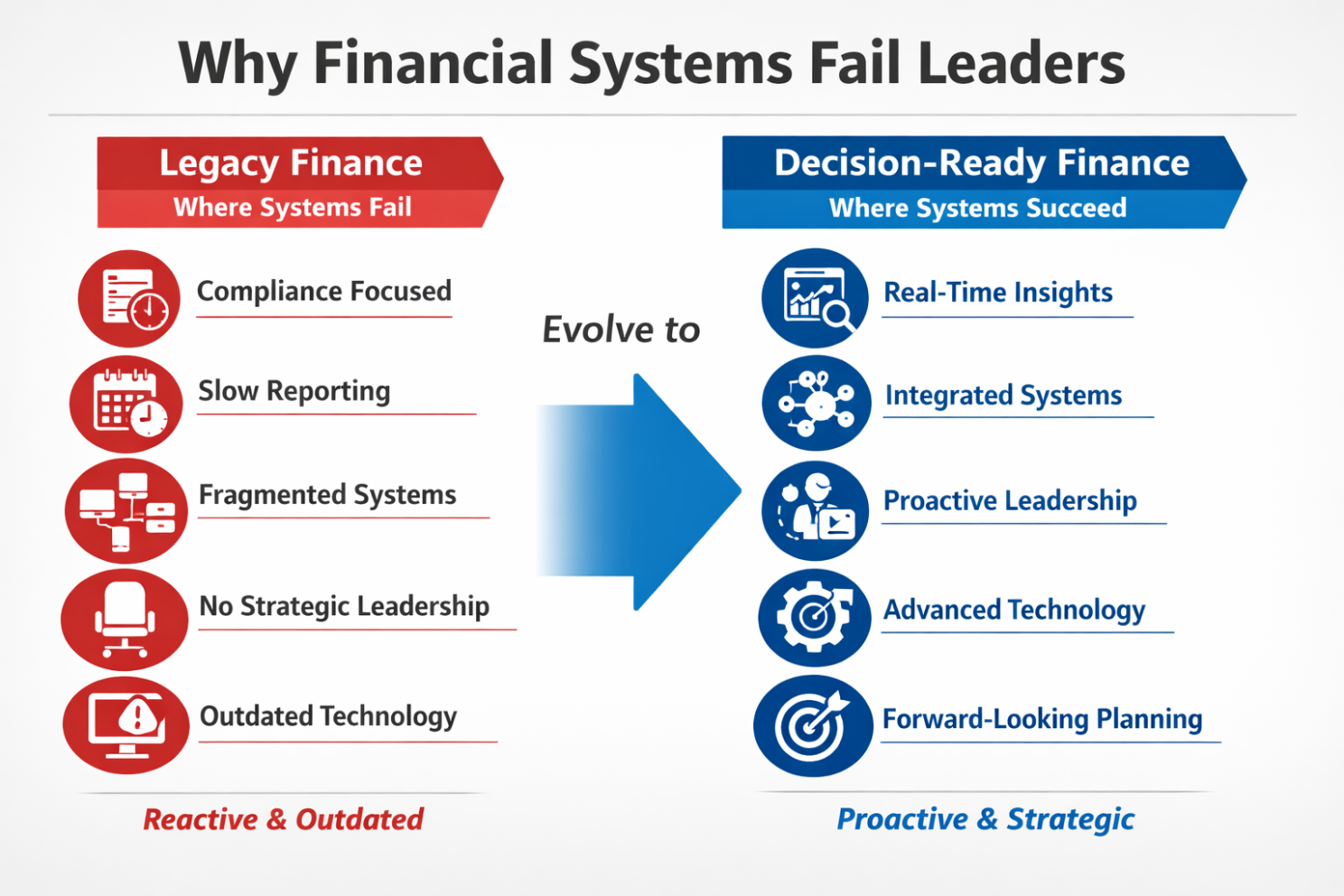
1. Finance Was Built for Compliance, Not Decisions
Historically, accounting systems were designed primarily for compliance and recordkeeping. Their job was to ensure accurate books for auditors, tax authorities, and regulators. While this responsibility remains essential, modern organizations require far more from finance. Today’s leaders need finance to answer questions like:
- Which contracts or services generate the highest margins?
- How will hiring affect cash flow?
- Can we scale without increasing financial risk?
- Are we pricing our work correctly?
A compliance-focused system produces reports, but not insight. When finance focuses only on historical reporting, leadership decisions are made without financial clarity.
2. Reporting Is Too Slow
Many organizations still rely on financial reporting cycles designed decades ago. Month-end close processes often take two to four weeks, meaning leaders may be making decisions based on outdated information. By the time financial reports are finalized:
- Opportunities have passed
- Risks have escalated
- Decisions have already been made
In today’s fast-moving environment, delayed financial insight is almost as damaging as having no insight at all. Leaders need timely financial visibility, not just accurate reports.
3. Systems Are Fragmented
In many companies, financial data lives in multiple disconnected systems:
- Accounting platforms
- Payroll systems
- CRM systems
- Billing platforms
- Expense tools
- Project management software
When these systems are not integrated, finance teams spend enormous time manually reconciling data. This fragmentation leads to:
- Inconsistent numbers
- Manual data entry errors
- Delayed reporting
- Limited analytical capability
Instead of producing insight, finance teams become data translators. The financial system becomes reactive instead of strategic.
4. Financial Leadership Is Missing or Overwhelmed
Another common reason financial systems fail is the absence of strategic financial leadership. Many growing organizations rely heavily on bookkeepers or controllers who excel at managing transactions but may not have the mandate, or time, to drive strategic insight.
Meanwhile, CEOs are left interpreting financial reports themselves. Without CFO-level leadership guiding the financial system, companies struggle with:
- Forecasting
- Scenario planning
- Cost structure optimization
- Strategic capital allocation
Finance becomes reactive instead of proactive.
5. Technology Has Not Kept Up With Growth
Many companies launch with simple accounting systems designed for early-stage operations.
These systems often work well until complexity increases. As organizations scale, new challenges emerge:
- Multi-entity reporting
- Government contract compliance
- Project profitability tracking
- Complex revenue recognition
- Advanced forecasting
When outdated systems attempt to manage this complexity, organizations often rely on workarounds:
- Spreadsheets everywhere
- Manual data reconciliation
- Fragile reporting processes
Eventually the financial system becomes brittle and every change introduces risk.
The Real Cost of a Weak Financial System
Weak financial infrastructure does not just create accounting headaches.
It directly impacts leadership effectiveness.
When financial systems fail, leaders experience:
- Reduced confidence in financial reports
- Delayed strategic decisions
- Unexpected cash flow issues
- Compliance risks
- Lower profitability
Perhaps most importantly, leadership teams lose the ability to clearly understand the financial performance of their organization. Without that clarity, scaling becomes far more difficult.
The Shift to Decision-Ready Finance
Organizations that solve these problems do not simply upgrade accounting software.
They rethink the role of finance entirely.
Instead of focusing only on reporting the past, they build systems designed for Decision-Ready Finance. This goes beyond just upgrading your accounting software or ERP. Decision-Ready Finance means:
- Financial information is timely and accessible
- Systems are integrated across the organization
- Reporting connects operational activity to financial outcomes
- Leaders can see forward-looking financial insights, not just historical results
Finance evolves from a recordkeeping function into a strategic decision engine.
How to Know if Your Financial System Is Holding You Back
Many leaders suspect their financial infrastructure may be fragile, but they struggle to objectively evaluate it. To help solve this problem, we developed the Financial System Readiness Assessment (FSRA). The FSRA diagnostic evaluates the strength of your organization’s financial infrastructure across key areas including:
- Structural Foundation: Governance, internal controls, and compliance
- Financial Systems Architecture: Systems of record, integrations, and automation
- Financial Intelligence: Close, reporting, and decision support
- Operational Discipline: Execution rhythm and process rigor
- Strategic Enablement: Growth, enterprise and AI readiness
In just a few minutes, leaders can identify hidden gaps that may be limiting their ability to scale confidently. Many of these gaps must be filled before investing in a new ERP.
👉 Take the Financial System Readiness Assessment.
It takes about 10 minutes and will give you a clearer view of whether your financial infrastructure is ready to support your next phase of growth.
The Future of Finance
The finance function is undergoing a fundamental transformation. Automation, AI, and integrated financial platforms are poised to dramatically reduce the manual work associated with accounting. As these tools mature, finance is shifting from processing transactions to powering decisions.
Organizations that embrace this transformation are building financial systems that scale with their ambitions. Those that do not will continue struggling with delayed reporting, fragmented data, and uncertain decision-making.
A Final Thought
Leaders should not have to guess their way through financial decisions.
Every organization deserves a financial system that provides clarity, confidence, and control.
Because when finance is built correctly, it becomes more than a reporting function. It becomes financial infrastructure that powers growth.
If you suspect your financial infrastructure may be limiting your ability to scale, start by taking the Financial System Readiness Assessment (FSRA).
👉
Take the 10-minute diagnostic.
It will help you identify gaps in your financial infrastructure and determine whether your organization is truly
Decision-Ready.

Ted Rose
In 1994 Ted Rose founded Rose Financial Solutions (ROSE), the Premier U.S. Based Finance and Accounting Outsourcing Firm. In 2010, the Blackbook of Outsourcing named ROSE the #1 FAO firm in the world based on client satisfaction. As the president and CEO of ROSE, he provides executives with financial clarity. Ted has also acted as the CFO for a number of growth companies and assisted with various rounds of financing and M&A transactions.
Share this article:
Visit Us On: