The Pentagon's CTO Just Told You Exactly What DoW Wants. Are You Listening?
By WALLY ANGEL, ROSE FINANCIAL SOLUTIONS
If you haven't listened to Episode 263 of the All-In Podcast, stop what you're doing and go watch it. The full episode. Not the clips. Not someone's summary thread on X. The whole thing.

Emil Michael, Under Secretary of War for Research & Engineering, effectively the Pentagon's CTO, sat down with Chamath, Friedberg, and J-Cal and laid out, in plain language, exactly where the Department of War is headed on procurement, contracting, technology, and the defense industrial base. This wasn't a sanitized press briefing. This was a senior Pentagon official telling the investment and tech world: here's what we need, here's how we're buying it, and here's who we want to buy it from.
And if you're running a small or mid-size government contracting firm, the signal could not be louder.
I've been writing about this shift for months, FAR 2.0 reforms, the expansion of OTAs and CSOs, CAS threshold changes, the commercial pivot. Everything I covered in my recent webinar and in pieces like "From FAR Grind to Commercial Speed", Emil Michael just confirmed all of it, on camera, to an audience of millions. This isn't theory anymore. This is the Under Secretary telling you the playbook.
Let me break down what matters most for your business.
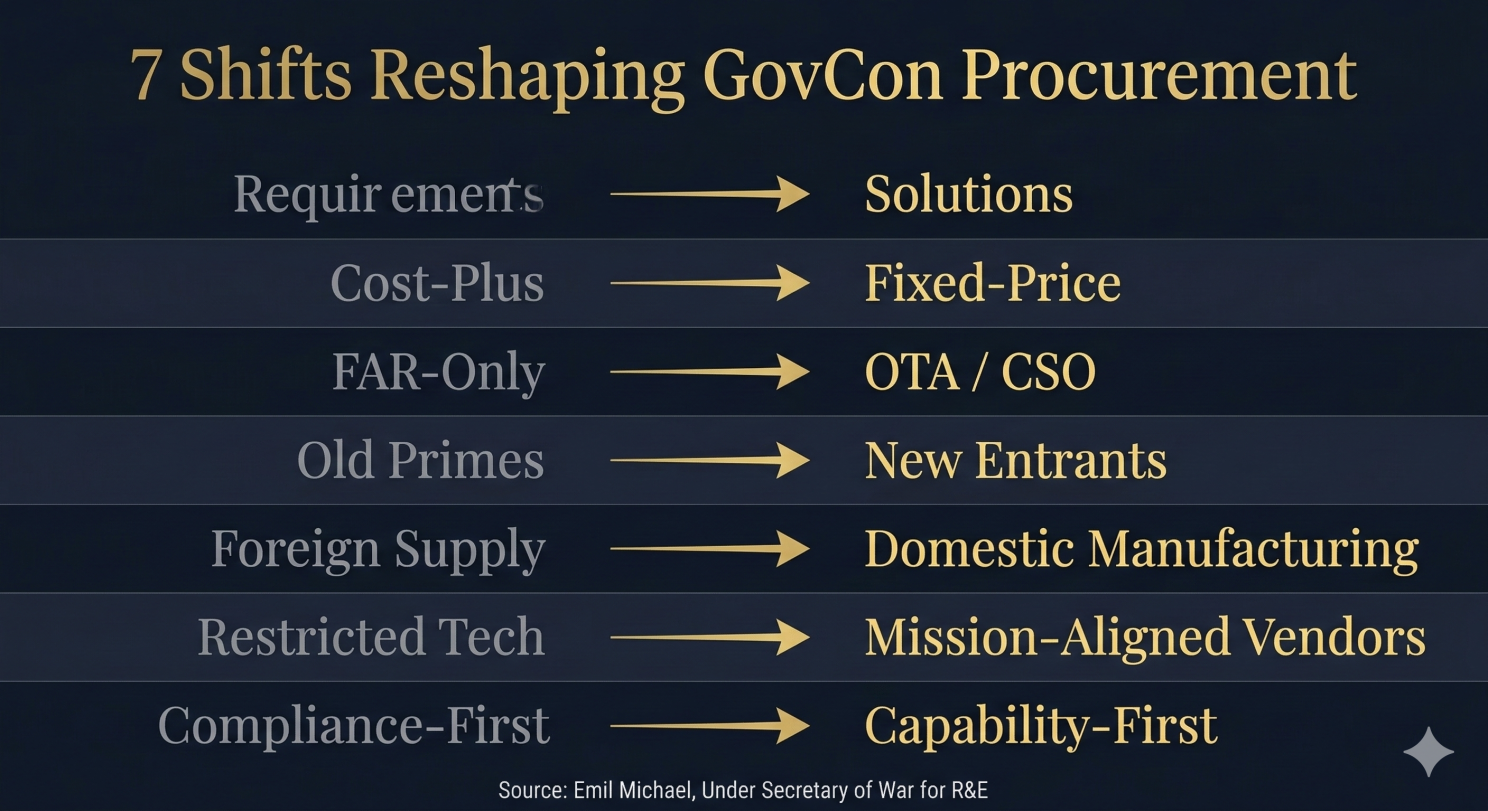
1. Requirements Reform: They Want Your Solutions, Not Your Compliance
This is the single biggest mental shift traditional GovCon firms need to make.
Here's Emil Michael, in his own words:
"I tell you my common operational problem. I need a bunch of missiles that go 500 miles or more... Come to me with solutions, as little requirements as possible."
Read that again. The Pentagon CTO is saying he does not want detailed requirements documents. He's saying the old model, where DoW writes a 200-page spec that creates, in his words, "unbuildable things" that contractors then fulfill on cost-plus, is dying.
The new model: Here's the problem. Bring me a solution.
For years, the GovCon industry has been built on the ability to respond to complex requirements. Entire businesses exist to decode RFPs, parse specifications, and build exactly what was asked for, no more, no less. That was the game. Compliance was the competitive advantage.
That game is changing. The competitive advantage is shifting to firms that can think, not just respond. Firms that understand an operational problem and can walk in the door with a working solution, or a credible path to one.
If your entire business model is "tell us what to build and we'll build it on cost-plus," you need to evolve. Fast.
2. Commercial Contracts Are the New Default
This connects directly to what I've been covering with FAR 2.0 and OTA expansion, but hearing it from Emil Michael makes it concrete:
"Trying to get to as close to commercial contracts as possible."
And then he went further:
"This is where the startups are so good, they'll do fixed cost pricing. They'll do, you know, you don't pay me as much if I deliver late. You pay me more if I deliver early."
"Super disruptive. But that's what I'm waking up every day trying to do."
Let that sink in. The Pentagon CTO is waking up every morning trying to move DoW contracting toward fixed-price, milestone-based, performance-incentivized contracts. He's explicitly praising the startup model of pricing, and explicitly saying that's what he wants from the defense industrial base.
What this means for you:
- Fixed-price contracting requires a fundamentally different financial infrastructure than cost-plus. Your estimating, your indirect rate structures, your cash flow management, all of it changes.
- Milestone-based payments mean you need strong project accounting and the ability to track deliverables against payment triggers.
- Performance incentives (bonuses for early delivery, penalties for late) mean your proposal pricing has to account for execution risk in ways most traditional GovCon firms have never modeled.
This isn't a future possibility. This is the stated priority of the person running R&E at the Pentagon. If your financial systems are built exclusively for cost-reimbursable work, you are not ready for where this is going.
A Word of Caution: OTAs and CSOs Are Not a Compliance Shortcut
Here's the trap I see firms walking into: they hear "OTAs" and "commercial-style contracts" and think that means they can skip the compliance infrastructure. Less paperwork. Fewer audits. No DCAA headaches. And yes, in the short term, that's partially true. Other Transaction Agreements and Commercial Solutions Openings do come with fewer administrative burdens than traditional FAR-based contracts.
But here's what nobody tells you until it's too late: success on OTA and CSO work often leads directly to traditional follow-on contracts. That prototype OTA turns into a production contract. That CSO award scales into a full program of record. And when it does, the government will expect your accounting system, your indirect rate structure, your cost accounting practices, and your timekeeping to meet the full weight of FAR, DCAA, and CAS requirements.
If you waited until that moment to build compliant systems, you're already behind. You're scrambling to stand up infrastructure while simultaneously executing on a contract, and the government is watching.
The smart play: Build your financial systems to be compliant now, even if your current contract vehicles don't require it. Treat it as an investment in scalability. When that OTA prototype turns into a $50M production contract, and they ask for an adequate accounting system determination, you want to hand them a package, not a promise.
The firms that will dominate the next decade of defense contracting are the ones that move at commercial speed and have government-grade financial controls. That combination is rare. Make it your competitive advantage.
3. The Shift from Old Primes to New Primes
The hosts asked Emil directly whether we're seeing a transition from legacy prime contractors to new entrants. He confirmed it.
The shift is away from what he described as "ships that cost $20 billion and a decade and a half to build" and toward "mass producible, low-cost things."
And he was explicit about why new entrants matter:
"That's what these new entrants can do. We need those to succeed so that the flywheel goes with venture capital money, entrepreneurs, capabilities."
This is not anti-incumbent rhetoric. This is industrial strategy. DoW recognizes that the current prime contractor base cannot deliver the volume, speed, and cost targets that modern defense requires. They need new players in the ecosystem, and they're actively building the economic incentives to bring them in.
For small and mid-size firms, this is an unprecedented opening. But "unprecedented opening" doesn't mean "show up and get money." It means the door is open for firms that can demonstrate:
- Speed to capability
- Commercial-style pricing discipline
- Manufacturing or technical solutions at scale
- The financial controls to handle fixed-price and milestone-based work
The flywheel Emil described, venture capital funding entrepreneurs who build capabilities DoW needs, only works if those companies can actually execute government work. That's where your financial readiness becomes a competitive weapon, not just a compliance checkbox.
4. LUCAS: The Drone Opportunity Is Massive
Emil detailed the LUCAS program, Low-Cost Unmanned Combat Attack Systems, and the numbers should make every small manufacturer pay attention:
- Small drones at a fraction of the current $35K benchmark
- One-way attack drones with 500-700 mile range, at airplane speeds: $50-80K per unit
- A "drone dominance program" focused on building an arsenal at scale
He compared it to the DARPA self-driving challenge, the kind of catalytic program that spawns entire industries. Except this one is for defense, and the Department is building the demand signal right now.
More drones were deployed in the last week, he noted, than in the entire prior history of US military drone activity. That's not a trend line. That's a step function.
For small manufacturers, especially those with expertise in composites, propulsion, electronics, or autonomous systems, this is the market being created in real time. DoW doesn't want one vendor building all of these. They want an ecosystem. They want competition. They want dozens of companies producing at volume.
If you make things, physical things, at scale, at competitive prices, the defense market is actively looking for you.
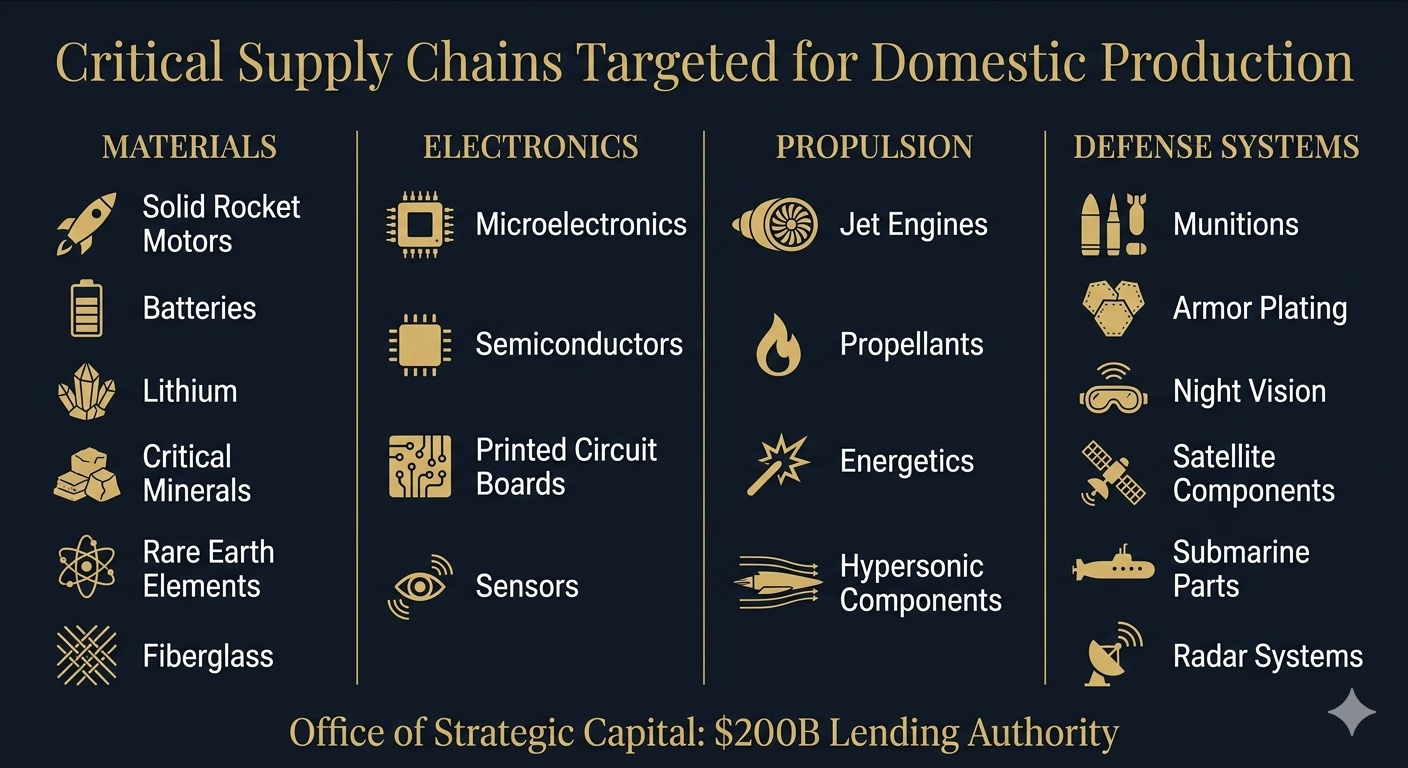
5. Office of Strategic Capital: $200 Billion in Lending Authority
This one doesn't get enough attention, and it should.
"$200 billion in lending authority... Treasuries plus 100 BPS loan to companies."
The Office of Strategic Capital isn't a grant program. It's a lending facility designed to help companies build the domestic manufacturing capacity that DoW needs. The mission: domesticate the critical supply chain components currently outsourced to China.
Emil identified roughly 20 critical categories, solid rocket motors, batteries, fiberglass, lithium, critical minerals, where the US is dependent on foreign (often adversarial) supply chains. The Office of Strategic Capital exists to fix that by showing companies the demand signal and giving them the capital to build capacity.
"I hope whatever administration comes next continues it."
That's a bipartisan signal. This isn't a one-cycle initiative. The supply chain vulnerability is real, the national security imperative is clear, and the money is on the table.
If you're a small manufacturer in any of these critical supply chain areas, or if you could be, this is a $200 billion reason to take a hard look at the defense market. The Department isn't just buying products. They're financing the production capacity to make those products domestically.
6. The Defense Tech Boom Is Not a Bubble
There's been a lot of Silicon Valley chatter about whether defense tech is a bubble. Emil addressed this directly, and his answer was clear: DoW is actively creating the demand signal. This isn't speculative investment chasing a trend. The Department is building programs (LUCAS, autonomous systems, supply chain domestication) that create real, funded requirements.
Venture capital + entrepreneurs + DoW capabilities = what Emil called "the flywheel."
DARPA, which he called the "best of the best," is working on next-generation capabilities, bio-synthesizing critical minerals, advanced cyber defense, autonomous systems. These aren't PowerPoint programs. They're funded R&D pipelines that will generate procurement requirements for years.
For GovCon firms, this means the opportunity window isn't closing next quarter. It's opening wider. But only for firms that can actually deliver.
7. AI, Autonomy, and the Vendor Trust Question
Emil discussed the rapid deployment of AI and autonomous systems, drone swarms with heterogeneous autonomy, autonomous target recognition, AI-controlled systems operating in contested environments. The trajectory is clear even if the tactical doctrine is still developing.
He also addressed the Anthropic situation, DoW's cancellation of a $200M contract and the unprecedented designation of an American AI company as a "supply chain risk." The core issue: Anthropic's restrictions on military use of their models.
"I don't want Lockheed Martin using their model to design weapons for me [if they can refuse]."
The signal for all defense contractors and technology vendors is unambiguous: DoW will not tolerate vendors who place policy restrictions on lawful military use. If you're bringing technology to the defense market, your terms of service and your corporate policies need to be compatible with the mission. Full stop.
This is relevant beyond AI companies. Any technology vendor selling to DoW should understand that restricting lawful use is now a supply chain risk factor. Structure your offerings accordingly.
What This Means for Your Firm, Right Now
Let me bring this back to the practical. Here's what I'd be doing if I were running a small or mid-size GovCon firm today:
- Get your financial house in order for fixed-price work. If your entire accounting infrastructure is built for cost-reimbursable contracts, start building the capability for fixed-price and T&M work now. That means strong estimating, project-level profitability tracking, and cash flow modeling that accounts for milestone-based payments.
- Understand the commercial contracting landscape. OTAs, CSOs, commercial item determinations, these aren't alternative pathways anymore. They're becoming the primary pathways. If your contracts team only knows FAR Part 15 source selections, you have a gap.
- Think solutions, not responses. The requirements reform Emil described means the winners will be firms that can identify DoW problems and propose solutions, not firms that wait for a detailed RFP and respond to every line item. That requires technical expertise, market awareness, and the confidence to lead with capability.
- Look at the supply chain domestication push. If you manufacture anything in the ~20 critical categories Emil identified, or if you could pivot into those areas, the Office of Strategic Capital exists to help you do it. $200 billion in lending authority is serious money.
- If you're in defense tech, commit to the mission. The Anthropic situation made it clear: DoW is drawing a line on vendor restrictions. If you want to sell technology to the Department, your corporate policies need to support the full scope of lawful defense use.
- Position yourself as a new entrant, even if you're not new. The flywheel Emil described favors firms that act like startups: fast, lean, commercially minded, willing to put skin in the game with fixed-price bids and performance guarantees. You don't have to be a Silicon Valley startup. You have to operate like one.
Pivoting to DoW? Align Your Capabilities First.
Here's the part most firms get wrong: they hear "the Department of War is spending" and they show up with the same capability statement they've been using for civilian agencies. That doesn't work. The DoW isn't buying the same things, the same way, from the same kinds of companies.
If you're a services firm, a technology company, or a manufacturer considering a pivot to DoW work, or trying to expand your defense footprint, you need to do the alignment work before you chase a single opportunity.
Step 1: Map your capabilities to DoW priority areas.
Emil laid them out explicitly. Ask yourself, honestly, where your company fits:
- Autonomous systems & drones: Do you build, integrate, or maintain UAS platforms? Do you have expertise in composites, propulsion, sensors, or autonomous navigation?
- AI & software: Can you deploy AI models that support targeting, logistics, maintenance prediction, or operational planning? Are your terms of service compatible with defense use?
- Critical supply chain manufacturing: Do you produce or could you produce any of the ~20 critical materials categories (solid rocket motors, batteries, critical minerals, fiberglass, lithium)?
- Cybersecurity & electronic warfare: Can you defend networks, harden systems, or operate in contested electromagnetic environments?
- Sustainment & logistics: Can you maintain systems at scale, in austere environments, with speed that matches operational tempo?
If your capabilities don't map to at least one of these areas, the DoW pivot may not be your play, and that's okay. Better to know that now than after you've spent six months and $100K on a BD effort chasing contracts you'll never win.
Step 2: Restructure your pitch around problems, not past performance.
Traditional GovCon business development leads with past performance: "We did X on contract Y for agency Z." That matters, but Emil made clear that DoW is shifting toward "tell me what you can solve."
For firms pivoting in, your pitch needs to answer three questions:
- What operational problem do you solve? Not "we provide IT services", what specific warfighter pain point does your solution address?
- How fast can you deliver? DoW is explicitly favoring speed. If your answer involves 18 months of requirements gathering, you've already lost.
- What's your pricing model? If you can only price cost-plus, you're speaking the wrong language. Fixed-price, milestone-based, and performance-incentivized pricing is what the Department wants to see.
Step 3: Get your financial infrastructure ready for defense work.
This is where I see the most firms stumble. You can have the perfect technical solution, but if your financial systems can't handle the unique demands of DoW contracting, you're dead on arrival:
- DCAA compliance isn't optional, even for commercial-item contracts, the Department increasingly requires adequate accounting systems
- Indirect rate structures need to support both cost-type and fixed-price work simultaneously
- Cash flow modeling must account for the realities of government payment cycles, milestone payments, progress payments, and the occasional CR-induced funding gap
- Cost accounting needs the granularity to track at the contract, task order, and CLIN level, because DoW auditors will ask
Step 4: Build relationships before you need them.
The DoW ecosystem runs on relationships, but not the golf-course kind. The relationships that matter now are:
- Program office engagement: attend industry days, respond to RFIs (even if you can't bid the full contract), get your name in front of program managers
- Prime contractor teaming: if you're too small to prime, identify which large primes are winning in your capability area and approach them as a subcontractor with a differentiated skill set
- Defense innovation units: DIU, AFWERX, NavalX, Army Applications Lab, these organizations exist specifically to connect non-traditional companies with defense requirements. Use them.
The firms that will win the DoW pivot aren't the ones with the best technology or the lowest price. They're the ones that did the hard work of aligning their solutions to what the Department actually needs, structuring their finances to support how the Department actually buys, and building the relationships that turn capability into contracts.
Don't show up with a hammer looking for nails. Study the blueprint first.
The Bottom Line
Emil Michael didn't speak in abstractions. He gave specific programs (LUCAS), specific dollar figures ($200B in lending authority, $50-80K attack drones), specific contracting preferences (fixed-price, milestone-based, commercial-style), and specific strategic priorities (supply chain domestication, drone dominance, autonomous systems).
This is the Pentagon CTO telling you, on a podcast with millions of viewers, exactly what the Department wants to buy and how they want to buy it. The question isn't whether the shift is happening. The question is whether your firm is positioned to compete in the new landscape.
Everything I've been covering, FAR 2.0, OTA expansion, CAS threshold changes, the commercial pivot, it's all converging. The Department is moving. The money is real. The opportunity is historic.
But opportunity without preparation is just a spectator sport. Get ready.
Watch the full episode: Emil Michael on the All-In Podcast (Episode 263)
This is part of my ongoing coverage of the structural changes reshaping government contracting. If you found this useful, follow along, there's more coming.
Wallace Angel
Wallace “Wally” Angel is a strategic CPA with more than 20 years of experience in the government contracting and consulting environments with companies ranging from start-ups to $800M. His government contracting expertise includes FAR and DCAA compliance, indirect rate calculation, forward pricing, proposal writing, pricing, and cradle to grave contracts management and system design and implementation. In his position as Partner, Financial Operations, Wally serves as a trusted advisor to the C-suite in controllership and cash management, revenue recognition, system design and implementation, and full financial planning and analysis.
Share this article:
Visit Us On: