Your Subcontractors Just Became Your Biggest Liability: What Trump's DEI Executive Order Really Means for Executives
By WALLY ANGEL, ROSE FINANCIAL SOLUTIONS
Trump's DEI Executive Order isn't just an HR policy change. It creates new supply chain liability that affects every invoice you submit to the government. President Trump's recent executive order targeting "discriminatory DEI activities" by federal contractors creates new compliance requirements: prime contractors must now monitor and certify subcontractor compliance across their supply chains.
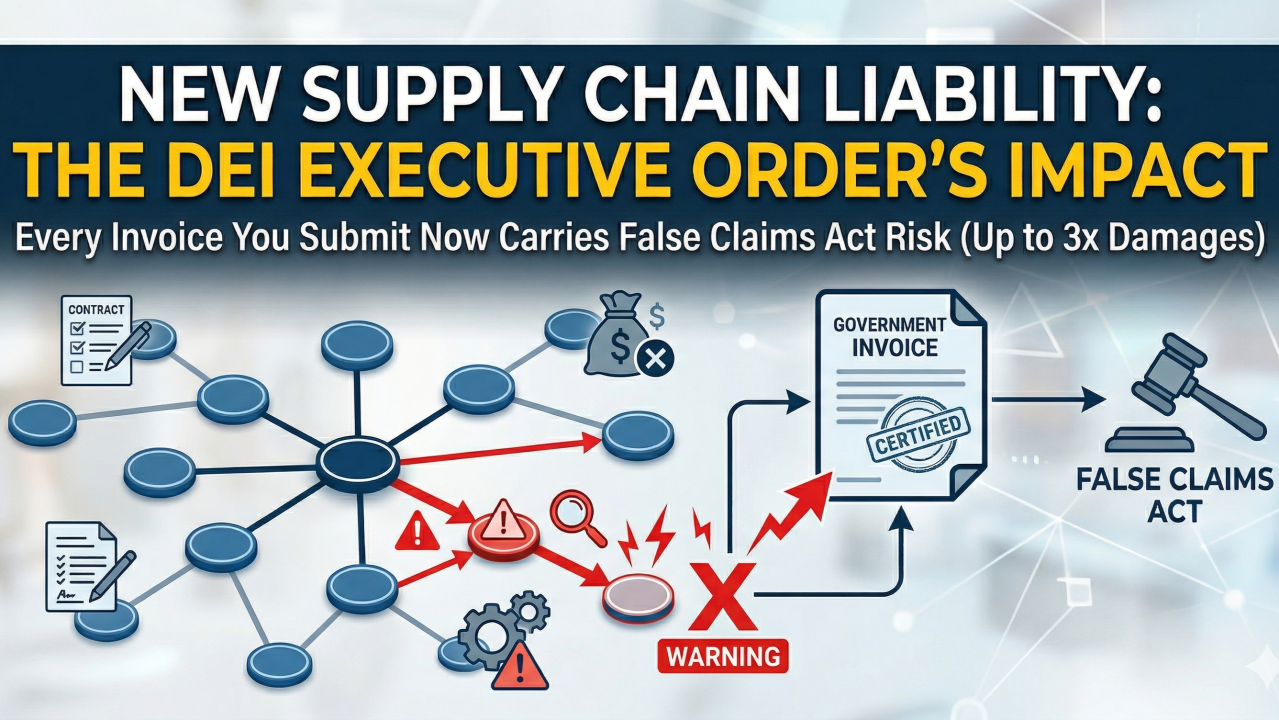
That tier-3 vendor your plumbing contractor uses? Their DEI violations can now create False Claims Act liability for your prime contract.
The False Claims Act Connection
Here's the key provision in the new mandatory contract language: contractors must certify that compliance is "material to the Government's payment decisions for purposes of the False Claims Act."
Translation: Every invoice you submit now includes certification of supply chain compliance. Violations can result in:
- Treble damages: 3x the contract value
- Civil penalties: $13,508 to $27,018 per violation
- Whistleblower bounties: 15-30% recovery incentives for tipsters
- Legal costs: Often exceed the underlying damages
The risk: False Claims Act liability can result in treble damages plus civil penalties; turning compliance failures into significant financial exposure.
Your New Supply Chain Nightmare
The order makes prime contractors responsible for monitoring and certifying compliance at all tiers. You're not just managing your own policies, you're the compliance police for potentially hundreds of business relationships.
What This Actually Means
- That small electrical subcontractor who's never dealt with government work? They need compliant systems and policies.
- Your tier-3 suppliers who provide office supplies? Subject to DEI audits.
- Every consultant and vendor touching government work? Potential False Claims Act liability.
Key consideration: Many subcontractors lack experience with government compliance requirements, creating potential oversight challenges for prime contractors.
Supply Chain Compliance Requirements
Financial System Requirements
Your finance team must now:
- Validate compliance before every subcontractor payment
- Maintain audit trails for all supply chain DEI decisions
- Monitor ongoing compliance across dozens of business relationships
- Document flow-down requirements in every vendor agreement
Legal Liability Management
Every subcontractor agreement needs:
- Compliance certifications with ongoing monitoring
- Audit rights extending through all business relationships
- Indemnification language (most small subs can't support)
- Termination rights for compliance failures
The Cost Reality
Depending on contract complexity, prime contractors may work with multiple tiers of subcontractors, from major subs to small suppliers. Each relationship now requires compliance oversight:
- Enhanced vendor qualification processes
- Ongoing compliance auditing and reporting
- Legal review of all subcontractor agreements
- Training programs for non-GovCon suppliers
- Documentation systems for audit defense
Bottom line: Supply chain compliance monitoring will add meaningful costs to contract execution and administration.
Implementation Deadlines
30 Days: Contract Clause Mandate (April 25, 2026)
All new federal contracts must include the compliance clause. Immediate action required:
- Audit current subcontractor base for compliance gaps
- Review professional liability insurance coverage for compliance-related claims
- Review all vendor agreements for flow-down language
- As a subcontractor, review any flow-down language from prime contractors
60 Days: Full Regulatory Guidance (May 26, 2026)
- Subcontractor certification programs
- Supply chain monitoring systems
- Audit-ready documentation standards
Impact on Small and Mid-Size Contractors
Large defense primes may have more resources to manage compliance requirements. Small and mid-size contractors face additional considerations:
- Managing compliance costs across supply chains
- Working with subcontractors to meet new requirements
- Pricing competitively while covering compliance overhead
- Assessing and managing potential False Claims Act exposure
Strategic Response Options
Option 1: Supply Chain Consolidation
Work only with larger, sophisticated subcontractors who can handle compliance burden. Risk: Reduced competition, higher costs, loss of small business subcontracting goals.
Option 2: Compliance Investment
Build comprehensive supply chain monitoring and training programs. Risk: Significant upfront costs, ongoing operational burden.
Option 3: Risk Management Strategy
Strengthen professional liability coverage and establish legal defense reserves. Risk: Insurance may not cover all False Claims Act scenarios, significant reserve requirements.
The Bottom Line
This executive order expands government contracting compliance from internal policies to supply chain oversight. Vendor relationships now require additional compliance management.
While competitors struggle to understand the implications, sophisticated contractors can turn supply chain compliance into competitive advantage through:
- Faster contract awards via demonstrated compliance readiness
- Strategic partnerships with compliance-ready vendors
- Risk mitigation through superior documentation and controls
Implementation timeline: New contracts include the compliance clause within 30 days. Contractors should prepare their supply chain oversight procedures accordingly.
Your subcontractors just became your biggest liability.
How ready is your compliance system?

Wallace Angel
Wallace “Wally” Angel is a strategic CPA with more than 20 years of experience in the government contracting and consulting environments with companies ranging from start-ups to $800M. His government contracting expertise includes FAR and DCAA compliance, indirect rate calculation, forward pricing, proposal writing, pricing, and cradle to grave contracts management and system design and implementation. In his position as Partner, Financial Operations, Wally serves as a trusted advisor to the C-suite in controllership and cash management, revenue recognition, system design and implementation, and full financial planning and analysis.
Share this article:
Visit Us On: