
Financial Readiness Is Not One Thing. It Is Six.
By TED ROSE, ROSE FINANCIAL SOLUTIONS
Most companies that complete the Financial System Readiness Assessment walk away with a number and a general sense of where the gaps are. Some are surprised. Most are not. They already knew something was off. The FSRA just told them where to look first.
But a score is not a strategy. And knowing where your infrastructure is weak is not the same as knowing what to do when the weakness gets tested.
That is the question this issue is designed to answer.
What Financial Readiness Actually Means
Financial readiness is not a single condition. It is not "we passed the audit" or "the books close on time." Those are indicators. They are not the thing itself.
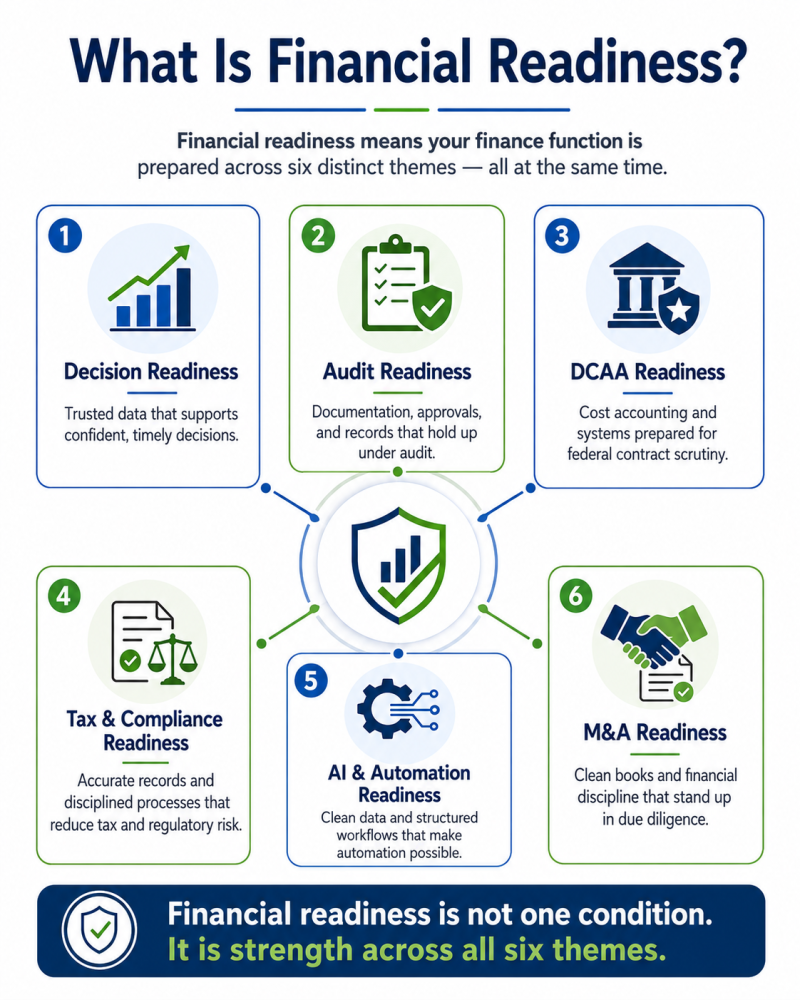
Financial readiness means your finance function is prepared across six distinct dimensions. All six, simultaneously. Not strong in two and fragile in four. Not audit-ready but not AI-capable. Not decision-ready in normal operations but exposed the moment a deal, a dispute, or a growth inflection hits.
Here is why that matters more than it sounds: most companies are partially ready. They have invested in some areas and deferred others. The close is tight but the reporting is slow. The controls are solid but the data is fragmented. The team is capable but the systems are not connected. In normal operating conditions, partial readiness looks like readiness.
It is not. Partial readiness is a structural liability. It just has not been triggered yet.
The six readiness themes are the trigger points. Each one is a real business situation where the full strength of your finance function gets tested, not just the parts you have invested in.
The Six Readiness Themes
- Decision Readiness. This is where most companies feel the friction first. The data exists. Reports get produced. Executives still are not confident in the numbers. Decisions get delayed. The same questions come up in every meeting. That is not a reporting problem. It is a trust problem, and it lives in the infrastructure underneath the reports.
- Audit Readiness. An audit does not create problems. It finds the ones that already exist. The companies that handle audits well did not get lucky. They built documentation habits, approval workflows, and transaction records that hold up because they were designed to hold up. That work happens before the auditor calls, not after.
- DCAA Readiness. For companies doing business with the federal government, the stakes are higher and the scrutiny is more specific. DCAA readiness is not a documentation exercise. It is an infrastructure posture. Your contract is only as secure as your cost accounting, and the gaps that create audit exposure are almost always built into the system long before the auditor arrives.
- Tax and Compliance Readiness. Your tax position is a direct reflection of your financial infrastructure. The accuracy of your records, the completeness of your entity structure, the discipline of your close process. All of it determines your exposure to SALT, IRS, and broader regulatory risk. Companies that treat tax as an annual event rather than an ongoing infrastructure function pay for it, usually in ways that never show up cleanly on a single line of the P&L.
- AI and Automation Readiness. Before AI and Automation can add value to a finance function, the underlying infrastructure has to be ready for it. Clean data, consistent processes, structured workflows, reliable systems of record. Without that foundation, AI and Automation don't improve your finance function. They accelerate the fragility already inside it.
- M&A Readiness. Buyers and investors do not buy your revenue. They buy what holds up under scrutiny. Companies that arrive at a transaction with clean books, documented processes, auditable records, and forward-looking financial intelligence negotiate from strength. Companies that do not will spend due diligence answering questions that strong infrastructure would have already resolved.
Why Partial Readiness Is Not Enough
If you are strong in three of these and fragile in three, you are not halfway ready. You are exposed in ways you probably have not mapped yet.
A company that is audit-ready but not decision-ready scales into confusion. A company that is AI-capable but not DCAA-compliant builds automation on a foundation an auditor will challenge. A company that clears a financial audit but cannot support a capital raise has invested in compliance without investing in finance infrastructure.
The six themes are not independent. Weakness in one creates pressure on the others. That is the structural reality a score alone does not reveal.
Where the FSRR Comes In
The FSRA tells you where your gaps are. The Financial System Readiness Review tells you what to do about them.
The FSRR is conducted by a ROSE professional, typically at the start of a FaaS engagement, and it goes deeper than the self-assessment. It examines your actual documentation, system architecture, workflows, data quality, and reporting practices against the same five-pillar framework. The output is a prioritized roadmap with specific findings, a baseline score, and a clear path forward.
For leaders heading into a growth push, a compliance review, a capital raise, or any of the six readiness situations above, the FSRR replaces guesswork with evidence. It is not just a diagnosis. It is a plan.
Built to Get There
Most growing companies know what good financial infrastructure looks like. The barrier is not awareness. It is the cost and complexity of building it.
Enterprise-grade finance systems, workflow automation, AI-enabled reporting, real-time dashboards. These tools exist. Large organizations use them. For most early-stage and middle-market companies, building that infrastructure internally is either prohibitively expensive or operationally unrealistic.
Easby is how we solve that problem. Easby is the operating backbone of ROSE's Finance as a Service model. It is the platform where transactions flow, approvals route, the close happens, and financial intelligence surfaces. It connects every dimension of the finance function: people, process, technology, organization/governance, and data. And it delivers that infrastructure at a fraction of what it would cost to build internally.
The 30 to 60 percent cost savings compared to building an equivalent finance function in-house is real. But the more important advantage is time. Companies that partner with ROSE and Easby get elevated financial infrastructure from the start of the engagement, not after a multi-year internal build.
The FSRR identifies what needs to change. Easby is the platform where that change happens and is operationalized.
What Comes Next
The next six issues work through each readiness theme in depth: what it means in practice, what the gaps look like, and what it actually takes to be prepared.
We start with Decision Readiness because it is the most universal. Every company, at every stage, is living with some version of the same tension: data exists, reports go out, and leadership still is not fully confident in the numbers. That pattern has a name. And it has a fix.
If you have not yet taken the FSRA, now is the right time. The series will land harder if you know where you stand going in.

Ted Rose
In 1994 Ted Rose founded Rose Financial Solutions (ROSE), the Premier U.S. Based Finance and Accounting Outsourcing Firm. In 2010, the Blackbook of Outsourcing named ROSE the #1 FAO firm in the world based on client satisfaction. As the president and CEO of ROSE, he provides executives with financial clarity. Ted has also acted as the CFO for a number of growth companies and assisted with various rounds of financing and M&A transactions.
Share this article:
Visit Us On: