The Part of Finance Nobody Talks About, Until Something Goes Wrong
By TED ROSE, ROSE FINANCIAL SOLUTIONS
Most finance conversations orbit the same topics: reporting speed, technology stack, headcount, AI readiness. These are real issues. But almost no one talks about what sits underneath all of them, the structural foundation that determines whether any of it holds when the pressure gets high.
That silence is expensive
Growth Covers the Cracks, Until It Doesn't
When companies are growing, weak infrastructure tends to stay invisible. Revenue is up. The team is moving fast. Controls that were adequate at $3M feel fine because nothing has broken yet.
But "nothing has broken yet" is not the same as "structurally sound."
The paradox of growth-stage companies is that they scale operations faster than they scale financial discipline. New contracts. New headcount. New complexity. The underlying governance framework, the policies, the controls, the oversight structure, often doesn't keep pace.
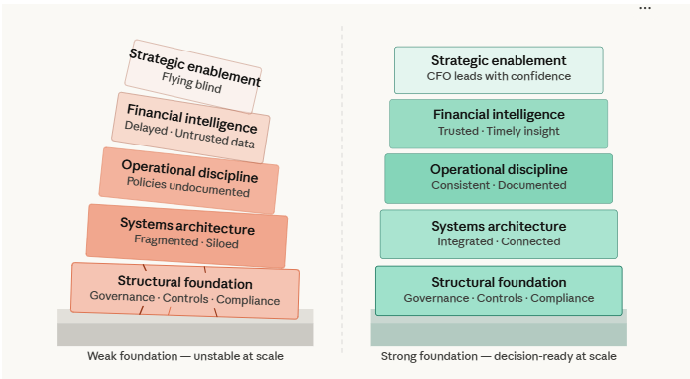
You don't find out your foundation is weak when things are going well. You find out during an audit, a due diligence review, or a contract protest.
By then, the cost of fixing it is much higher than it would have been to build it correctly.
What Structural Foundation Actually Means
Structural foundation is not a compliance checkbox. It is the load-bearing wall of the entire finance function.
It includes:
- Governance and accountability — who owns what decisions, how financial authority is structured, and whether roles are clearly defined
- Segregation of duties — ensuring that no single person can initiate, approve, and record a transaction without oversight
- Internal controls — the policies and procedures that prevent errors, fraud, and misreporting before they happen
- Compliance frameworks — the documentation, processes, and audit trails required to meet regulatory, contractual, and reporting obligations
These are not bureaucratic formalities. They are the mechanisms that make everything else trustworthy. When they are weak, even strong reporting tools and capable people produce results that cannot be fully relied upon.
Four Signs Your Foundation Is Already Showing Cracks
Most companies do not discover structural weakness through self-assessment. They discover it through consequences. Here are four signs the foundation is already under strain:
1. Month-end close takes longer than it should and errors surface after the fact. When closing is slow and corrections are common, it usually reflects process gaps and control failures, not just staffing issues.
2. Financial responsibilities are concentrated in one or two people. When the same person approves, processes, and reconciles, there is no structural check on accuracy or integrity. This is among the most common and most risky patterns in growing organizations.
3. Your finance function operates largely on tribal knowledge. If the processes live in someone's head rather than in documented policy, the organization is one departure or audit away from a significant problem.
4. Compliance obligations are being managed reactively. If your team is scrambling to produce documentation when a request arrives, rather than maintaining it as a standard operating practice, the foundation is not structured for the environment you are operating in.
Any one of these is a warning sign. More than one is a structural problem that will surface under pressure.
Why This Is an Existential Issue in GovCon
In commercial environments, weak structural foundation creates internal risk: errors, inefficiency, and surprises at audit time. That is painful enough. In government contracting, weak structure creates existential contract risk.
DCAA audits do not evaluate intent. They evaluate documentation, controls, and compliance with FAR and DFARS requirements. If your indirect rate structure is not properly supported, if your timekeeping controls are inadequate, or if your cost accounting practices cannot be defended with documentation, the consequences extend well beyond a finding on a report. They can affect contract awards, cost recovery, and your ability to compete.
Controls that worked at $3M don't scale to $15M on their own. The volume, the complexity, and the audit scrutiny all increase. The foundation has to be built to carry the weight.
For GovCon companies especially, structural foundation is not a back-office concern. It is a competitive and compliance-critical requirement.
What Strong Foundation Actually Enables
There is a tendency to think about structural foundation only in terms of what it prevents. That framing is too narrow. A well-built structural foundation does not just protect companies from risk. It accelerates everything else.
- Audits move faster — because the documentation exists, the processes are consistent, and the controls are demonstrable
- Capital events go more smoothly — because investors and acquirers do not find structural surprises during due diligence
- Decisions are more confident — because the data coming out of the system rests on a foundation of controls and process discipline
- Scaling is less disruptive — because the governance model is built to absorb growth, not just the current size of the organization
Structural weakness doesn't show up on a P&L. It shows up when the pressure is highest, at exactly the moment when you can least afford it.
FSRA Pillar 1: Structural Foundation
The Financial System Readiness Assessment is a diagnostic tool built around five pillars. Structural Foundation is the first, and for good reason.
It assesses:
- The governance structure and clarity of financial authority
- The strength and completeness of internal controls
- Segregation of duties and oversight design
- Policy documentation and operational consistency
- Compliance readiness across regulatory and contractual obligations
The FSRA does not produce a score for its own sake. It produces a clear picture of where the foundation is solid and where it is not, and a roadmap for what to address first.
If you are growing, planning to raise capital, pursuing government contracts, preparing for M&A, or simply trying to build a finance function that can support the decisions ahead, this is where the work starts.
The Starting Point Is a Diagnostic
Most companies do not know exactly where their structural foundation is weak until they look closely. The problems tend to be quiet, right up until they are not.
The FSRA takes about ten minutes. It surfaces the gaps before they surface themselves at the worst possible time.

Ted Rose
In 1994 Ted Rose founded Rose Financial Solutions (ROSE), the Premier U.S. Based Finance and Accounting Outsourcing Firm. In 2010, the Blackbook of Outsourcing named ROSE the #1 FAO firm in the world based on client satisfaction. As the president and CEO of ROSE, he provides executives with financial clarity. Ted has also acted as the CFO for a number of growth companies and assisted with various rounds of financing and M&A transactions.
Share this article:
Visit Us On: