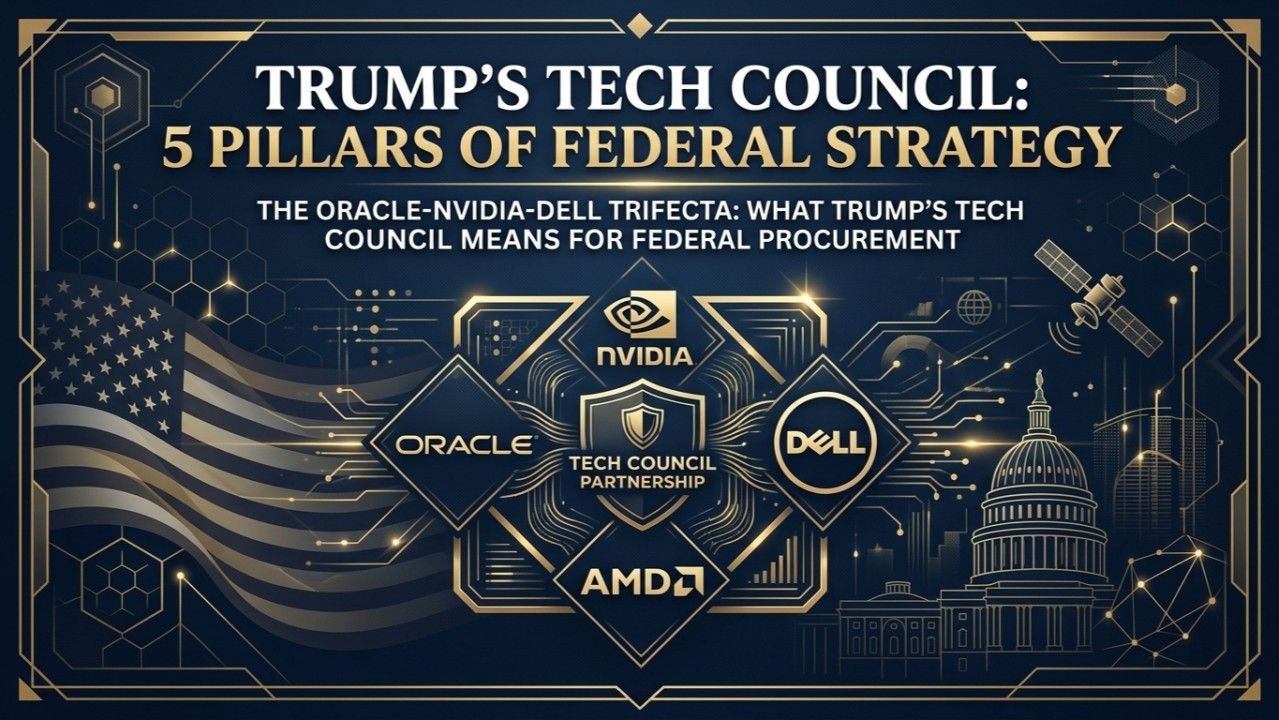
The Oracle-NVIDIA-Dell Trifecta: What Trump's Tech Council Means for Federal Procurement
By WALLY ANGEL, ROSE FINANCIAL SOLUTIONS
President Trump just unveiled the first 13 members of his tech advisory council, and every government contractor should be paying attention. This isn't just another Washington advisory group, it's a blueprint for where federal technology spending is headed.
The Power Players
The lineup reads like a who's who of federal IT dominance:
- Oracle CEO Safra Catz and Co-Founder Larry Ellison
- NVIDIA CEO Jensen Huang
- Dell CEO Michael Dell
- AMD CEO Lisa Su
- Meta CEO Mark Zuckerberg
- Google Co-Founder Sergey Brin
Notice what's missing? Traditional defense contractors. This council is heavy on commercial tech titans who've been aggressively pursuing federal business.
The Silicon Valley Power Bloc
Here's what most analysts will miss: This council represents unprecedented Silicon Valley coordination. David Sacks (chairing) and David Friedberg are two of the four All-In podcast hosts, while Marc Andreessen (A16Z) plus the Coinbase co-founder create a powerful crypto bloc.
This isn't coincidence, it's strategic alignment. The All-In podcast has become the unofficial voice of Silicon Valley's political awakening, and their presence alongside crypto pioneers signals coordinated tech industry engagement with federal policy.
This matters for procurement because this group consistently advocates for streamlined regulation, merit-based contracting, digital asset integration, and Silicon Valley innovation over traditional defense industrial complex approaches.
The Next-Generation Technology Signal
Beyond the obvious players, the council includes:
- Two fusion energy CEOs (Oklo & Commonwealth Fusion)
- UC Physics Professor John Martinis (2025 Nobel Laureate in quantum computing)
This signals federal investment priorities shifting toward breakthrough technologies: quantum computing for cybersecurity, fusion energy for defense installations, and next-generation power systems for critical infrastructure.
The Five Pillars of Federal Tech Strategy
The initial appointments reveal a clear strategic framework across five critical domains:
1️⃣ AI Dominance - NVIDIA and AMD controlling the semiconductor roadmap
2️⃣ Energy Revolution - Dual fusion energy leadership positioning for defense installations
3️⃣ Quantum Computing - Nobel Laureate ensuring cybersecurity leadership
4️⃣ Crypto Integration - Andreessen/Coinbase bloc driving digital asset adoption
5️⃣ Technology On-shoring - Dell and Oracle anchoring domestic supply chains
What This Means for GovCon Executives
- Budget Allocation Shifts: Expect RFPs favoring commercial cloud solutions over traditional on-premise systems across all five technology pillars.
- Partnership Strategies: Winners will have strong relationships with these tech giants while ensuring domestic supply chain compliance. Pure-play system integrators without cloud partnerships will struggle.
- Compliance Evolution: The crypto influence runs deeper than most realize. Expect federal blockchain adoption, digital identity infrastructure, and potentially government crypto payment systems. CFOs should prepare for new compliance frameworks around digital assets and crypto-based federal transactions.
- Supply Chain Security: Stricter "Buy American" compliance tracking, particularly for AI infrastructure, quantum systems, and energy technology.
- Next-Gen Investment: Federal R&D spending will accelerate in breakthrough technologies. Position for quantum-safe cybersecurity and advanced energy system contracts.
The Missing Players
Notably absent: Elon Musk, traditional defense contractors like Lockheed, Raytheon, or Boeing, and major technology consulting firms like Accenture, IBM Global Services, or Deloitte. This signals a shift toward commercial tech adoption and direct vendor relationships rather than defense-industrial complex or traditional consulting intermediaries.
The Silicon Valley unity (All-In podcast influence) suggests coordinated tech industry engagement with federal procurement, potentially creating new competitive dynamics.
The Bottom Line
This council composition represents coordinated federal investment across breakthrough technologies while maintaining American technological sovereignty. Oracle, NVIDIA, Dell, and AMD have been positioning for federal dominance while building domestic capabilities. Now they have direct policy influence, backed by Silicon Valley's most influential voices.
Smart GovCon Executives will start modeling scenarios where these five technology pillars become federal priorities. The procurement landscape is shifting toward commercial solutions with proven American supply chains and next-generation capabilities.
What do you think? Are we seeing the end of traditional defense contractor and technology consulting firm dominance in federal IT?

Wallace Angel
Wallace “Wally” Angel is a strategic CPA with more than 20 years of experience in the government contracting and consulting environments with companies ranging from start-ups to $800M. His government contracting expertise includes FAR and DCAA compliance, indirect rate calculation, forward pricing, proposal writing, pricing, and cradle to grave contracts management and system design and implementation. In his position as Partner, Financial Operations, Wally serves as a trusted advisor to the C-suite in controllership and cash management, revenue recognition, system design and implementation, and full financial planning and analysis.
Share this article:
Visit Us On: