
6 Benefits of Outsourcing Accounting Services
By TED ROSE, ROSE FINANCIAL SOLUTIONS
Outsourcing accounting gives a business access to finance and accounting expertise, technology, processes, and capacity without building every capability in-house.
The primary benefits include specialized expertise, greater scalability, stronger internal controls, modern financial technology, less hiring complexity, and better information for decision-making.
But the real value is easy to miss. Outsourcing done poorly is labor arbitrage: cheaper hands doing the same disconnected work. That relocates the cost. It does not remove it. Outsourcing done well builds something more durable, a finance function that produces trusted, decision-ready information faster than a growing company could build on its own. The difference is infrastructure.

Outsourced accounting can range from day-to-day accounting and financial reporting to controllership, financial planning and analysis (FP&A), financial systems management, compliance support, and CFO-level guidance.
That distinction matters more now than it used to. Businesses face a tight accounting talent market, financial technology that changes every quarter, and rising expectations for timely, reliable numbers.
According to the AICPA’s 2025 Trends Report, U.S. colleges awarded 55,152 bachelor’s and master’s degrees in accounting in the 2023-2024 academic year, a 6.6% decline from the year before. At the same time, 75% of accounting firms that hired in 2024 expected to hire the same number or more in 2025. The talent is getting harder to find, and the competition for it is not letting up.
Expectations are shifting too. Deloitte’s Q4 2025 CFO Signals survey found that 50% of CFOs named digital transformation of finance their top priority for 2026, and 49% pointed to automating routine work so their people can focus on higher-value work.
For a growing business, outsourced accounting can supply the financial capability needed to scale without building every function from scratch. Here are six benefits worth understanding.
1. Reduce the Cost and Complexity of Building a Finance Team
Outsourced accounting gives a business access to several levels of finance expertise without hiring a full-time employee for every function.
Building a finance department takes more than hiring an accountant. As a company grows, it needs capability across accounting operations, financial reporting, controllership, FP&A, financial systems, compliance, tax coordination, and strategic finance. Few businesses can justify a full-time hire for each one, and fewer still can recruit and retain all of them at once.
Trying to do so is expensive and slow. It also tends to leave a company with the wrong amount of capacity, too much in some areas and too little in others, as its needs change.
There is a simpler way to think about it. Every CEO needs a financial guide. Every guide needs a team. Every team needs the right tools. And those tools need to be integrated. Outsourcing lets a business assemble all of their needs without carrying the full cost of building each one internally.
So the question shifts. Instead of asking whether to add another accounting seat, leadership can ask a better one: what financial capability does the business actually need right now?
2. Gain Access to Specialized Expertise You Cannot Hire All at Once
Outsourcing gives a business a full team of specialists instead of asking one or two employees to cover everything.
Modern finance calls for skills well beyond traditional bookkeeping. Depending on the business, that can include:
- Financial reporting and analysis
- Budgeting and forecasting
- Financial systems and automation
- Internal controls and compliance
- Data and KPI reporting
- Strategic financial planning
Industry requirements add another layer. A government contractor, for example, needs people who understand DCAA requirements, indirect cost structures, cost allocation, timekeeping, and contract accounting. That expertise is rare, and it is costly to keep on the payroll full-time when you need it only part of the time.

An experienced outsourced provider spreads that depth across a team. Instead of hoping one controller happens to know GovCon rules, revenue recognition, and systems design all at once, a business gets the right specialist for each need.
Get started with ROSE®
3. Scale Your Finance Function as the Business Grows
Outsourced accounting lets a business add capacity and expertise as requirements grow, without rebuilding the finance team each time.
Financial complexity rarely rises in step with revenue or headcount. A new contract, an acquisition, a funding round, a geographic expansion, an audit, or a stretch of fast growth can create demands the existing team was never built to handle. The work arrives before the capability does.
For a government contractor, winning a larger or more complex contract can introduce new requirements around cost accounting, indirect rates, timekeeping, reporting, and cash flow, often on a compressed timeline.
An outsourced model can expand as those needs change. A business might start with accounting operations and monthly reporting, then add controller oversight, FP&A, and strategic finance as it grows:
Accounting Operations → Financial Reporting → Controller Oversight → FP&A → Strategic Finance
The goal is not to rebuild the finance department every time the business changes. It is to build a finance function that changes with it.
4. Strengthen Internal Controls and Reduce Financial Risk
Outsourcing can help a business tighten internal controls, standardize processes, improve documentation, and put clear accountability behind the finance function.
As a business grows, financial risk becomes tied to the quality and consistency of its processes. Reconciliations, approvals, access controls, close procedures, reporting, and documentation all need clear ownership. When they live in one person’s head, the business is one resignation away from a problem.
A capable provider builds repeatable processes, defined responsibilities, appropriate controls, and consistent reporting. That reduces the risk of critical financial knowledge sitting with only one or two people.
In regulated environments, this matters even more. A government contractor needs well-defined controls to support DCAA compliance and audit readiness, including timekeeping, cost allocation, documentation, and reporting.
Strong controls are what let a business hold up under scrutiny, whether the test is an audit, a financing round, a due diligence process, or rapid growth. That is the practical meaning of financial readiness: the numbers, and the processes behind them, stand up when someone looks closely.
5. Access Modern Financial Technology, Automation, and AI
Outsourced accounting can give a business the systems expertise to automate repetitive work, connect financial data, and see the business more clearly.
Technology is changing how finance operates. Deloitte’s Q4 2025 CFO Signals survey found that 50% of CFOs rank digital transformation of finance as their top priority for 2026, and 87% expect AI to be extremely or very important to finance operations. But buying software is not the same as transforming finance.
Automation and AI depend on reliable data, sound processes, appropriate controls, integrated systems, and people who understand how the technology fits the business. Without that foundation, another application usually adds complexity rather than removing it.
Technology readiness starts with financial readiness.
This is the reframe worth sitting with. The most expensive problem in finance is not the cost of automation. It is the cost of bad data, slow reporting, and weak controls, because those produce bad decisions. AI layered on a fragile foundation does not fix that. It speeds it up.
A capable partner builds the foundation first, then connects accounting platforms, reporting tools, and automation into a finance environment that works together. At ROSE, we combine experienced finance professionals, proven financial systems, and Easby®, our finance platform, to reduce manual work, improve visibility, and prepare a finance function for increasingly capable automation and AI.
6. Give Leadership Better Information, and More Time to Use It
Outsourced accounting lets leaders spend less time managing financial processes and more time using financial information to make decisions.
As a business grows, leadership needs more than accurate historical statements. Leaders need timely visibility into cash flow, profitability, budget performance, forecasts, key performance indicators, working capital, and the financial implications of major decisions.
That means finance has to move past recording what happened. It has to help leadership understand why it happened, what it means, and what should happen next.
This is also where the CFO’s role comes into focus. A CFO should not be closing the books. A CFO should be reviewing closed books and guiding the decisions that follow. When the close, the reporting, and the systems run on a dependable outsourced foundation, the CFO, whether full-time or fractional, stays where the value is: strategy, capital, and judgment. The team and the tools handle production. The guide reads the results and points the way.
The result is a finance function that does more than report the past. It helps leadership prepare for what comes next.
When Should a Business Consider Outsourcing Accounting?
A business should consider outsourcing accounting when its financial requirements outgrow the capacity, expertise, systems, or processes of its current team.
Outsourcing does not have to mean replacing an internal department. It can support an existing team or provide a complete outsourced finance function. Common signs it may be time:
- Financial reporting takes too long to produce
- Leadership waits too long for answers to basic financial questions
- Accounting depends heavily on one or two people
- Recruiting experienced finance talent has become difficult
- Manual spreadsheets and disconnected systems are creating extra work
- The business needs stronger budgeting, forecasting, FP&A, or management reporting
- Growth is creating new accounting, compliance, or reporting requirements
- A new contract, audit, acquisition, or funding event is stretching the team
- Leadership needs controller or CFO-level expertise without another full-time executive
For government contractors, add the signs specific to GovCon: more complex contract requirements, difficulty managing indirect rates or cost allocation, growing DCAA obligations, or preparing the finance function for larger federal contracts.
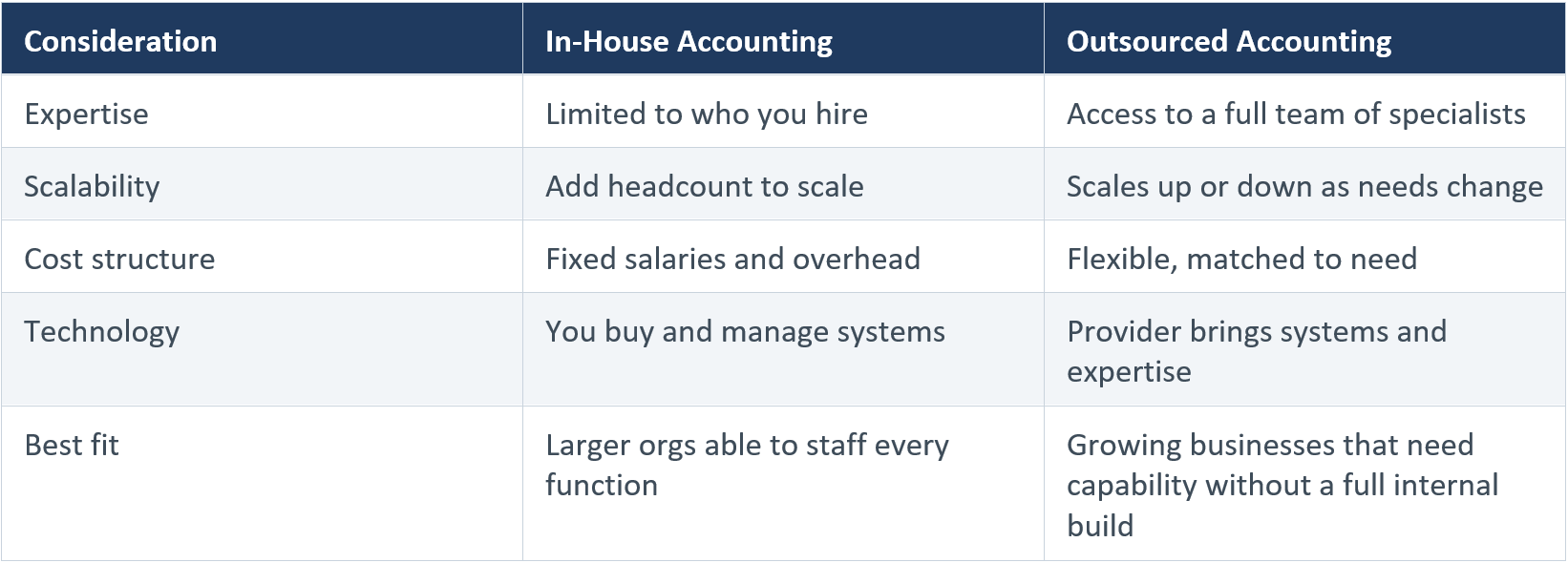
Outsourced Accounting vs. In-House Accounting
The difference between outsourced and in-house accounting is how a business accesses and manages its finance capability.
An in-house model relies on employees hired directly. An outsourced model uses an external provider for some or all finance functions. The two are not mutually exclusive: many businesses run a hybrid model, pairing internal employees with outsourced support for specialized areas like controllership, FP&A, financial systems, compliance, or strategic finance.
How to Choose an Outsourced Accounting Provider
Choose a provider that can support both your current requirements and the added complexity that comes with growth. Look for:
- Range and depth of finance and accounting expertise
- Ability to scale services as requirements change
- Financial technology and systems capability
- Internal controls and reporting processes
- Experience in your industry
- Ability to work alongside an existing finance team
- FP&A, controller, and CFO-level capability
- A clear approach to reporting and decision support
A useful test before you commit: ask a provider to assess where your finance function stands today. Our Financial System Readiness Assessment (FSRA) does exactly that, scoring a business across five areas, Structural Foundation, Systems Architecture, Operational Discipline, Financial Intelligence, and Strategic Enablement, and turning the result into a roadmap rather than just a grade. That roadmap is a plan that shows how we can improve your Decision Readiness, AI and Automation Readiness, Tax and Compliance Readiness, Audit and DCAA Readiness, and M&A and Financing Readiness. A provider who starts with a clear-eyed diagnosis is more useful than one who starts with a proposal.
For government contractors, weigh industry experience heavily. A provider fluent in GovCon accounting, DCAA compliance, cost allocation, indirect rates, and timekeeping brings capability that general accounting support does not.
Build a More Financially Ready Business
Outsourcing accounting can do more than add capacity or ease the burden of hiring.
The right partner strengthens the financial foundation a business relies on to make decisions, manage risk, meet compliance requirements, adopt new technology, and grow with confidence.
Our Finance as a Service (FaaS) model brings together the five elements that foundation requires: People, Process, Technology, Organization, and Data. It is an onshore, systems-driven approach built to make an existing team more effective, not to replace strong leadership. Whether a business needs day-to-day accounting, financial reporting, budgeting and forecasting, FP&A, financial systems, controller oversight, compliance, or strategic finance, we build the solution around the need.
The goal is the same in every case: finance that operates as decision-ready infrastructure, not just a record of the past.
Frequently Asked Questions About Outsourced Accounting
What are the main benefits of outsourcing accounting?
In federal contracting, contract administration means post-award execution — Outsourcing accounting can provide specialized expertise, scalable capacity, stronger internal controls, modern financial technology, and better information for decision-making, without building every function in-house., funding and period-of-performance tracking, subcontract flow-downs, compliance reporting, and closeout. It's the government's own term: FAR Part 42 is titled Contract Administration and Audit Services. Contract management is broader and usually includes pre-award work such as capture, bid decisions, and proposal pricing; in commercial software it generally refers to contract lifecycle management platforms. ROSE performs contract administration and supports the cost side of negotiations.
When should a business consider outsourcing accounting?
When its financial needs outgrow the team’s capacity or expertise, reporting is slow, hiring is hard, or growth is creating more complex accounting and compliance requirements.
Can outsourced accounting work with an internal finance team?
Yes. Many businesses use a hybrid model, pairing internal employees with outsourced support for areas like controllership, FP&A, financial systems, compliance, or strategic finance.
Is outsourcing accounting the same as offshoring?
No. Offshoring moves tasks to lower-cost labor in another location. Modern outsourced accounting, done well, is about systems, controls, and expertise that produce reliable, decision-ready information. Our model is onshore and systems-driven.
Can government contractors outsource their accounting?
Yes. Government contractors can outsource some or all finance functions. A provider with GovCon experience can also support specialized requirements like cost allocation, indirect rates, reporting, and DCAA compliance. GovCon’s should ensure that their outsource provider is maintaining FCI within a certified CMMC Level 1 compliance solution.
Ready to strengthen your finance function?

Ted Rose
In 1994 Ted Rose founded Rose Financial Solutions (ROSE), the Premier U.S. Based Finance and Accounting Outsourcing Firm. In 2010, the Blackbook of Outsourcing named ROSE the #1 FAO firm in the world based on client satisfaction. As the president and CEO of ROSE, he provides executives with financial clarity. Ted has also acted as the CFO for a number of growth companies and assisted with various rounds of financing and M&A transactions.
Share this article:
Visit Us On: