
Contract Administration for
Government Contractors
The contracts function you don't have, fractional and run by the team that already holds your books.
Your funded value determines what you can bill. When contracts, project controls, and accounting sit in three places, that chain breaks; as an over-ceiling invoice, a limitation-of-funds notice nobody sent, or a closeout you can't support three years later.
You have contracts to administer and nobody whose actual job it is
It sits with whoever will absorb it. Often that's the CEO, handling modifications and reporting deadlines between everything else a CEO is supposed to be doing. Sometimes a controller at night, or a program manager between deliverables.

If you're the owner doing this yourself, the hours are the smaller cost. The larger one is where they come from; capture, teaming conversations, client relationships. The work nobody else in the company can do.
ROSE maintains the contract file, processes modifications, manages subcontract flow-downs, and carries contracts through closeout with every change reflected in your accounting system and reconciled monthly.
Contract Administration That Supports the Full Lifecycle
The contract file, deliverable and reporting deadlines, period of performance, and the documentation trail behind every change.
Funding mods, option exercises, and renewals tracked through to the funded value, ceiling, and billing formula in your system.
Funding, deliverables, invoicing coordination, purchasing system readiness, and subcontracting plan reporting.
NDAs, teaming agreements, consultant and vendor agreements, with expiry and obligation tracking.
Named, dated, and tracked. Subcontracting reports, service contract reporting, VETS-4212, and GSA sales reporting.
Final invoice, release of claims, quick-closeout evaluation, and the final indirect rate proposal that gates all of it.
A modification isn't done when it's signed.
It's done when it's right in the system.
A funding mod changes the funded value. That has to land in the CLIN, the billing formula, the ceiling, and the period of performance, or your next invoice is wrong and your EAC is wrong with it.
ROSE closes that loop because we're already inside the system with Deltek Costpoint, Unanet, and QuickBooks with the Easby layer, or whatever you already run.
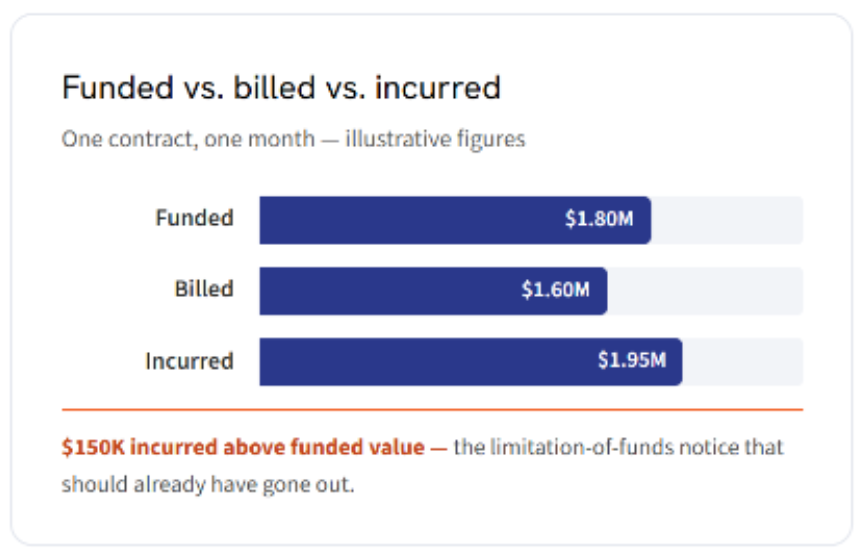
Every month we reconcile three numbers per contract and per CLIN that most contractors never see side by side. When they diverge, you hear it from us, not from a rejected invoice or an incurred-cost audit.




Flow-down management
Under FAR 52.244-6 a prime placing work with a commercial-item subcontractor must flow down a specific enumerated clause set (24 clauses in the current revision) and is barred from flowing down others unless required. Too few is a finding. Too many and your sub either refuses or prices for it.
We maintain the matrix by subcontract type, update it when the clause list changes, and keep the executed file to match. That file is what a purchasing system review actually examines.

We build the position and sit at the table. You make the call.
The constraint usually isn't negotiating skill. It's that nobody built the cost position underneath it, and when the contracting officer pushes on an indirect rate the person who built the number isn't in the room. ROSE participates in the negotiation itself, with the analysis in hand. Decision authority and signature stay with your authorized representative. We advise; you decide.

What it costs
Fixed monthly fee, not hourly. You shouldn't pay by the hour for work whose whole purpose is that deadlines get met — hourly pricing puts the incentive backwards and makes your budgeting impossible.
Scoped by portfolio: prime contracts, subcontracts, whether you hold a Schedule, and whether the contract file is current. Backlog work — closeout cleanup, file rebuild, catalog baseline — is a separate fixed-fee project that finishes.
Frequently Asked Questions
What's the difference between contract management and contract administration?
In federal contracting, contract administration means post-award execution — modifications, funding and period-of-performance tracking, subcontract flow-downs, compliance reporting, and closeout. It's the government's own term: FAR Part 42 is titled Contract Administration and Audit Services. Contract management is broader and usually includes pre-award work such as capture, bid decisions, and proposal pricing; in commercial software it generally refers to contract lifecycle management platforms. ROSE performs contract administration and supports the cost side of negotiations.
When should a contractor hire a contracts manager instead of outsourcing?
When contract volume is steady enough to keep one person fully utilized and the work no longer spans specialties. Outsourcing usually wins while the need is broad but shallow — contracts, subcontracts, GSA reporting, and closeout all at once, none of them full-time.
Who signs contract modifications if contract administration is outsourced?
Your authorized representative. ROSE prepares, tracks, and files the modification and participates in the negotiation, but decision authority and signature stay with you. On GSA Schedule contracts, ROSE is typically added as a named Authorized Negotiator so mods can be submitted through eMod on your instruction.
Which FAR clauses must flow down to a commercial-item subcontractor?
FAR 52.244-6 enumerates the required set — 24 clauses in the current revision — and prohibits flowing down other FAR clauses unless required. The list changes; check the current clause revision rather than a copy in your subcontract template.
When do I need contracting officer consent to subcontract?
Under FAR 52.244-2, without an approved purchasing system: all cost-reimbursement, time-and-materials, and labor-hour subcontracts, plus fixed-price subcontracts above the simplified acquisition threshold or 5% of total estimated contract cost. With an approved system, only those identified in the contract.
Where do I file the ISR and SSR now that eSRS is gone?
SAM.gov. eSRS.gov was retired in February 2026. ISR is semi-annual for periods ending 31 March and 30 September, due 30 days after each; SSR is annual by 30 October.
How long do I have to close out a government contract?
Under FAR 4.804-1: six months after the contracting officer receives evidence of physical completion for firm-fixed-price contracts, 36 months for contracts requiring indirect cost rate settlement, and 20 months for everything else.
Do I need contract management software or a contract administrator?
Software organizes documents and dates. It doesn't read a modification, determine flow-downs, build a negotiation position, or reconcile funded to billed to incurred. If you have someone to run the system, buy the software. If you don't, the tool isn't the constraint.
Ready to Take Contract Administration Off Your Team's Plate?
Tell us how many contracts you're carrying and we'll come back with a scoped fixed fee.


Tell us what you're carrying
How many prime contracts, how many subcontracts, whether there's a Schedule in the mix, and what's keeping you up. We'll come back with a scope and a fixed fee.
A GovCon contracts lead replies within one business day.