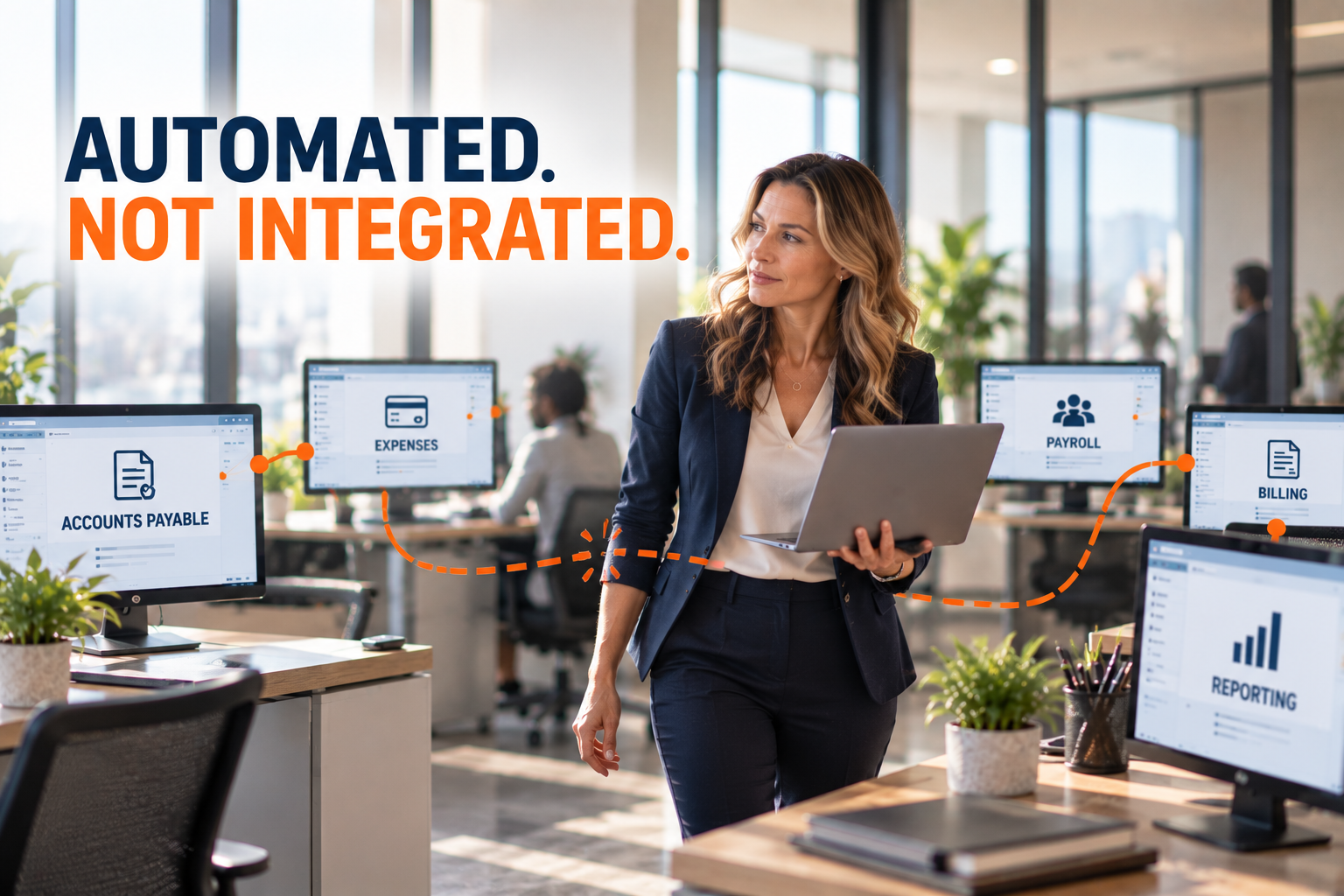
Enterprise-Grade Finance Is No Longer Reserved for Enterprise Companies
By TED ROSE, ROSE FINANCIAL SOLUTIONS
For most of my career, the quality of a company's financial infrastructure was a function of its size. If you ran a Fortune 500, you had integrated systems, documented controls, a close that ran on a calendar instead of a prayer, and reporting your board could act on. If you ran a $10M company, you had QuickBooks, a few spreadsheets held together by one person who knew where everything lived, and a close that finished whenever it finished. That gap was accepted as the price of being small. It is not anymore.
Across this series, I walked through five kinds of readiness. Each one looked like its own problem. They are not. They are five views of the same thing, and this issue is where they connect.
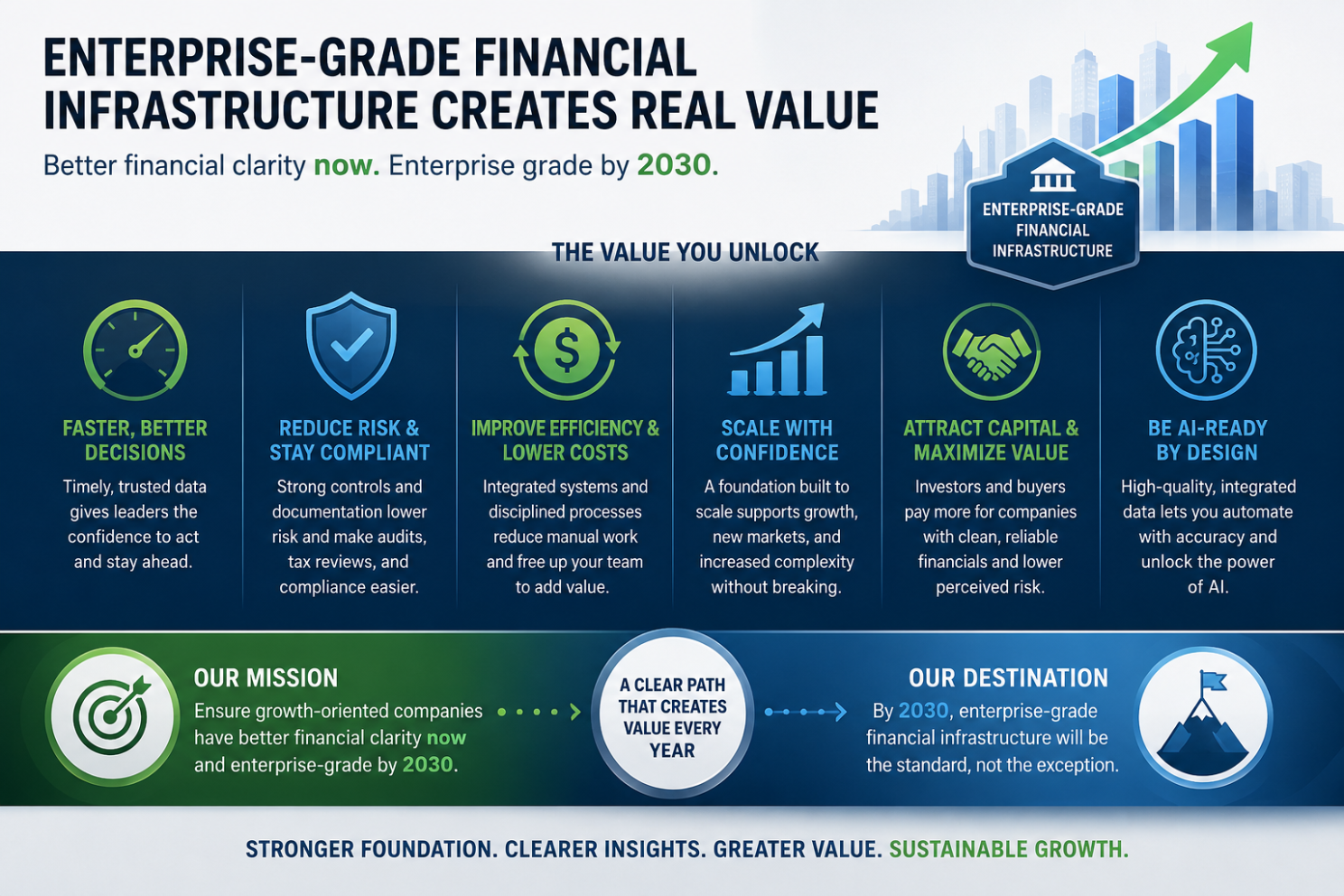
Five financial readiness themes, one condition
Here is the whole series in one sentence. Financial Readiness is the condition of being prepared across all five themes at once: Decision Readiness, Audit Readiness, Tax and Compliance Readiness, AI Readiness, and M&A Readiness.
Most companies are ready for one or two. They can close the books, so they feel audit-ready. They bought a reporting tool, so they feel decision-ready. Then a buyer runs diligence, or an auditor asks for evidence, or leadership tries to point AI at the data, and the gaps surface all at once.
The reason they surface together is that they share a foundation. Readiness is not five projects. It is one system holding up under five different kinds of weight.
Where the five themes actually live
The system underneath all five is the FSRA and its five pillars: Structural Foundation, Systems Architecture, Operational Discipline, Financial Intelligence, and Strategic Enablement. Map the five readiness themes back onto those five pillars and something useful happens. You stop guessing where your risk is. The pillar gap tells you which readiness fails first.
Structural Foundation is governance, controls, and compliance posture. When it is weak, three readinesses are exposed at once: Audit, Tax and Compliance, and M&A. Audit here is broad. It covers financial statement audits, bank reviews, tax audits including state and local reviews, and, for GovCon contractors, DCAA. A missing control does not show up in daily operations. It shows up in a finding, a questioned cost, a penalty, or a diligence flag that quietly lowers your price.
Systems Architecture is whether your systems work together or fight each other. When it is weak, AI Readiness and Decision Readiness break. You cannot point intelligent tools at fragmented data and expect answers you can trust. Automation built on disconnected systems just produces wrong answers faster.
Operational Discipline is whether finance runs as a system or as a set of individual efforts. When it is weak, Audit, Tax and Compliance, and AI Readiness all take the hit. Undocumented process is invisible right up until the person who carries it in their head is out, or until an auditor asks to see it written down.
Financial Intelligence is whether you trust your numbers: close speed, reporting you can use, forecasting you believe. When it is weak, Decision Readiness and M&A Readiness suffer. Leadership hesitates because the data arrives late or feels soft, and a buyer discounts a company whose numbers cannot survive a hard look.
Strategic Enablement is whether finance helps you scale or holds you back. When it is weak, M&A and AI Readiness stall. The infrastructure that should be a competitive asset becomes the reason a deal drags or an automation plan never leaves the slide.
Read that mapping again and the pattern is hard to miss. Every one of the five readiness themes trace back to one or more of the five pillars. Fix a pillar and you improve several readiness themes at once. Ignore a pillar and you can predict, with real accuracy, which readiness breaks under pressure.
That is what the series has been building toward. Achieve all five, and you have earned a specific outcome: enterprise-grade financial infrastructure.
What enterprise-grade actually means, and when
I want to be precise about that phrase, because it is easy to oversell. Enterprise-grade is not a marketing word. In our framework it is the top tier of the RFSI, the score the FSRA produces. It describes finance that is built to scale, runs with minimal key-person dependency, and holds up under scrutiny. It is the standard a company should be operating at when growth, audits, capital events, and AI all arrive at once.
Here is the truth. What we deliver today already puts our clients above where most growth-stage companies operate. That is real, and it matters. But above the current standard is not the same as enterprise-grade. True enterprise-grade is the goal we are building toward, and the deadline is closer than it feels.
I keep coming back to 2030. Automated systems are already common. Integrated systems are not, and that gap is one of the biggest impediments to readiness right now. By 2030, AI and true integration will be the baseline in finance, not the edge. The companies that win will not be the ones that adopted AI fastest. They will be the ones whose infrastructure was ready for it. That kind of readiness is not built in a quarter.
Here is the part I want leaders to sit with. The work you start now pays off big in 2030. But you do not wait until 2030 to collect. Partner with ROSE and it pays off every year in between, because we measure against the same baseline every cycle and the improvement compounds. The RFSI you move this year becomes the floor you build on next year. The 2030 horizon is not a prediction to watch from the sidelines. It is a window to build in, and it is open now.
The part that used to be impossible
For decades, the reason a $30M company could not have enterprise-grade infrastructure was simple. It cost too much and took too long to build. You needed the systems, the integrations, the controls, the automation, and a team to run all of it. That was a seven-figure commitment and a multi-year project, and most companies in that range could not justify either.
That is the problem we built Easby to solve.
Easby is our Finance as a Service platform, built on Appian, the same enterprise-grade foundation used by some of the largest organizations and government agencies in the world. It gives our clients the security, scalability, and automation standards of an enterprise platform without the enterprise price tag or the multi-year build. We have been developing it for two decades: rules-based workflow automation since 2005, machine learning since 2014, generative AI in 2025, and agentic AI going into production this year. That is not a roadmap. It is a track record.
What matters for this issue is how Easby maps to the work. It does not sit on one pillar. It runs across all five. It enforces the documented process and approval routing that Operational Discipline requires. It connects the systems and data flow that Systems Architecture depends on. It delivers the real-time, trusted reporting that is Financial Intelligence. It makes authority and audit trails visible, which is Structural Foundation. And it carries the automation and AI capability that Strategic Enablement is about.
Two things make this practical rather than theoretical. First, Easby makes enterprise-grade infrastructure affordable. Our model saves clients 30 to 60 percent compared to building the equivalent in-house, because the platform investment is already made. You get access to it on day one instead of funding it yourself.
Second, and this is the part people underestimate, we build it underneath a finance function that is still running. Your close still happens. Your bills still get paid. Your team keeps operating while the infrastructure is strengthened around them. We do not stop the business to rebuild the business. The transformation happens under the operation, not instead of it.
How the work actually runs
None of this starts with a platform. It starts with an accurate baseline. The FSRA is the entry point. It is a self-assessment for CEOs and CFOs, about 15 minutes, and it produces your RFSI score with a pillar-by-pillar breakdown. It tells you where you stand and whether a deeper look is warranted. It is a diagnostic, not a remediation plan.
The FSRR is the deeper look. It is an 80-indicator review conducted by a ROSE professional, four times deeper into each pillar, weighted by risk, and built on documented evidence rather than self-reporting. It produces a current-state diagnosis, a prioritized risk inventory, and a phased remediation roadmap. Every FaaS engagement starts here.
From there the model is the same every time. We diagnose. We build the roadmap. We implement in the right sequence: stabilize first, then standardize, then automate. And we measure improvement against the same baseline we started with, so the value is not a feeling. It is a number you can watch move, year after year.
That last point is the one I care about most. Most financial improvement is invisible. You spend the money, the team seems busier, and no one can say what actually got better. We refuse to work that way. The RFSI is a baseline before, during, and after. When it moves, you know what changed and what it was worth, and next year you move it again.
Where to start
I am pulling the whole series into one place. The guide maps the five readiness themes to the five pillars, shows the risk each gap predicts, and lays out the path to enterprise-grade infrastructure. It is a working reference, not a brochure. The download will be available next shortly. Follow me on LinkedIn for notice of its release or type FSRA into the comments and I'll make sure we send you a copy.
If you want the fastest accurate read on where you stand, take the FSRA. Fifteen minutes, five pillars, one score.
Enterprise-grade finance used to be reserved for enterprise companies. It is not anymore. The only question left is whether you start building toward it now, while the window is open, or explain later why you waited.

Ted Rose
In 1994 Ted Rose founded Rose Financial Solutions (ROSE), the Premier U.S. Based Finance and Accounting Outsourcing Firm. In 2010, the Blackbook of Outsourcing named ROSE the #1 FAO firm in the world based on client satisfaction. As the president and CEO of ROSE, he provides executives with financial clarity. Ted has also acted as the CFO for a number of growth companies and assisted with various rounds of financing and M&A transactions.
Share this article:
Visit Us On: