
Automation Layered on Fragile Infrastructure Does Not Improve It. It Accelerates the Fragility.
By TED ROSE, ROSE FINANCIAL SOLUTIONS
Three years from now, there will be two kinds of finance organizations.
The first will have used AI to genuinely change how their financial function operates. Faster close, better forecasting, less time on data entry and more on analysis. Finance working as a real decision engine.
The second will be explaining why their AI implementation underperformed, rebuilding the foundation they skipped, and wondering why the technology did not deliver what the vendor promised.
What separates them has almost nothing to do with which AI tools they chose. It has everything to do with what was already true about their financial infrastructure before they turned it on.
The Conversation Has Moved. The Question Has Not.
The AI debate in finance has shifted. Two years ago, most CFOs were asking whether to invest. Now they are asking when, which tools, and at what cost. That shift sounds like maturity. It is not always.
Back in Issue 4 of this newsletter, I made the argument that AI does not fix broken financial systems. It amplifies them. I want to take that further today, because we are past the theoretical stage.
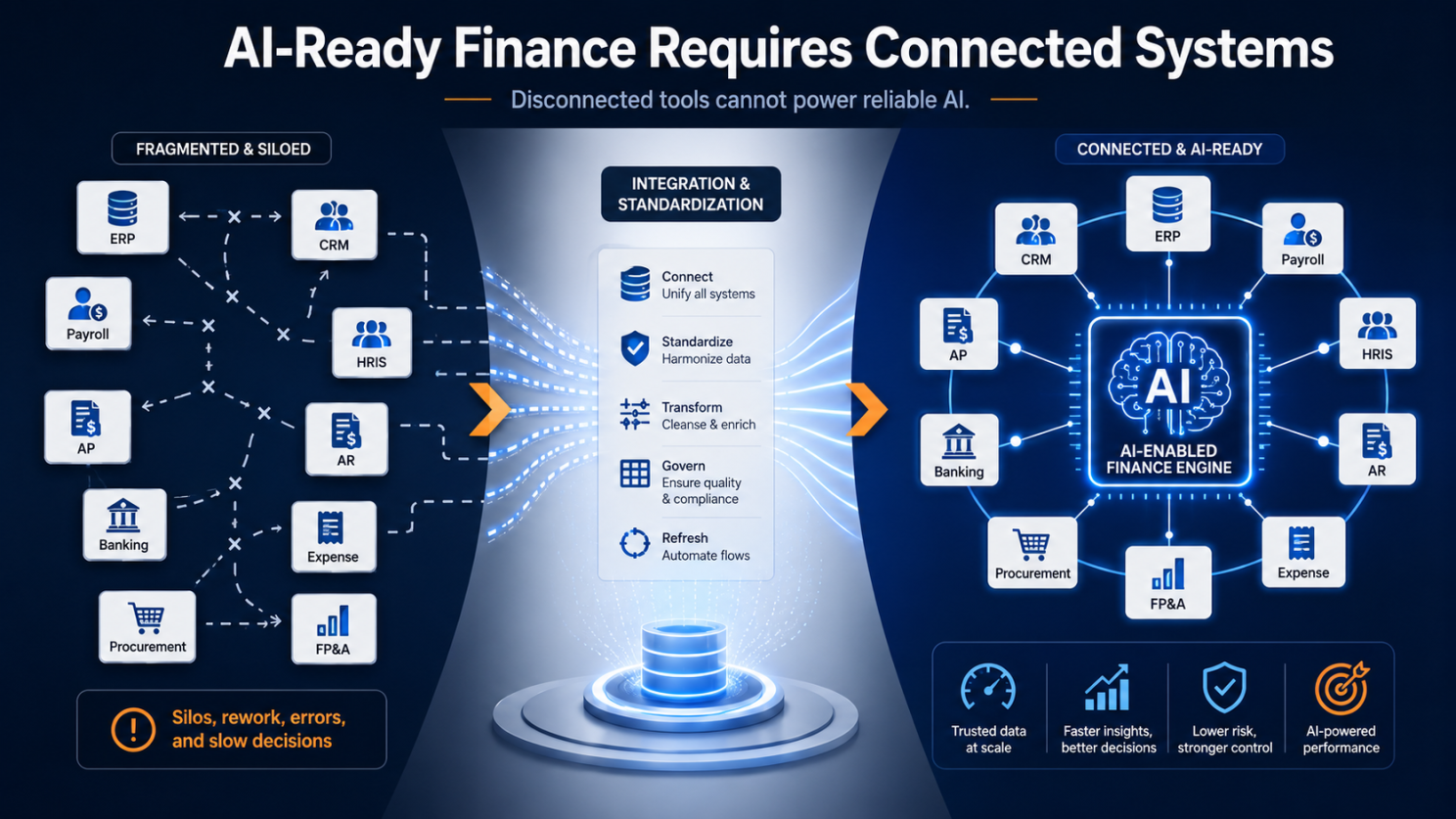
Automation layered on fragile infrastructure does not improve it. It accelerates the fragility. Errors move faster. Control gaps scale. Bad data populates more reports. And because automation looks like it is working on the surface, the underlying problems take longer to detect. That is not a reason to avoid AI. It is a reason to get the sequence right.
Why Most Organizations Do Not Know They Are Not Ready
This is the part that deserves more attention than it usually gets. Most organizations that have underinvested in financial infrastructure do not think of themselves that way. The close happens. Reports go out. The books get reconciled. Everything looks functional from the outside.
The gaps are underneath: in data that cannot flow cleanly between systems, in processes that exist in people's heads rather than documented workflows, in reporting that leadership reviews with quiet skepticism, in controls that are applied inconsistently depending on who is doing the work that week.
None of those gaps are obvious until you layer automation on top of them. Then they become obvious fast. The confidence problem runs deeper than most CFOs acknowledge. Because finance teams are capable and resourceful, they compensate for infrastructure weaknesses through effort. Extra manual steps. Offline reconciliations. Shadow spreadsheets. The system produces the right answer, eventually, through a combination of technology and human workaround.
AI cannot do the workaround part. It follows the system as it finds it. If the system has gaps, the AI finds them too, then operates inside them at scale.
What AI Actually Needs to Function Well
AI in finance is not magic. It is pattern recognition applied to structured data, following logic and rules that have been built and validated. It performs as well as the inputs it receives and the processes it operates within.
That means AI needs four things to work as promised.
Clean, consistently-organized data it can actually consume. Documented, repeatable processes it can follow without human judgment filling the gaps. Controls that can govern what it does and catch it when it drifts. And reporting infrastructure that leadership trusts enough to act on.
Most finance organizations have some of these. The assessment work we do regularly shows that very few have all of them. And without all of them, AI implementations underperform in ways that are entirely predictable before they happen.
The FSRA Map: Where Specific Gaps Block AI First
The Financial System Readiness Assessment measures five dimensions of financial infrastructure maturity. For AI readiness, those pillars map directly to where implementations succeed or fail. Here is where the gaps tend to show up.
- Structural Foundation is the starting point. Governance, role clarity, and internal controls are not background noise for AI. They are the rules AI operates within. If approval authorities are undefined, if controls are applied inconsistently, if data ownership is unclear, the AI operates inside those gaps. It does not compensate for them. It codifies them and scales them forward.
- Systems Architecture is where most implementations break down first. ERP data that does not flow cleanly between systems. Manual handoffs between platforms. Disconnected tools with no integration layer underneath. AI needs clean, structured, accessible data. Not data that lives across three systems and requires a human to reconcile it before it means anything. A fragmented systems architecture does not become less fragmented when you add AI on top. It becomes a fragmented architecture that fails faster.
- Operational Discipline is the pillar that surprises organizations most. If a process is not documented, AI cannot automate it consistently. What looks like a repeatable workflow is often a collection of individual decisions made by people who each do it slightly differently. AI learns those variations. It replicates them. If the underlying process discipline is not in place, the automation is learning and scaling inconsistency, not correcting it.
- Financial Intelligence is about whether the reporting your finance team produces is actually trusted. If leadership is already working around gaps in the close process, if forecasts exist but no one uses them to make real decisions, if the CFO quietly adds a buffer to every number before presenting to the board, AI does not fix any of that. AI-generated forecasts built on untrustworthy data are just faster wrong answers. The trust problem has to be solved at the source.
- Strategic Enablement is where AI delivers real value: automated close support, real-time anomaly detection, predictive cash flow modeling, decision support at speed. This is the payoff. But it is only accessible to organizations that have built the foundation underneath it. Strategic Enablement is not where you start with AI. It is where you arrive when the other four pillars are solid.
The Sequence Is the Strategy
The remediation sequence we use with clients follows three stages: Stabilize, then Standardize, then Automate. That order is not arbitrary. Stabilize means addressing the structural and control gaps that could create immediate damage. Standardize means documenting processes, cleaning data flows, and building the operational discipline that automation requires. Automate means layering AI onto a foundation that can support it, producing outputs that are trustworthy because the inputs are.
Most organizations want to skip straight to Automate. The instinct is understandable. AI is visible, it is exciting, and it is easy to point to in a board presentation. But automation without foundation is not a shortcut. It is a loan at a very high interest rate. And the bill comes due later, when the problems it was supposed to solve have been coded into the system itself.
Earning the Right to Deploy AI
The organizations that get AI right are not necessarily the ones that move fastest. They are the ones that asked a different question before they invested.
Not just: which AI tools should we use?
But: what has to be true before those tools pay off?
That second question is harder. It is also the only one that matters in the long run. We built Easby on this principle. Rules-based workflow automation was the foundation we laid starting in 2005, long before AI became the conversation it is today. The AI capabilities inside Easby, including the agentic workflows going live this year, are operating on top of workflows that have run in production for years. That is not a marketing angle. It is the reason those implementations hold when they are deployed. Infrastructure first. Automation second.
That sequence produces a different kind of AI story. One that does not require rebuilding afterward.
The Diagnostic Step Before the Investment Step
AI Readiness is not primarily a technology question. It is a financial infrastructure question, and it maps directly onto the five FSRA pillars.
If you are planning an AI investment, or evaluating why a current one has underdelivered, the most productive next step is an honest diagnostic of where your infrastructure stands across those five dimensions today.
The ROSE Financial System Readiness Assessment takes about 15 minutes and gives you a clear, pillar-by-pillar picture. It will not tell you which AI tools to buy. It will tell you what has to be true before those tools can pay off. That conversation is worth having before the investment, not after.

Ted Rose
In 1994 Ted Rose founded Rose Financial Solutions (ROSE), the Premier U.S. Based Finance and Accounting Outsourcing Firm. In 2010, the Blackbook of Outsourcing named ROSE the #1 FAO firm in the world based on client satisfaction. As the president and CEO of ROSE, he provides executives with financial clarity. Ted has also acted as the CFO for a number of growth companies and assisted with various rounds of financing and M&A transactions.
Share this article:
Visit Us On: