
The Audit Notice Arrives
By TED ROSE, ROSE FINANCIAL SOLUTIONS
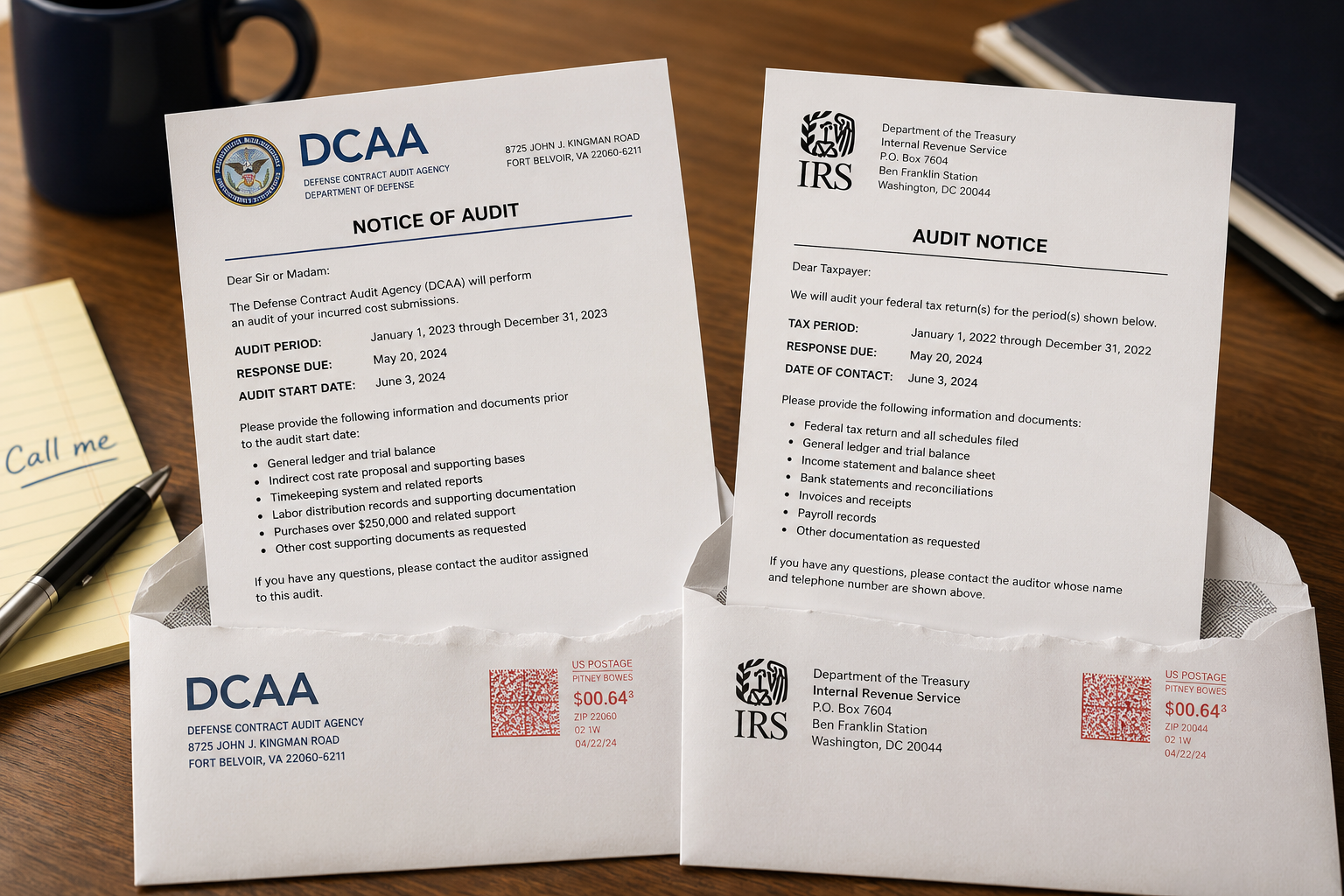
The notice is short. Sometimes it is a single page on letterhead. It names a period, requests a list of documents, and sets a date. And in most companies, the moment it lands, the temperature in the finance function changes.

Someone forwards it with a note that just says "call me." A meeting gets scheduled. People start asking where things are. What did we tell them last year? Who has the support for that number? Is the documentation actually where we think it is?
I have watched this scene play out in government contractors facing DCAA, in nonprofits facing a financial statement and program audit, and in growth companies facing the expansion of their line of credit with the bank. Different letters, different auditors, same reaction. The notice did not change anything about the company's finances. It simply asked to see them. The scramble that follows is the tell.
Here is the reframe I want to offer. You do not pass an audit. You either walk in ready or you spend weeks pretending you were.
An audit is a posture, not an event
Most leaders treat an audit as a project. A thing that starts when the notice arrives and ends when the auditor leaves. Staff up, pull the files, get through it, exhale.
That framing is the problem. It turns readiness into something you produce on demand, under pressure, against a clock someone else set. Audit readiness is not a project you run. It is a condition you are either in or you are not. A company that is audit-ready does nothing special when the notice arrives, because the work that makes an audit smooth was already done, months and quarters earlier, as part of how the finance function operates every day.
The company that is not audit-ready does something very different. It reconstructs. It goes looking for support that should have been attached to the transaction when it happened. It rebuilds the story of the year from memory and spreadsheets. That is not reporting. That is archaeology, and auditors can tell the difference.
If an audit notice sends your team digging, you were never audit-ready. You were audit-lucky. And luck is not a control. This is rarely a story about negligence. It is a story about growth outrunning process. The company got bigger, the transactions got more numerous, and the informal way of tracking support that worked at a smaller size stopped being enough. Nobody decided to be unready. They simply never decided to build for readiness, and the notice found the gap that decision left behind.
Same test, three different doors
The audit that lands on your desk depends on who you are. The underlying test does not. For a government contractor, it includes the DCAA. They want to see that your timekeeping is enforced by the system rather than by good intentions, and that your indirect rates actually tie to the cost pools you have claimed.
For a nonprofit, it is a financial statement and program audit. They want to see that restricted funds were spent on what they were restricted for, and that your fund accounting holds up line by line, program by program, rather than in summary.
For a growth company, it is often an audit or review that is triggered by a lender, an investor, or a board that now needs numbers a third party will stand behind. They want a disciplined close and revenue recognition that is defensible, so the numbers you report can be traced back to something real.
Three different doors. Behind each one, the same question. Can you show your work, or can you only show your conclusions?
What audit-ready actually requires
Audit readiness is not a binder you assemble. It is a property of your financial infrastructure. It means transactions carry their support at the moment they happen, not months later when someone asks. It means your close follows a disciplined, repeatable process, so the controller produces books that hold together and the CFO reviews them and turns them into management reporting leadership can trust. Your systems, not your spreadsheets, hold the truth, connected well enough that a number in a report can be traced back to the entry that created it without a scavenger hunt.
That is infrastructure. And it is exactly why audit readiness cannot be created in the weeks after the notice arrives. You cannot install a control retroactively. A control either governed the transaction when it happened or it did not.
This is the part that gets missed. An audit does not just test the work you do during the audit. It tests the work you did all year. By the time the moment arrives, it is too late to build for it.
Even when you pass, the scramble costs you
Let me be fair to the audit-lucky. Many of them pass. They get through it, the findings are manageable, the auditor leaves. So what was the harm?
The harm is everything the scramble displaced. For the weeks/months the fire drill runs, your best finance people stop doing the forward-looking work the business actually needs. Reporting slows. Decisions wait. The CFO who should be helping price the next deal is instead reconstructing last year's support. That is real cost, and it never shows up on an invoice.
Then there is the trust cost. A messy audit, even one you pass, tells your lender, your investor, your board, or your funder something about how the company is run. Findings have a memory. The next audit starts from a more skeptical place, and skepticism is expensive.
There is also a version of this that cuts the other way. Readiness built once serves every audit after it. The contractor who is DCAA-ready sits closer to ready for the bank. The nonprofit with clean fund accounting is also ready for the board. Strong infrastructure does not solve one audit. It retires the category.
The question worth asking before the notice
The question is not whether you will pass your next audit. You might. The question is what passing will cost you, and whether the weeks before it will be spent building or reconstructing.
If you are not sure you could hand an auditor a clean trail today, without the fire drill, that uncertainty is your answer. And it is far cheaper to resolve now than under a deadline someone else controls.
That is what our Financial System Readiness Assessment is built to surface. It gives you an accurate read on where your financial infrastructure stands today, across the five areas that determine whether you are ready to be looked at closely: Structural Foundation, Systems Architecture, Operational Discipline, Financial Intelligence, and Strategic Enablement. Not a guess about audit readiness. A baseline.
Download our FSRA digital asset to learn more, and find out where you stand before the notice does it for you.

Ted Rose
In 1994 Ted Rose founded Rose Financial Solutions (ROSE), the Premier U.S. Based Finance and Accounting Outsourcing Firm. In 2010, the Blackbook of Outsourcing named ROSE the #1 FAO firm in the world based on client satisfaction. As the president and CEO of ROSE, he provides executives with financial clarity. Ted has also acted as the CFO for a number of growth companies and assisted with various rounds of financing and M&A transactions.
Share this article:
Visit Us On: