Buyers Do Not Buy Your Revenue. They Buy What Holds Up Under Scrutiny.
By TED ROSE, ROSE FINANCIAL SOLUTIONS
Most growth-stage leaders think about M&A readiness at exactly the wrong moment. When a buyer is already in the room.
The banker is engaged. The NDA is signed. The data room is being assembled. And the finance team is scrambling, often for the first time, to make the numbers look as organized as the pitch deck has always sounded.
That scramble is expensive. The consultant fees add up fast. But the real cost is that due diligence is built to find exactly what a sixty-day sprint cannot fix.
What Buyers Are Actually Examining
When a private equity firm, a strategic acquirer, or a bank sends in a due diligence team, they are not arriving to validate your revenue story. They already heard that from your banker.
They are there to ask a harder question. Does this company operate the way they say it does?
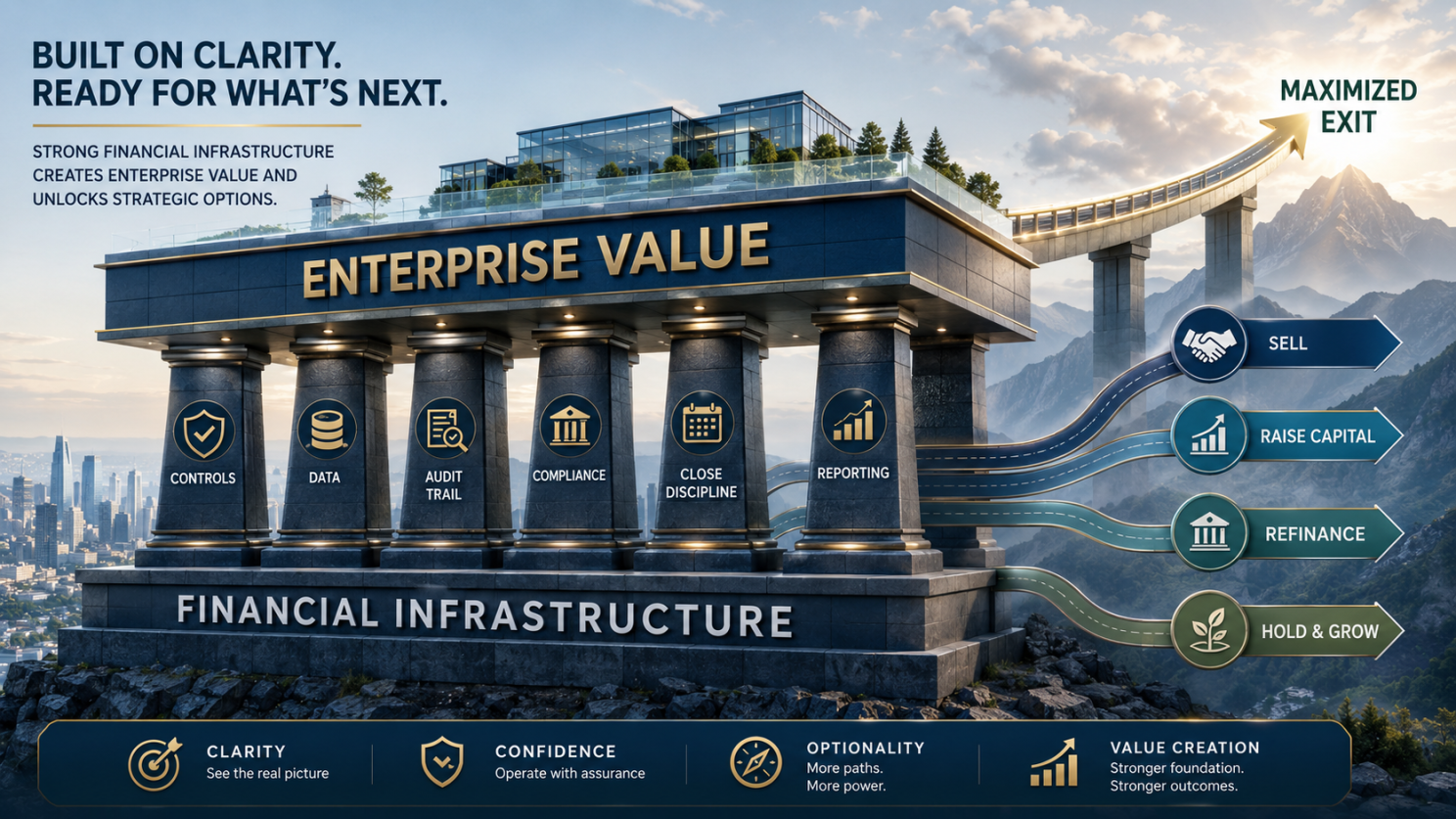
That question gets answered through the finance function. Your product, your customer relationships, and your pitch deck do not answer it. The documentation, the systems, the controls, and the data trail your finance team has been building, or has not been building, for years, are what answer it.
Here is what comes under examination in nearly every deal.
Revenue quality. Can the numbers be supported? Revenue recognition policies, contract documentation, deferred revenue schedules, and the consistency between what was reported and what can actually be verified, these are where Quality of Earnings work surfaces the first discounts. Revenue that looks strong in aggregate but becomes murky at the transaction level is a liability, not an asset.
There is a second layer, and most companies miss it entirely. Acquirers will ask for revenue and profitability cut by client, project, industry, and division. Not to audit your formatting. To understand where the business is actually generating value, which segments are growing, which are in decline, and what they are really buying.
This is the story inside the story. And if you are not already running that analysis and reviewing it regularly, you do not have a complete picture of your own business's value. The due diligence team will get there before you explain it to them.
Are certain client types growing while others quietly shrink? Are specific project types driving the margin, or dragging it down? Is one division carrying the rest? These are not abstract questions. Strategic buyers think about them before the LOI is signed. A buyer looking to enter a growing industry vertical in your portfolio needs that profile. It shapes what they offer, and it shapes who the best buyer for your business actually is.
Know what is inside your numbers before someone else defines it for you.
Controls and documentation. Are approvals documented and enforced through a system, or do they live in email threads and individual memory? Buyers want to see controls that run whether or not a specific person is in the seat. Email-dependent approvals, undocumented policies, and processes that exist only in someone's head all create risk. That risk gets priced into the deal.
Tax exposure. This is one of the most common places deals get complicated late. Uncovered state and local tax obligations, misclassified contractors, deferred liabilities that were never booked properly. None of these are small issues. They become deal contingencies, escrow requirements, or price adjustments. Most are avoidable with proper compliance infrastructure in place before the conversation begins.
Close speed. How long does it take to close the books each month? An organization closing in five to seven business days signals discipline and controls. One closing in twenty days or more is telling a different story. Manual reconciliations, key-person dependency, fragmented systems, or all three. Buyers read close speed as a proxy for operational maturity. A slow close raises questions before a single document has been formally requested.
Key-person dependency. If your CFO or Controller left tomorrow, could your finance function keep running cleanly? Buyers think about this question. If the honest answer is probably not, the company carries more risk than its revenue growth suggests.
The Deal That Slows, Discounts, or Dies
I have watched deals stall for reasons that had nothing to do with a company's underlying strength.
A company with genuine growth, solid margins, and a compelling market position. Books that could not support a clean Quality of Earnings because the revenue recognition policy had never been documented properly. The deal closed eventually, at a lower multiple than the seller expected, after three months of remediation mid-process.
That story is not unusual. The difference between companies that close cleanly and companies that do not usually comes down to one thing. Was financial infrastructure treated as a priority before the process started?
Buyers discount for risk. Fragile systems, undocumented controls, slow closes, and tax exposure all read as risk. Each one becomes a line item in the deal, even if it never shows up labeled that way.
Why a Sprint Will Not Save You
When companies realize their finance function is not ready, the instinct is to prepare for the process rather than have built for it.
Engage a CPA firm for a QofE. Tighten the close. Organize the data room. Bring in a financial consultant to clean up the reporting package.
The problem is that due diligence is not evaluating your preparation. It is evaluating your history. The audit trail, the documentation, the control evidence, the close cadence, those all reflect what you actually built. Not what you assembled in sixty days.
Buyers know the difference. They see it every time.
The companies that consistently get clean, efficient deal processes and defend their valuations are the ones that treated M&A readiness the way they treat DCAA readiness or audit readiness. An ongoing operating discipline, not a transaction project.
What M&A Readiness Actually Looks Like
The companies I have seen enter deals from a position of strength share a common profile.
Revenue recognition policies are written down, applied uniformly, and supported by contract documentation at the transaction level. Revenue and profitability are understood at the segment level, cut by client, project, industry, and division, so leadership knows the story inside the numbers before an acquirer asks for it. Approval workflows are system-enforced and leave a clean audit trail, not email chains assembled after the fact. Tax compliance is reviewed regularly, not just during filing season. Monthly closes happen in a defined window. No single person holds the function together.
In terms of the Financial System Readiness Assessment framework, M&A readiness draws from all five pillars. Structural Foundation establishes the governance, controls, and compliance posture buyers expect. Systems Architecture determines whether your data is clean, integrated, and traceable. Operational Discipline produces the close quality and documentation that holds up under scrutiny. Financial Intelligence determines whether your reporting can support a credible Quality of Earnings process. Strategic Enablement is where M&A and investor readiness are explicitly measured, and where most companies discover the gap far too late.
These companies are not doing anything exotic. They run their finance function as though scrutiny is coming. Because it always is.
The Infrastructure That Holds Up
When we build financial infrastructure for clients at ROSE, one test we apply throughout is a practical one. Would this hold up in due diligence?
System-enforced approvals with a full audit trail on every transaction. Process documentation that lives in the system, not in someone's memory. Close checklists that produce consistent results regardless of who executes them. That is what Easby, the platform that runs our Finance as a Service model, is built to produce. Not because M&A is always the goal, but because that level of operational discipline is what a serious finance function requires.
If you are building toward a transaction, the best time to think about readiness is now. Not sixty days before the LOI. Not when the due diligence team sends their first request list. Now.
Know Where You Stand
If you are not certain where your finance infrastructure is solid and where it is fragile, that question is worth answering before a buyer asks it.
The Financial System Readiness Assessment at rosefinancial.com takes about fifteen minutes. It gives you an RFSI score and a pillar-by-pillar picture of where you stand across the same dimensions acquirers examine in due diligence.
When the due diligence team walks in, the time for building has passed. What they find is what exists.
Build it now. Not for the deal. For the company.

Ted Rose
In 1994 Ted Rose founded Rose Financial Solutions (ROSE), the Premier U.S. Based Finance and Accounting Outsourcing Firm. In 2010, the Blackbook of Outsourcing named ROSE the #1 FAO firm in the world based on client satisfaction. As the president and CEO of ROSE, he provides executives with financial clarity. Ted has also acted as the CFO for a number of growth companies and assisted with various rounds of financing and M&A transactions.
Share this article:
Visit Us On: