An Audit Does Not Create Problems. It Reveals the Ones Already There.
By TED ROSE, ROSE FINANCIAL SOLUTIONS
Most organizations believe they are audit-ready. Most of them are wrong.
Not because they are careless. Not because they are hiding something. Because "audit-ready" and "compliant" are not the same thing, and the difference only becomes visible when the auditors walk in.
Compliance is a status. Audit readiness is a capability. A compliant organization has followed the rules. An audit-ready organization can prove it: quickly, consistently, and without disrupting normal operations to do so. That second part is where most companies fall short.
The Audit as a Stress Test
Think about what an audit actually does. It applies pressure to your financial infrastructure at the exact points where it is weakest. Auditors are not looking for intent. They are looking for evidence. And if your infrastructure cannot produce that evidence in a clean, organized, and timely way, the audit experience goes from routine to painful fast.
The hidden cost is not just the time your team loses pulling documents and answering questions. It is the signal the audit sends. Every finding, every delay, every request for clarification that turns into a multi-week back-and-forth tells a story about how your finance function actually operates. For a company seeking capital, considering a sale, or holding government contracts, that story matters more than most leaders realize.
I have worked with companies that believed they were in excellent shape because they had never failed an audit. That is a low bar. Passing an audit is not the same as being audit-ready. Passing just means you survived. Readiness means you walked in confident, produced what was needed without scrambling, and walked out with zero surprises.
Those are very different outcomes. The gap between them lives inside your infrastructure.
Two Pillars. One Condition.
When I look at what separates organizations that handle audits well from those that struggle through them, two pillars of financial infrastructure stand out consistently: Structural Foundation and Operational Discipline.
Structural Foundation is the compliance layer. Governance, internal controls, role clarity, tax posture, regulatory positioning. When this pillar is weak, audits reveal it quickly. Controls that exist on paper but are not enforced. Approval workflows that bypass documented policy. A chart of accounts that does not reflect actual business activity. Documentation that depends on one person's memory rather than a repeatable process. None of these problems are invisible before an audit. They are just invisible to leadership. The audit makes them visible to everyone.
Operational Discipline is where Structural Foundation lives day to day. It is the difference between having a policy and running one. This pillar covers data quality, process documentation, budget performance tracking, and cash management rigor. An organization with strong Operational Discipline does not scramble when auditors ask for support documentation. The evidence exists because the processes that generate it run every month, not just when someone external is watching.
That last sentence is worth reading again. The processes run every month, not just when someone is watching. This is where most organizations underestimate their exposure. They have the controls. They do not have the habit.
The Infrastructure Gaps That Turn Routine Audits Into Ordeals
There is a pattern I have seen repeat across industries, organization sizes, and audit types. The company feels prepared. The audit begins. Auditors request documentation. The finance team realizes they cannot produce what is needed in the format or timeframe expected. Scramble begins. Audit scope expands. Findings accumulate.
The triggering gap is almost never the absence of a policy. It is almost always one of these. Disconnected systems that cannot produce a clean audit trail. When your ERP, payroll system, project management tool, and expense platform do not integrate, tracing a transaction from source to financial statement becomes a manual exercise. Auditors do not just want the number. They want the path. If your team has to reconstruct that path by hand, the audit has already become more expensive than it needed to be.
Process documentation that lives in someone's head. Finance teams that run on institutional knowledge rather than documented process are one personnel change away from a significant compliance exposure. Auditors want to see evidence that a control runs consistently. If the person who knows how it works is not available, "we do it this way" does not hold up.
Controls that have never been tested. There is a real difference between designing a control and verifying it operates effectively. Many organizations design controls once and assume they function until proven otherwise. Audits prove otherwise. Internal testing, especially for higher-risk transaction types, is the work that keeps audit findings from becoming surprises.
Financial reporting that tells a different story than the supporting data. When the numbers in the financial statements cannot be traced cleanly back to underlying transactions and accounts, auditors will find the gap. This is not a fraud issue. It is an infrastructure issue. The more manual the close process, the more opportunities for the numbers to drift from the evidence.
The GovCon Reality
For organizations operating under government contracts, audit readiness is not optional and the stakes are higher. DCAA auditors are not looking at whether you are generally organized. They are looking at whether your financial infrastructure can support the specific cost accounting requirements that government contracts impose. Indirect rate structures have to be defensible. Timekeeping has to be system-enforced and auditable. Direct and indirect costs have to be allocated according to a consistent, documented methodology. The chart of accounts has to map to cost pool structures that reflect how the work is actually performed.
A company that has grown quickly under government contracts and has not updated its financial infrastructure to match that growth is carrying real audit risk. It is not a question of whether DCAA will find it. It is a question of when.
The organizations that handle DCAA audits well built the infrastructure first. They did not wait for a pre-award survey to discover their timekeeping system was not compliant. They did not find out during an incurred cost audit that their indirect rate methodology had not been consistently applied. They built what the audit requires, and then they maintained it.
Audit Readiness Is Not an Audit-Season Activity
This is the point most organizations miss. Audit readiness is not something you achieve in the weeks before an auditor arrives. It is the condition of your financial infrastructure on an ordinary Tuesday in March. Whether your team closes the books the same way every month, with documented procedures and reviewable evidence, regardless of whether anyone external is watching.
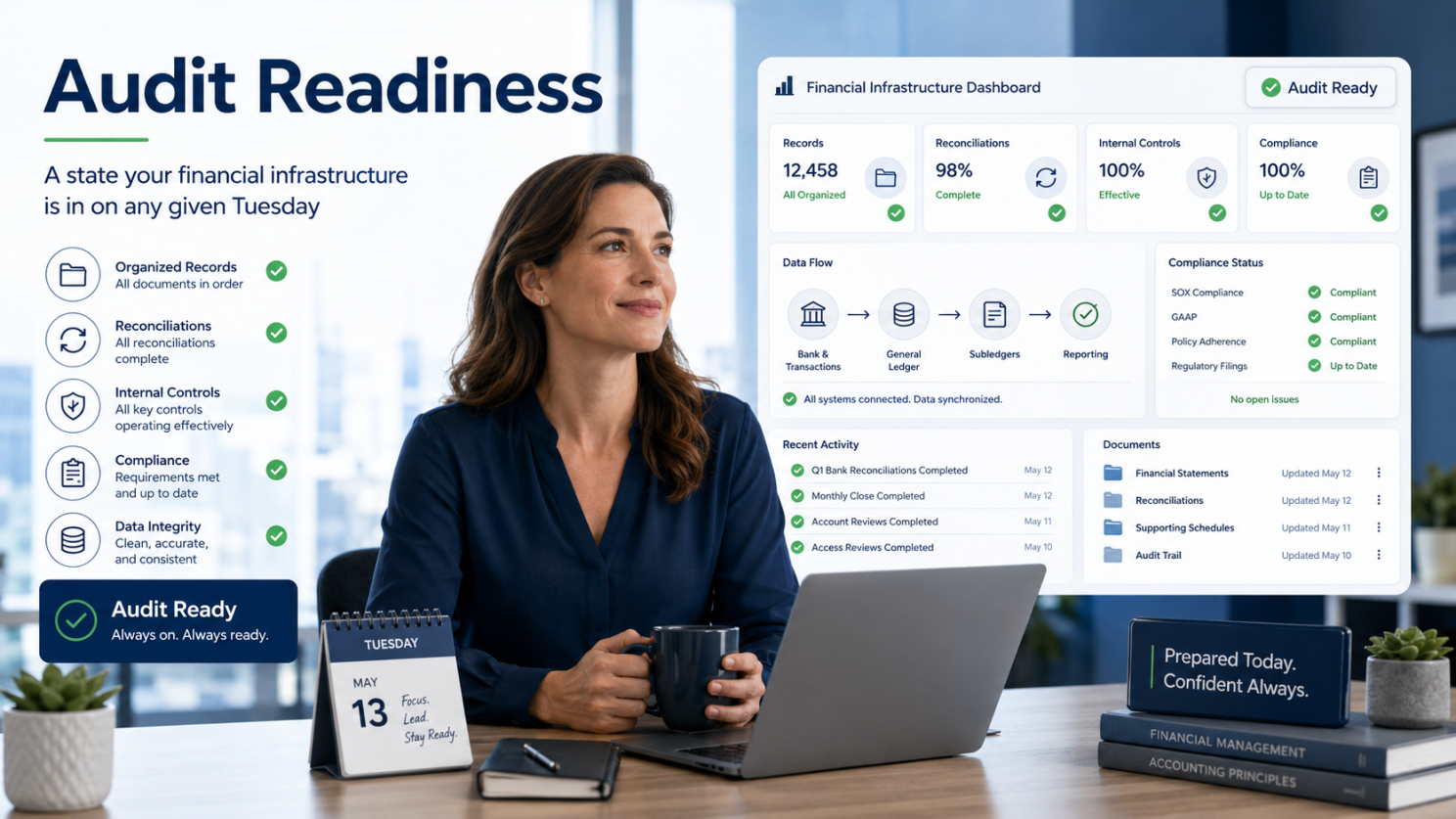
If your finance function has to shift into a different mode when an audit approaches, that is the signal. The audit is not creating the problem. It is revealing that the infrastructure has been operating below the level that external scrutiny requires.
The fix is not better audit preparation. The fix is better financial infrastructure. An honest assessment of where you stand on Structural Foundation and Operational Discipline will tell you more about your audit readiness than any pre-audit checklist. Not because the checklist is wrong, but because the checklist is a symptom check. The infrastructure assessment measures the underlying condition.
Two Questions Worth Asking Today
Can your team produce audit-quality documentation for any significant transaction in your financial statements without a special project? Not within a week. Within hours. If the answer is no, your Structural Foundation needs attention.
Do your financial processes run the same way every period, with documented evidence of the controls that govern them? Not "we have a policy." Evidence that the policy runs. If the answer is no, your Operational Discipline has gaps that will show up under scrutiny.
Neither gap is fatal. Both are fixable. The organizations that fix them before the audit arrive are the ones that handle audits without drama. The audit does not create the problem. It just tells you what was always there.
If you want a structured view of where your financial infrastructure stands today, the FSRA is a 15-minute self-assessment that measures both pillars, along with the three others that define a decision-ready finance function.

Ted Rose
In 1994 Ted Rose founded Rose Financial Solutions (ROSE), the Premier U.S. Based Finance and Accounting Outsourcing Firm. In 2010, the Blackbook of Outsourcing named ROSE the #1 FAO firm in the world based on client satisfaction. As the president and CEO of ROSE, he provides executives with financial clarity. Ted has also acted as the CFO for a number of growth companies and assisted with various rounds of financing and M&A transactions.
Share this article:
Visit Us On: