620 More 8(a) Firms Just Got Cut. The Program Is Down 29%.
By WALLY ANGEL, ROSE FINANCIAL SOLUTIONS
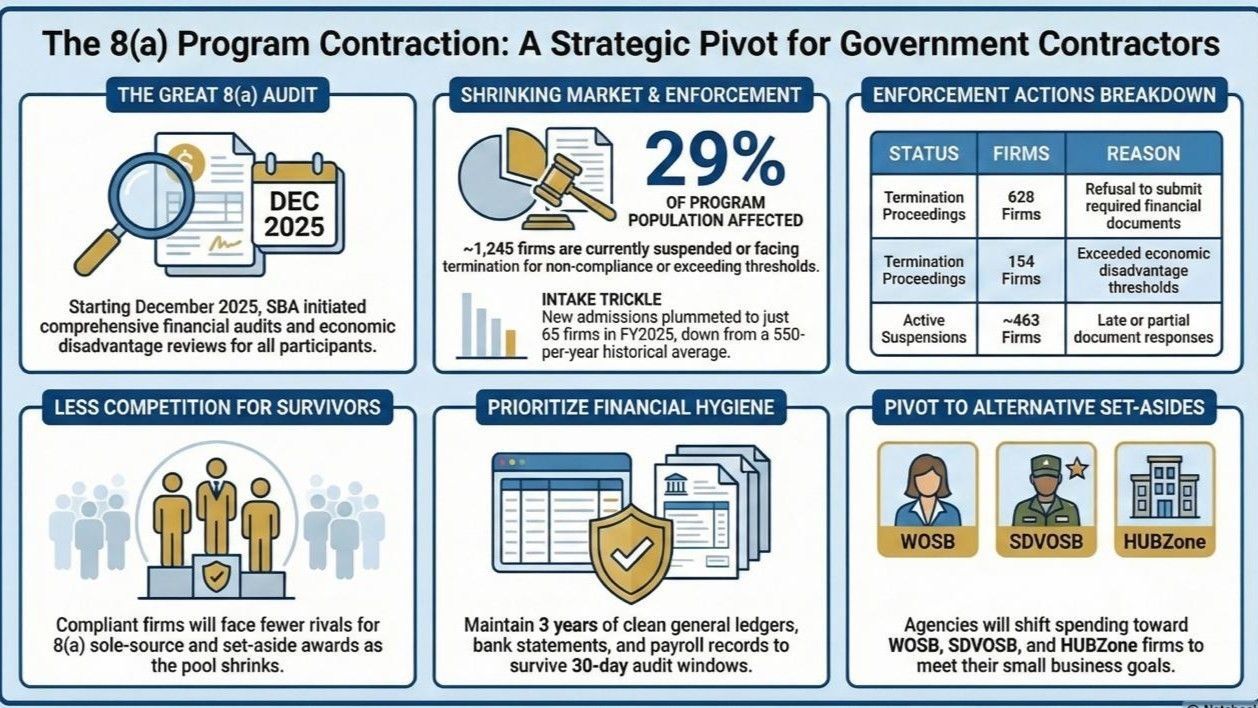
The SBA just initiated termination proceedings against 628 more firms in the 8(a) program. These are firms that refused to turn over three years of financial documents after the agency's December 2025 data call to all 4,300 participants.
The SBA just initiated termination proceedings against 628 more firms in the 8(a) program. These are firms that refused to turn over three years of financial documents after the agency's December 2025 data call to all 4,300 participants.
This isn't a new action. It's the next phase of one that started months ago. And when you add up the numbers, the picture is stark.
The Timeline
- December 5, 2025. SBA orders all 4,300 active 8(a) firms to produce three years of financial records: general ledgers, bank statements, payroll registers, and contract documentation. Deadline: January 5, 2026.
- January 28, 2026. SBA suspends 1,091 firms for failing to comply with the document request. Those firms collectively held approximately $850 million in 8(a) contracts during FY2021 through FY2024.
- February 11, 2026. SBA initiates termination proceedings against 154 8(a) firms that submitted their financials but exceeded statutory limits for economic disadvantage. Those 154 firms held nearly $1.3 billion in 8(a) contracts, including $1 billion in sole-source awards. I covered this in detail in my previous article.
- March 4, 2026. SBA moves to terminate 628 of the 1,091 originally suspended firms. These are participants who still have not complied with the document request after being suspended. According to the SBA, they received $637 million in 8(a) set-aside contracts during the Biden administration.
Add It Up
The SBA has now initiated termination proceedings against approximately 782 firms (154 plus 628). That's roughly 18% of the entire 8(a) program population.
But the real number is worse. The remaining original 1,091 suspensions are still in effect. That means approximately 1,245 firms are either suspended, facing termination, or both.
- 628 firms moving to termination for refusing to submit documents
- 154 firms moving to termination for exceeding economic disadvantage thresholds
- ~463 firms still suspended (the remainder of the 1,091 who submitted late or partial responses)
- Total affected: ~1,245 firms
Out of approximately 4,300 participants, that's nearly 29% of the program either suspended or in termination proceedings.
The Intake Problem
Here's the number that should concern every 8(a) firm and every contracting officer who relies on the program.
In fiscal year 2025, the SBA accepted 65 new firms into the 8(a) program. Sixty-five. Compare that to more than 2,200 accepted during the four years of the prior administration, or roughly 550 per year.
So while approximately 800 firms are being removed, the pipeline of new entrants has slowed to a trickle. The net effect is that the 8(a) program is shrinking in real terms, and it's shrinking fast.
If you started 2025 with roughly 4,300 firms and you subtract the 782 in termination proceedings, then add back only 65 new entrants, the effective program population is heading toward 3,500 or lower. Factor in firms that naturally graduate or exit, and we could be looking at a program that's 25 to 30 percent smaller than it was 18 months ago.
What the SBA is Saying
Administrator Kelly Loeffler framed this as a fraud enforcement action: "If you have something to hide, you cannot do business with the federal government."
The SBA's position is that the 8(a) program expanded under the prior administration without adequate oversight, creating opportunities for pass-through schemes and shell companies. The agency launched its first-ever comprehensive audit of the program in June 2025, covering all high-dollar and limited-competition contracts going back 15 years.
Other enforcement actions in this audit cycle include:
- Rescinding USAID's independent 8(a) contracting authority after a DOJ investigation uncovered a $550 million bribery scheme
- Suspending contractors following pass-through fraud allegations involving $253 million in contract awards
- Issuing warnings to contracting officers about penalties for failing to report suspected fraud
What this Means for Current 8(a) Firms
If you're still in the program and in good standing, three things are true:
1. The competitive field just got smaller. Fewer participants means less competition for set-aside and sole-source awards. If you're compliant, documented, and ready to perform, this is an advantage.
2. Compliance scrutiny is not going away. The SBA is clearly willing to enforce thresholds and deadlines. Your annual review under 13 CFR 124.112 is no longer a formality. Treat it like a DCAA audit: complete, timely, documented.
3. Agencies still need to hit small business goals. The federal government's small disadvantaged business contracting goal is 5% (reduced from 15% on Day One of the current administration). Fewer qualified 8(a) firms means agencies will concentrate awards among the remaining pool. If you're positioned correctly, you will see more opportunities.
The Opportunity Shift: Other Set-Asides Stand to Gain
As the 8(a) program contracts, agencies still have small business dollars to spend. That money has to go somewhere.
Watch for growth in other socioeconomic set-aside programs:
Women-Owned Small Business (WOSB/EDWOSB). Agencies that can't fill their 8(a) pipeline will look to WOSB set-asides to meet broader small disadvantaged business goals. If you hold WOSB certification, now is the time to update your capability statements and get in front of contracting officers who just lost their go-to 8(a) vendors.
Service-Disabled Veteran-Owned Small Business (SDVOSB). The VA's Vets First program already has its own verification process. SDVOSBs with clean certifications are well-positioned to absorb work that would have gone to 8(a) firms, particularly in IT, professional services, and facilities management.
HUBZone. Firms in designated HUBZone areas offer agencies another path to meet small business contracting targets without relying on a shrinking 8(a) pool.
The math is simple. Fewer 8(a) firms plus the same agency spending targets equals more opportunity flowing to other set-aside categories. Firms holding multiple certifications have the most flexibility to capture redirected work.
What this Means for Agencies and Primes
Contracting officers who relied on now-terminated firms for set-aside and sole-source work need replacement vendors. That creates recompete opportunities across every set-aside category.
Prime contractors with 8(a) subcontracting commitments need to evaluate their small business participation plans. If your SB subs are among the suspended or terminated, your compliance is at risk. Start identifying replacement firms now.
The Bigger Question: Who's Next
The 628 firms that refused to submit documents already made their choice. They're gone. But the more important question isn't whether 8(a) firms can survive this scrutiny. It's whether the other set-aside programs could.
The SBA asked for basic financial documentation. General ledgers. Bank statements. Payroll registers. Contract files. Three years' worth. That's not an unusual request. That's what any competent accounting department should be able to produce on short notice.
So here's what every WOSB, SDVOSB, and HUBZone firm should be asking right now: if the SBA turned this same lens on your program tomorrow, could you respond in 30 days?
Because the precedent has been set. The SBA just proved it's willing to audit an entire program, suspend a quarter of participants, and move to terminate hundreds of firms in a matter of months. There is no reason to assume 8(a) is the last program to get this treatment.
If you're in any socioeconomic set-aside program, treat this as your early warning. Get your books in order. Make sure your eligibility documentation is current and defensible. The firms that got caught flat-footed in the 8(a) audit didn't fail because the bar was too high. They failed because they weren't keeping up with basic financial hygiene.
The bar isn't going back down. It's going to spread.
Bottom Line
The 8(a) program entered 2025 with approximately 4,300 firms. Between terminations, suspensions, natural attrition, and a near-total slowdown in new admissions, the effective population is heading well below 3,500. We haven't seen numbers like this since the program's early years.
For compliant firms, this is an inflection point. Less competition, more agency need, and a premium on clean books. For firms that can't produce basic financial documentation, the message from the SBA is clear: the free ride is over.

Wallace Angel
Wallace “Wally” Angel is a strategic CPA with more than 20 years of experience in the government contracting and consulting environments with companies ranging from start-ups to $800M. His government contracting expertise includes FAR and DCAA compliance, indirect rate calculation, forward pricing, proposal writing, pricing, and cradle to grave contracts management and system design and implementation. In his position as Partner, Financial Operations, Wally serves as a trusted advisor to the C-suite in controllership and cash management, revenue recognition, system design and implementation, and full financial planning and analysis.
Share this article:
Visit Us On: