Your Tax Position Is a Reflection of Your Financial Infrastructure
By TED ROSE, ROSE FINANCIAL SOLUTIONS
Before I get into this week's topic, I want to say thank you.
The
2026 ROSE FaaS Conference on June 9 was everything I hoped it would be. The room was full of exactly the right people: CFOs, GovCon operators, NFP leaders, founders thinking about what comes next, fractional advisors who are in these situations every week. The conversations were honest and specific. Speakers talked about what they have actually seen. And the energy at the reception told me what the agenda alone cannot: people left with something to think about.
If you were there, thank you for showing up. If you missed it, many of themes we covered on June 9 are the same ones running through this newsletter. I've had a few people ask me whether the content will be available online. Yes, we are making the content available to ticket holders (virtual tickets are still available) in the ROSE Community. You can find the link on our website. Which brings me to this article.
Most leaders believe their tax situation is covered. They have a CPA firm. They file on time. They haven't been audited. That combination feels like safety.
But "not audited yet" is not the same as "clean." And "filed on time" tells you nothing about accuracy, completeness, or exposure.
The real question is not whether your taxes are being filed. It's whether your financial infrastructure is capable of producing the information your tax filings actually require. That distinction is where I've seen real exposure build quietly, over years, inside organizations that believed they had this handled.
They weren't careless. The infrastructure feeding the tax return was just never built to the standard the return demands.
The CPA Firm Works With What You Give Them
Your CPA or tax advisor is skilled. But they work downstream from your financials. They prepare returns based on the data, schedules, and documentation your team provides.
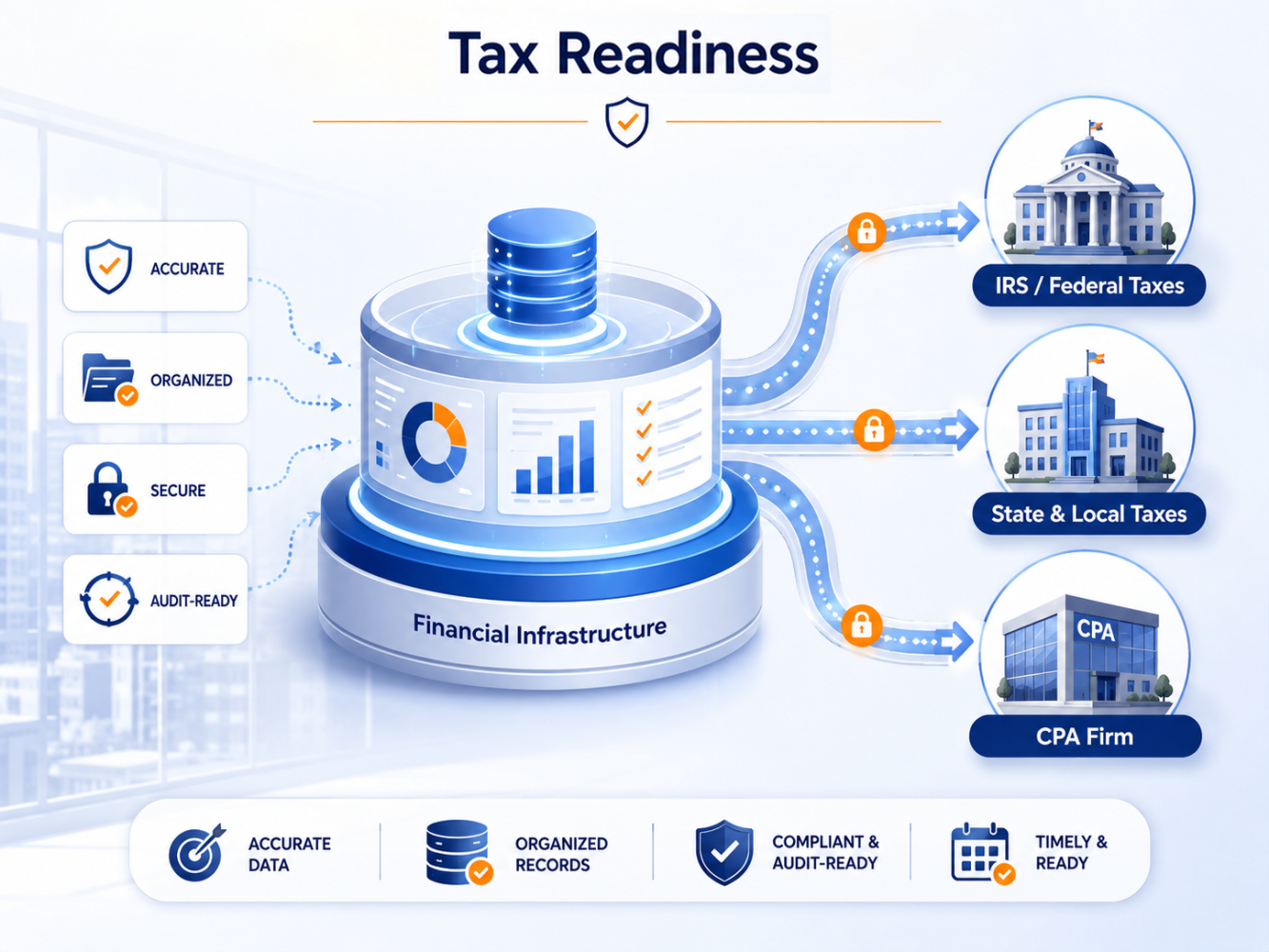
If your chart of accounts is disorganized, they work with it. If your transaction classifications are inconsistent, they make adjustments. If subsidiary data doesn't reconcile cleanly, they sort it out as best they can. If documentation is thin, they ask for more, or they make a judgment call.
The problem is not that the return gets filed anyway. The problem is that none of those corrections show up on the surface. The return looks complete. The filing goes out. But what was submitted may not accurately reflect your actual position, and you may not find out until someone looks more closely.
I've seen this pattern create real exposure across state and local tax, IRS filing positions, and broader regulatory compliance areas that trace directly back to the financial infrastructure layer.
Where the Gaps Consistently Show Up
State and local tax is probably the most underestimated area of risk in growth-stage companies. Since the Supreme Court's 2018 decision in South Dakota v. Wayfair, economic nexus rules have created filing obligations across dozens of states for businesses that have never physically operated there. The trigger is no longer a warehouse or an office. It's revenue thresholds and transaction volume.
If your systems don't track revenue by state, or if your ERP isn't configured to flag nexus triggers as they occur, you may be accumulating obligations you don't know about. Those obligations don't disappear. They accrue, with interest and penalties.
SALT exposure is not a tax strategy problem. It's a data and systems problem. The companies with the worst SALT risk aren't trying to avoid taxes. Their financial infrastructure just isn't designed to tell them what they owe.
At the federal level, the most common infrastructure-driven problems I see are misclassified expenses, thin documentation on deductions, inconsistent treatment of similar transactions across periods, and incomplete intercompany records in multi-entity structures. These aren't exotic avoidance schemes. They're the predictable output of financial systems that were never designed to maintain the precision a strong IRS filing position requires.
A tax return built on imprecise financials is defensible right up until the moment it isn't. At that point, the weakness isn't in the tax strategy. It's in the records behind it.
Beyond SALT and federal income tax, there is a growing category of obligations that live at the intersection of financial reporting and regulatory compliance. Payroll tax accuracy, 1099 completeness, sales tax reconciliation, foreign transaction reporting, and equity and compensation disclosures all depend on the underlying financial systems working cleanly and consistently. These are not exotic problems. They fall through the cracks in companies that have grown faster than their financial infrastructure.
The Infrastructure Argument
When we assess organizations using the FSRA, tax and compliance exposure consistently maps to weaknesses in the Structural Foundation pillar. Structural Foundation is the first dimension of financial readiness. It covers governance, role clarity, internal controls, audit and regulatory posture, and tax compliance risk. It is the layer everything else depends on.
Companies with strong Structural Foundation have a clean, consistently applied chart of accounts. Their transaction classifications follow documented policies rather than informal habit. Intercompany and entity-level records are reconciled and reviewable. The monthly close produces accurate, timely financials that can serve as the source of record for a tax return, an audit, or a regulatory inquiry.
Companies with weak Structural Foundation carry the same underlying risk across every compliance dimension. The IRS filing, the SALT return, the regulatory disclosure, they all draw from the same well. If that well is cloudy, everything downstream reflects it.
This is the core of the argument. Tax and compliance readiness is not primarily a tax problem. It is a financial infrastructure problem. The fix does not start with better tax planning. It starts with cleaner financials, tighter controls, and systems designed to maintain precision by design, not by heroic effort at year-end.
What Readiness Actually Requires
Tax and compliance readiness does not require a perfect system. It requires one that operates at a standard high enough to support accurate, defensible, auditable filings.
That means the chart of accounts is structured so that data flows into the right categories without correction at reporting time. Transaction classification policies are written and enforced, not informally understood. The monthly close produces financials accurate enough to rely on, not just directionally right.
It also means entity-level and intercompany records are maintained with the precision multi-entity structures genuinely require. Documentation meets the threshold that a tax advisor, an auditor, or a regulator would expect, not what was convenient at the time of the transaction.
None of this is out of reach. But it requires intention and structure. For companies that haven't built it yet, the window to address these gaps is always before the audit, before the inquiry, and before the filing that draws attention.
The Practical Test
Your CPA firm is your tax advisor. They confirm the past and protect your filing position based on what they receive. What they receive comes directly from your financial infrastructure.
The question is not whether you have a good CPA. The question is whether your financial systems are producing the information they need to do their job well.
If you're not sure, the
Financial System Readiness Assessment is a 15-minute executive diagnostic, book a no-cost meeting with ROSE to evaluate. It will show you exactly where your Structural Foundation stands, what gaps are present, and where your compliance exposure is most likely building. Tax readiness starts with financial infrastructure. That's where to look first.

Ted Rose
In 1994 Ted Rose founded Rose Financial Solutions (ROSE), the Premier U.S. Based Finance and Accounting Outsourcing Firm. In 2010, the Blackbook of Outsourcing named ROSE the #1 FAO firm in the world based on client satisfaction. As the president and CEO of ROSE, he provides executives with financial clarity. Ted has also acted as the CFO for a number of growth companies and assisted with various rounds of financing and M&A transactions.
Share this article:
Visit Us On: