
What Is an Agentic Finance Organization?
By TED ROSE, ROSE FINANCIAL SOLUTIONS
An agentic finance organization is not just automated. It is coordinated.

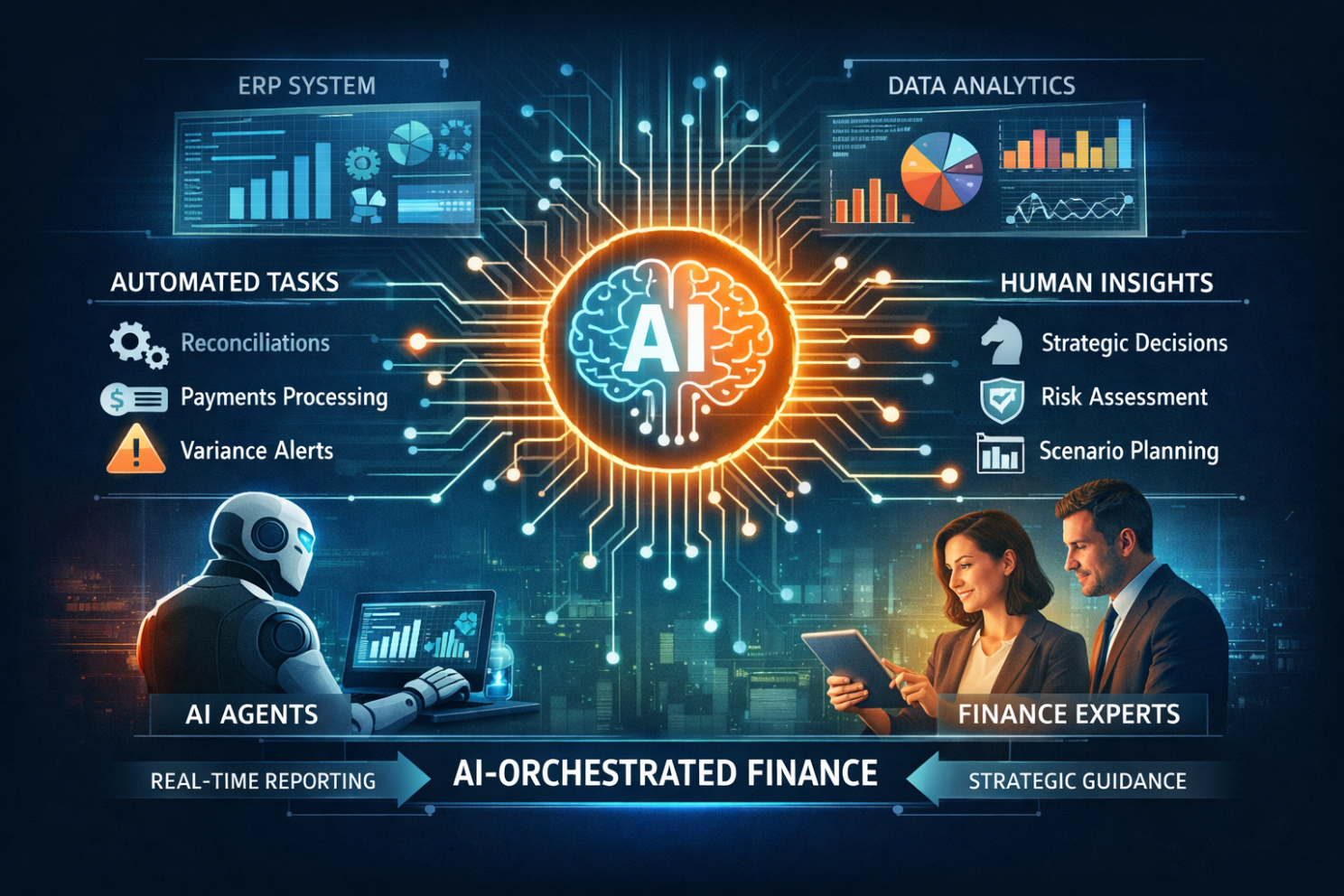
AI agents do not simply execute tasks. They:
- Monitor financial systems in real time
- Trigger workflows across ERP and adjacent systems
- Reconcile data across sources
- Flag anomalies and exceptions
- Draft insights and explanations
- Escalate only what requires human judgment
Finance becomes a real-time decision engine, not a historical reporting function. Your ERP remains the system of record. An AI-enabled operating layer sits above it, orchestrating work across systems. This is how finance moves from reactive to proactive.
What This Looks Like in Practice
1. AI Agents Coordinate Work Across Systems
Instead of humans stitching together data from ERP, CRM, payroll, billing, and FP&A tools:
- Agents reconcile revenue automatically
- AP exceptions are resolved end-to-end
- Intercompany mismatches are flagged instantly
- Variances are explained before the meeting
Agents monitor continuously. They act automatically. They escalate intelligently. The result: fewer bottlenecks and fewer surprises.
2. Humans Focus on Judgment, Strategy, and Exceptions
In an agentic model, finance professionals stop being task managers. They become strategic advisors, risk evaluators, capital allocators, scenario planners, and decision architects.
Humans review exceptions, not transactions. They design systems, not spreadsheets. This elevates finance roles into high-leverage positions aligned with growth and strategy.
3. Continuous Learning and Optimization
Traditional automation is static. Agentic finance is adaptive. AI agents improve through feedback loops:
- Exception patterns are learned
- Forecast models refine automatically
- Risk indicators evolve
- Controls strengthen over time
The system becomes smarter every month. Finance is no longer a monthly event. It becomes a continuously optimized function.
The Four Pillars of Agentic Finance
- People: Strategic, high-leverage finance professionals focused on insight, not manual processing.
- Process: Adaptive workflows that improve automatically and eliminate friction.
- Technology: ERP as the trusted system of record with an AI-enabled operating layer coordinating activity across the enterprise.
- Data: Structured, reconciled, and positioned for intelligence, not just reporting.
When these four pillars align, scale becomes possible without linear headcount growth.
Why ~85% Automation Is the Right Target
100% automation is unrealistic and risky. Finance requires:
- Judgment
- Governance
- Ethical oversight
- Risk management
- Accountability
But 85% automation? That is transformational. It removes:
- Manual reconciliations
- Status chasing
- Routine variance explanations
- Basic compliance workflows
- Transaction-level review
While preserving human oversight and control. The result is a system that is faster, safer, more transparent, more scalable and most importantly, trusted.
Finance as a Real-Time Decision Engine
In an agentic organization:
- Cash position updates continuously
- Forecasts adjust dynamically
- Margin shifts are flagged instantly
- Risks surface before they escalate
Executives no longer wait for month-end packets. They operate with living financial intelligence. Finance shifts from reporting history to shaping the future.
What This Means for CFOs
The CFO pipeline is changing because the role is changing. The future CFO must understand:
- Systems architecture
- Data infrastructure
- AI governance
- Process orchestration
Not just accounting rules. Building an agentic finance organization is not about replacing people. It is about designing a finance function that scales without burnout. One that drives clarity instead of producing noise. One that turns data into advantage.
The Key Outcome
An Agentic Finance Organization delivers:
- ~85% automation
- Real-time financial visibility
- Lower risk through intelligent monitoring
- Scalable operations without linear headcount growth
- Strategic finance talent focused on value creation
This is not theoretical. The AI-enabled operating layer is emerging now. 2026 will accelerate adoption across digital finance platforms. The organizations that architect for it early will compound advantages quickly.
The Bottom Line
The future of finance is not more dashboards. It is orchestrated intelligence. When AI agents coordinate the system and humans focus on judgment, strategy, and growth, finance becomes what it was always meant to be: A proactive force that empowers leadership.
That is the path to ~85% automation with safety, scale, and trust.

Ted Rose
In 1994 Ted Rose founded Rose Financial Solutions (ROSE), the Premier U.S. Based Finance and Accounting Outsourcing Firm. In 2010, the Blackbook of Outsourcing named ROSE the #1 FAO firm in the world based on client satisfaction. As the president and CEO of ROSE, he provides executives with financial clarity. Ted has also acted as the CFO for a number of growth companies and assisted with various rounds of financing and M&A transactions.
Share this article:
Visit Us On: