
The Contract You Can't Yet Support
By TED ROSE, ROSE FINANCIAL SOLUTIONS
A founder called me about the biggest win in her company's history.
She had just won a contract that would push her business past $10M. Years of pursuit, and it finally landed. The team celebrated. Then the questions started.
Could the current close handle a contract this size? Were the systems set up to track it the way the customer required? Who was going to build the reporting the new work demanded, and when? Underneath the celebration was a worry she could not shake.
Here is what I told her, and what I want to tell you.
The win did not create the problem. It revealed one that was already there.
The growth you talk yourself out of
That founder at least went after the contract. Many leaders never get that far. CEOs tell me routinely that they are not pursuing certain contract types, or certain contract sizes, because they do not believe their accounting system can handle the work. So they self-select out. They chase the deals that fit the system they already have, and they leave the larger opportunities to companies they assume are better equipped. The belief underneath that decision is worth saying plainly. They think the ceiling is real. It is not. The system can be fixed.
The largest contracts are not just bigger versions of the small ones. They are more complex to run and more complex to account for, and that complexity is exactly what a strong financial infrastructure is built to carry. The companies that can handle complexity win work that others cannot even bid on. The ability to manage it is not a tax on growth. It is a qualification for it.
So the cost of weak infrastructure is not only the scramble after a win. It is the growth you never pursue because you have quietly decided you cannot handle it. That is a decision made on a false belief, and it compounds. Every contract you talk yourself out of is one a better-built competitor takes instead.
Fixing this early does more than protect you from the scramble. It expands what you are willing to chase. The infrastructure question is a growth question long before it is an audit question.
The moment finds the weakness
Every growing company carries some slack in its finance function. A close that runs a few days long. A report that gets rebuilt by hand every month. A system that technically works but depends on one person knowing where everything lives. At a smaller size, that slack is invisible. The business absorbs it. Nobody feels the cost because the volume is low enough to hide it.
A big win removes the slack. Now the close that ran long runs late into decisions that cannot wait. The report rebuilt by hand cannot keep up with the volume. The one person who knew where everything lived becomes a single point of failure the whole company can feel.
None of this is new. The contract did not break the finance function. It loaded it, and the load found the weakness that was already sitting there. That is the part most leaders miss in the moment. They treat the strain as something the win caused, so they try to solve it by working harder. But effort was never the shortage. The infrastructure was.
For first-time contractors, the gap is wider
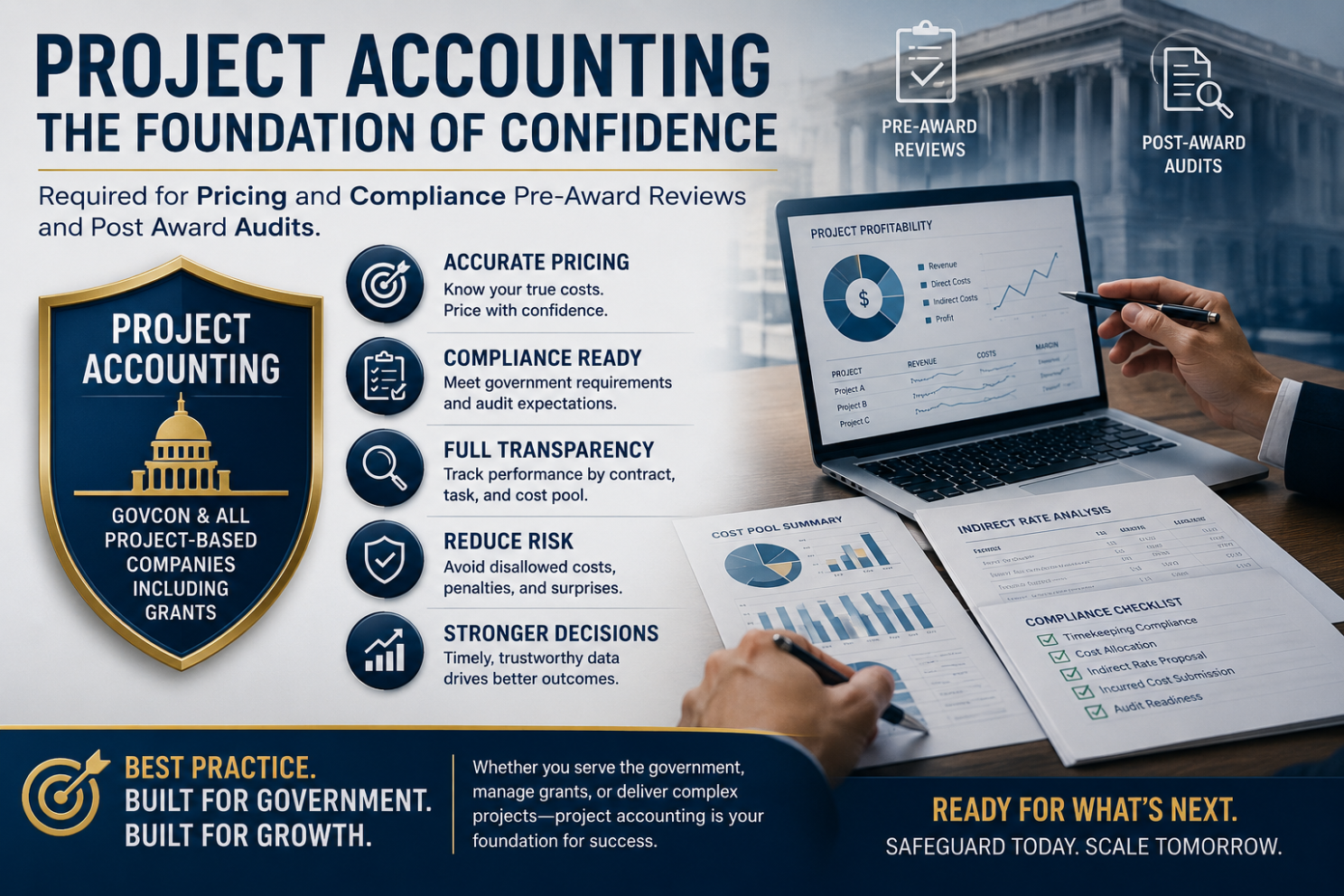
If that first big win happens to be a government contract, the gap is not just wider. It is a different kind of gap. Commercial finance and government finance are not the same discipline. A federal contract brings requirements most growing companies have never had to meet. Timekeeping has to be system-enforced and auditable. The chart of accounts has to reflect cost pool structures. Indirect rates have to be modeled, tracked, and defended against a provisional number you may have set before you fully understood your own cost base.
Somewhere in the excitement of the win, a company can commit to a compliance posture it does not yet have the infrastructure to hold. I have watched capable teams win their first federal contract and then spend the next six months building, under pressure, the financial infrastructure they should have had before they signed. The work gets done. It just gets done in the worst possible conditions. Fast and expensive, with an audit clock already running and no room to get it wrong.
The specifics are unforgiving. A provisional indirect rate set too low early on can quietly starve the company of cash recovery for a full year. Timekeeping that was fine for a commercial shop will not survive a review that expects a documented, system-enforced trail. And the first incurred cost submission has a way of exposing every shortcut taken in the months before it. None of these are exotic problems. They are known requirements. The trouble is that they arrive as a set, all at once, on top of the actual work of delivering the contract.
Why the scramble costs more than it looks
The visible cost of the scramble is the overtime and the outside help brought in to catch up. That is the part everyone sees, and it is the smaller number. The real cost is the decisions made on numbers no one fully trusts while the scramble is underway. Pricing set without accurate indirect rates. Hiring approved without a clear read on margin. Cash commitments made against reporting that is weeks behind the business. The most expensive thing in finance is rarely the automation or the staffing. It is the bad decision made on data that arrived too late to be useful.
There is a quieter cost too. The founder who spent years earning the customer's trust now spends the first months of the relationship worried about whether the back office can keep the promise the front office made. That worry is not a finance problem. It is a leadership problem wearing a finance costume.
Build before the moment, not during it
The pattern I want you to see is simple. The companies that handle the big win well are not the ones who scramble faster. They are the ones who were already built for it. That does not mean standing up an enterprise finance department before you need one. It means having infrastructure that is ready to scale with the business rather than after it.
Connected systems instead of manual handoffs. A close you can trust on a predictable schedule. Reporting your CFO can review and turn into management insight, rather than reporting your controller is still assembling by hand when leadership needs answers. Compliance built in as a standing posture, so an audit becomes a confirmation instead of a crisis. When that infrastructure is in place, the big win is what it should be. A milestone, not an emergency.
Most growing companies do not have the time or the reason to build all of this from scratch, and they should not have to. A strong CFO or fractional CFO should be guiding capital decisions and reading the business, not personally standing up cost pool structures or rebuilding a close. The infrastructure underneath them can be bought and put in place faster than it can be built internally, which is the difference between being ready for the next contract and racing to catch up to the last one. By the time the moment arrives, it is too late to build for it. The moment does not give you time. It gives you consequences.
The question worth asking now
The question is not whether your finance function can handle today. Most can. The question is whether it can handle the contract, the grant, or the growth you are working right now to win. If you are not sure, that uncertainty is your answer. And it is worth resolving before the win, not after.
That is exactly what our Financial System Readiness Assessment is built to surface. It gives you an accurate read on where your financial infrastructure stands today, across the five areas that determine whether you can scale with confidence: Structural Foundation, Systems Architecture, Operational Discipline, Financial Intelligence, and Strategic Enablement. Not a guess. A baseline you can act on.
Download our
FSRA digital asset to learn more, and see where you stand before the next big moment finds you.

Ted Rose
In 1994 Ted Rose founded Rose Financial Solutions (ROSE), the Premier U.S. Based Finance and Accounting Outsourcing Firm. In 2010, the Blackbook of Outsourcing named ROSE the #1 FAO firm in the world based on client satisfaction. As the president and CEO of ROSE, he provides executives with financial clarity. Ted has also acted as the CFO for a number of growth companies and assisted with various rounds of financing and M&A transactions.
Share this article:
Visit Us On: