Project-Level Truth
By TED ROSE, ROSE FINANCIAL SOLUTIONS
A few years ago I met with the founder of a growing services firm who could not understand why
he felt broke.

Revenue was up. The team was busier than it had ever been. New clients kept signing. By every number he looked at, the business was winning. And yet cash was tight, he was stressed, and something did not add up. So I asked him a simple question. Which of your projects make money, and which lose it?
Crickets...
He could tell me total revenue to the dollar. He could not tell me, with any confidence, which of the projects generating that revenue were profitable and which were draining the company. He was running a project-based business without project-level truth, and it is one of the most common and most expensive gaps I see.
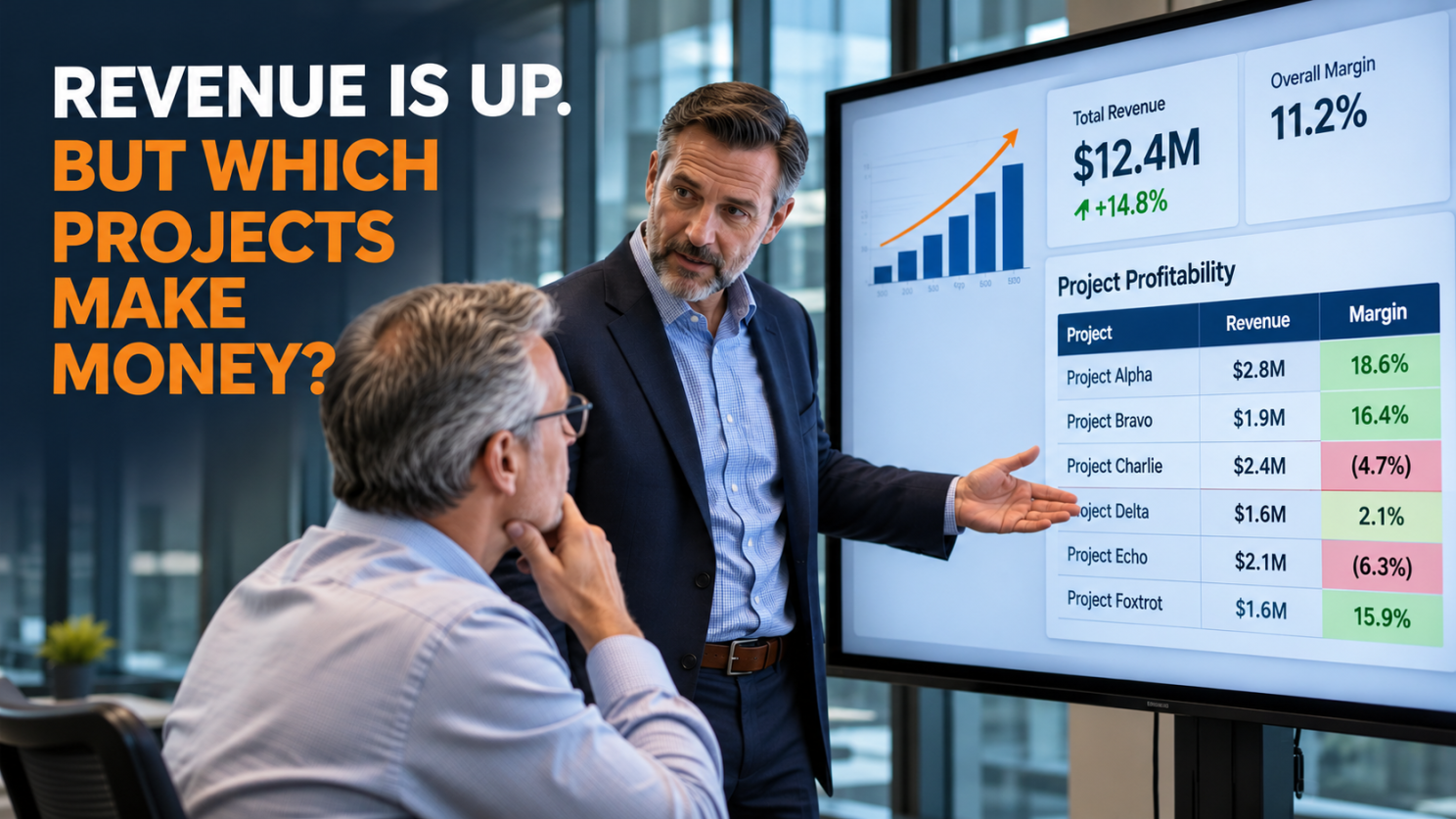
In a project business, revenue tells you that you are busy. Only project-level margin tells you whether being busy is worth it.
A blended margin hides the truth
Most project-based firms look at the business in aggregate. Total revenue, total costs, an overall margin. And the overall margin usually looks acceptable, which is exactly the problem.
An average is a blend. It hides the mix underneath it. In almost every firm I have seen, that blend is made up of some genuinely profitable projects, some that barely break even, and some that are losing money the business cannot see. The healthy average is covering for the losers. On the top line, the project bleeding cash looks identical to the one carrying the firm.
You cannot fix what you cannot see. And when your reporting stops at the aggregate, the money-losing work stays invisible, so it never gets fixed. It gets repeated as it hides who your ideal client are. Companies need to see what type of clients and projects they should look for and which they should avoid.
This is not a rare affliction. In the 2026 SPI Professional Services Maturity Benchmark, a large share of firms reported measurable revenue leakage, averaging more than 4.5 percent of revenue. 4.5 percent does not sound fatal until you remember it comes straight off the bottom line, where the margin is already thin. And that is only the leakage firms could measure. The losses hiding inside a blended average are the ones no one has found yet.
Without project truth, you decide blind
That invisibility shows up in the three decisions that most determine whether a project business thrives.
The first is pricing. If you do not know what it actually cost to deliver the last project, you price the next one off a guess or off the quote you used last time. If that last job lost money, you just repeated the loss, with a fresh coat of confidence on it. This is also where a subtle arithmetic error compounds. Many firms price off markup and assume it equals margin, when a healthy-looking markup can still deliver a thin or negative margin once the true cost to deliver, including the hours that never got billed, is counted.
The second is staffing. Without project-level visibility, your best people get assigned to whatever is loudest, not to what creates the most value. Utilization can look full while the work those hours go into earns very little. The industry is feeling this right now. In the 2026 SPI Professional Services Maturity Benchmark, billable utilization fell to 66.4 percent, the lowest in the study's nineteen-year history, even as firms added headcount. More people, working no more productively, is not growth. It is margin leaking out of the company.
The third is client and work mix. When you cannot see which engagements are profitable, you keep renewing and chasing the ones that generate revenue even when they erode margin, because revenue is the only signal you have. You end up selling more of your least profitable work and calling it success.
The same problem, sharper, in GovCon
Government contractors live a more structured version of this. A government contractor has to see profitability at the contract level, not just across the company, because each contract carries its own budget, its own funding, and its own fee.
Without contract-level truth, a government contractor can over-run a contract and absorb a loss it only discovers at the end, misprice the next proposal because it never learned what the last job truly cost, and struggle to produce the cost-by-contract view the government expects. The compliance structure of GovCon actually forces a discipline every project business would benefit from. You have to track cost by contract. The government contractors who treat that as a source of management truth, not just a compliance chore, make far better decisions than the ones who treat it as paperwork.
Same financial infrastructure, different stakes
The financial infrastructure that produces project-level truth is not exotic. It is job costing done well, time and cost tracked against each project as the work happens, systems connected so the data is trustworthy, and reporting that shows margin by project, client, and service line. It is the same disciplined infrastructure every finance function in this series has needed. The controller maintains it through the close, and the CFO uses it to guide pricing and staffing.
What changes, as it has in every issue of this series, is the cost of not having it. For a project-based firm, the cost of flying without project-level truth is pricing blind, staffing blind, and growing in a way that makes you busier and poorer at the same time. With industry EBITDA for professional services firms down near 9.8-9.9 percent in 2024 - 2025, well below the level the sector held for years, the room to absorb losses you cannot see has rarely been thinner.
The financial infrastructure need does not change. What changes is the cost of not having it.
The question worth asking now
So here is the question I asked that founder, the one worth asking yourself. Without a special project and a week of digging, can you tell me today which of your projects or contracts make money and which lose it?
If the answer is no, you are making your largest decisions, what to price, who to staff, which clients to keep, on a number that averages the truth away. That is not a reporting inconvenience in a project business. It is the difference between growth that builds the firm and growth that hollows it out.
That is what our Financial Readiness Assessment is built to surface. It gives you an accurate read on where your financial infrastructure stands today, across the five areas that determine whether you can see and act on project-level truth: Structural Foundation, Systems Architecture, Operational Discipline, Financial Intelligence, and Strategic Enablement. Not a guess. A baseline.
Download our RFRA digital asset to learn more, and find out whether your firm can see which of its work is actually worth doing.

Ted Rose
In 1994 Ted Rose founded Rose Financial Solutions (ROSE), the Premier U.S. Based Finance and Accounting Outsourcing Firm. In 2010, the Blackbook of Outsourcing named ROSE the #1 FAO firm in the world based on client satisfaction. As the president and CEO of ROSE, he provides executives with financial clarity. Ted has also acted as the CFO for a number of growth companies and assisted with various rounds of financing and M&A transactions.
Share this article:
Visit Us On: