
Decision Readiness: The Data Exists. The Question Is Whether Anyone Trusts It Enough to Act.
By TED ROSE, ROSE FINANCIAL SOLUTIONS
There is a meeting happening right now, somewhere, where someone has asked a reasonable question about the business and the answer is: "Let me check on that."
Not because the data does not exist. Because no one is certain enough in the numbers to say what they mean.
That moment, repeated across enough decisions, is one of the most expensive things that happens inside a growing company.
We spend a lot of time talking about data gaps. Not enough data. Wrong data. Old data. But the more common problem is different. It is not that the data is absent. It is that the data is not trusted. When people do not trust the numbers, they do not act on them. They delay, they hedge, they wait for one more look, or they go with their gut and ignore the reports entirely. Either way, the finance function has failed at its most important job.
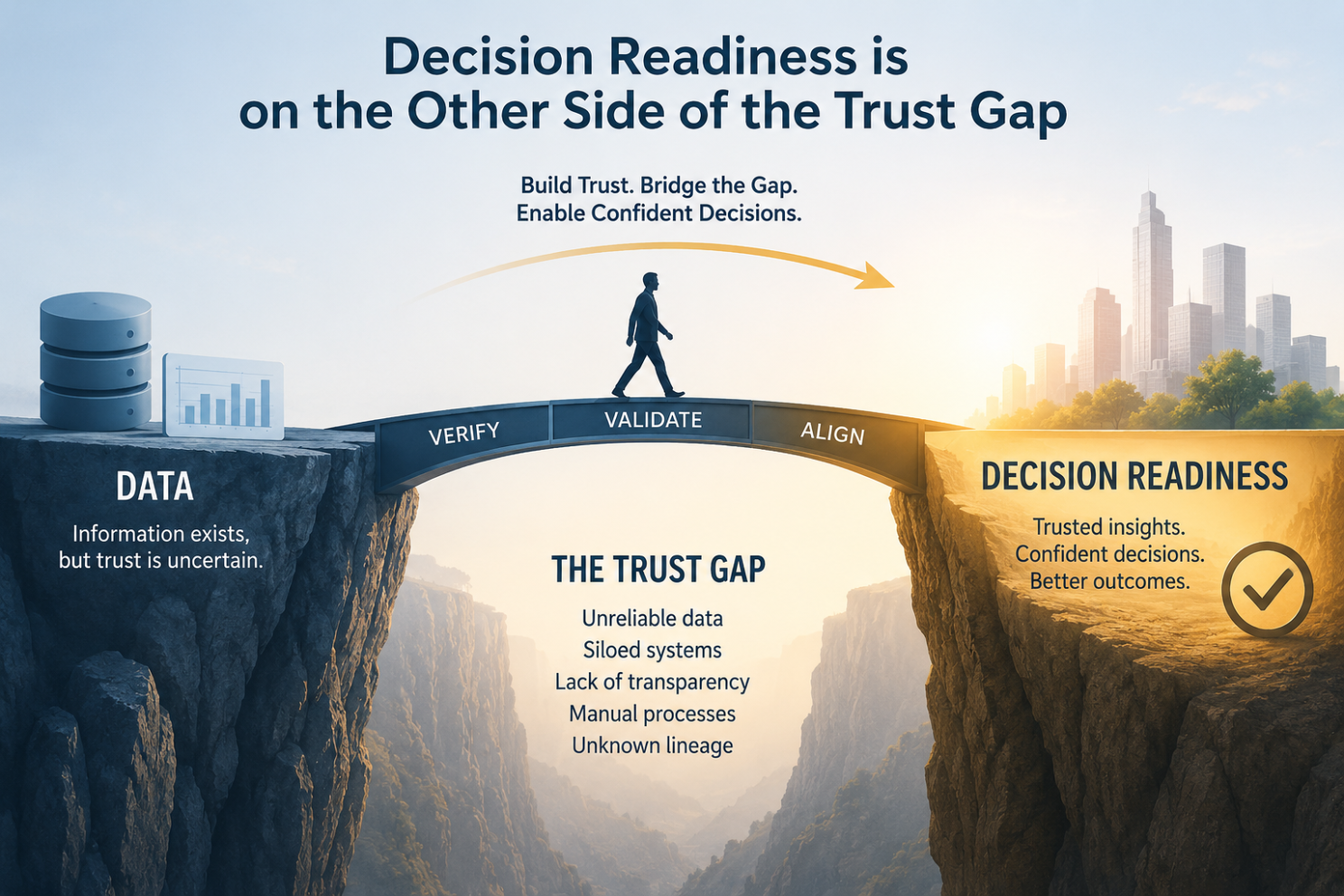
I call this the trust gap. It is the issue I want to address directly.
The Trust Gap Is Not a Reporting Problem
Most organizations think of this as a reporting problem. Reports are late, or poorly formatted, or living in the wrong system. Fix the report, fix the problem.
That framing is wrong. It is also expensive to be wrong about it.
Reports are a symptom. The trust gap is a structural problem. It lives in the foundation of how financial information is collected, standardized, connected, and delivered. When that foundation is weak, no amount of dashboard improvement fixes the core issue. You get nicer-looking reports that people still do not trust.
The trust gap shows up in behaviors before it shows up in any metric. You know it is there when:
- Leadership asks the same financial question to two different people to see if they get the same answer. They do not always.
- The CEO has a spreadsheet they keeps on the side. Not the official model. The one they actually use.
- Budget reviews routinely become exercises in defending the numbers before anyone has discussed what the numbers mean.
- Finance produces a monthly report on day fifteen for decisions that needed to be made on day three.
- A major decision gets made on instinct because the data "wasn't quite ready."
None of these are data problems in the narrow sense. They are confidence problems. Confidence is built on infrastructure, not effort.
Why "Almost Right" Is Not Good Enough
There is a specific frustration that finance leaders know well. You have done the work. The numbers are close. The variance is small. But the CEO pushes back, or the board asks for a reconciliation, or someone wants to verify a figure you know is right but cannot instantly prove.
That friction has a real cost.
When financial information requires explanation before it can be used, it stops being an asset and starts being a liability. Every minute spent defending data is a minute not spent interpreting it. Every question about accuracy is a delay in the decision. Every request to "double check" before committing signals that the infrastructure has not earned trust yet.
The cost is invisible on any individual report, but it accumulates. Hiring decisions made two weeks late. Growth opportunities evaluated after the window has closed. Investor questions answered with uncertainty instead of clarity. Compliance reviews that surface issues because no one was watching the right signals in real time.
The real cost of the trust gap is not bad data. It is good data that arrives too late, in a form people do not believe, with no clear connection to the decision at hand.
What Decision-Ready Finance Actually Looks Like
Decision-ready finance is not about perfection. It is about reliability. The numbers do not have to be flawless. They have to be trusted. Trusted financial information has five characteristics.
It is connected. Data flows from source systems without manual intervention. One source of truth, not three versions living in three places.
It is standardized. Definitions, categories, and calculations are consistent. When two people pull the same report, they get the same number.
It is timely. The close is not dragging into the third week of the month. Leadership is not reviewing last quarter's performance in the middle of this quarter. Finance runs at the speed the business actually moves.
It is structured around decisions, not just history. Reporting is not only what happened. It includes what changed, what it means, and what it suggests about what to do next.
It is governed. The data has controls. People know where it comes from, who touches it, and how it gets reviewed. That governance is what allows leaders to rely on it rather than verify it every single time.
Most organizations have pieces of this. Very few have all five. The ones missing even one piece tend to have a trust gap that gets papered over with manual effort, workarounds, and a lot of "let me just double-check that."
The FSRA and the Trust Gap
The Financial System Readiness Assessment (FSRA) was built around exactly this problem.
The five pillars, Structural Foundation, Systems Architecture, Operational Discipline, Financial Intelligence, and Strategic Enablement, all feed into decision readiness. But Financial Intelligence sits closest to the trust gap. That pillar asks a specific question: Is your finance function producing information that leaders actually use to make decisions? Or is it producing reports that leaders receive and then proceed to verify, question, or quietly ignore?
The FSRA is not a test you pass or fail. It is a diagnostic. It surfaces the specific places where the foundation is weak, where systems are disconnected, where processes are creating delays, where reporting is out of alignment with how decisions actually get made. The output is not a score. It is a roadmap.
Most organizations that take the FSRA come away with two things. First, clarity about what is actually creating the trust gap, not a general sense that finance could be better, but a specific picture of where the breakdowns live. Second, a logical sequence for addressing it. Not everything at once. The right things in the right order.
The First Question Worth Asking
If you are a CFO or a CEO reading this, here is the clearest test I know. Think about the last major decision your organization made. A hiring wave. A pricing change. A contract. A capital request. What role did financial data play? Was it the anchor? Or was it one input among several, consulted but not decisive, confirmed but not truly relied upon?
If the honest answer is that the data was present but not really trusted, that is the trust gap. It is not a reporting problem. It is an infrastructure problem. The difference matters because one gets fixed with a better template and one requires building something more solid underneath.
The companies that move fastest are not always the ones with the most data. They are the ones that trust their data enough to act on it clearly and early, before the window closes.
That trust does not happen by accident. It gets built. And it starts with an honest look at the infrastructure underneath the reports.
If you are not sure where your organization stands, the FSRA is the right place to start. It takes about fifteen minutes. What it surfaces tends to take much longer to address, but knowing where you are is the first step.

Ted Rose
In 1994 Ted Rose founded Rose Financial Solutions (ROSE), the Premier U.S. Based Finance and Accounting Outsourcing Firm. In 2010, the Blackbook of Outsourcing named ROSE the #1 FAO firm in the world based on client satisfaction. As the president and CEO of ROSE, he provides executives with financial clarity. Ted has also acted as the CFO for a number of growth companies and assisted with various rounds of financing and M&A transactions.
Share this article:
Visit Us On: