
Automated but Not Integrated
By TED ROSE, ROSE FINANCIAL SOLUTIONS
A CFO told me recently that her company had automated everything, and finance was still a mess.
She was not exaggerating on either count. They had an automated accounts payable tool. A modern expense platform. A payroll system that ran itself. A billing tool that generated invoices without anyone touching them. Every individual piece worked, and each one had been sold as a step into the modern era.
And yet the close still took too long. The numbers still did not tie without effort. Someone on her team still spent days each month moving data from one system to another, reconciling what should have matched, and chasing down why two tools disagreed. She had spent real money on automation and gotten a faster version of the same underlying problem.
Here is what I told her. You do not have an automation problem. You have an integration problem. And they are not the same thing, even though the market sells them as if they were.
Automation and integration are different things
Automating a task means a tool does that task without a person doing it by hand. Automating accounts payable speeds up accounts payable. That is real, and it is useful.
Integrating systems is something else entirely. It means the tools share the same data and pass work between them without a human in the middle. Integration is what lets the whole finance function operate as one connected thing rather than as a set of separate ones.
Most companies have the first and not the second. They have automated the islands. They have not connected them. And a stack of automated tools that do not talk to each other is not a modern finance function. It is a collection of fast, efficient islands with manual bridges between every one of them.
The work moves to the seams
Picture your finance systems as those islands. Each one is automated and efficient on its own terms. The trouble is the water between them.
Between the islands are the manual bridges. Someone exports from one system and imports into another. Someone reconciles two tools that should agree and do not. And the same number gets re-keyed in three places, until someone hunts down the version that is wrong. The automation did not remove that work. It moved it to the seams between the tools, and the seams are exactly where the errors and the version conflicts live.
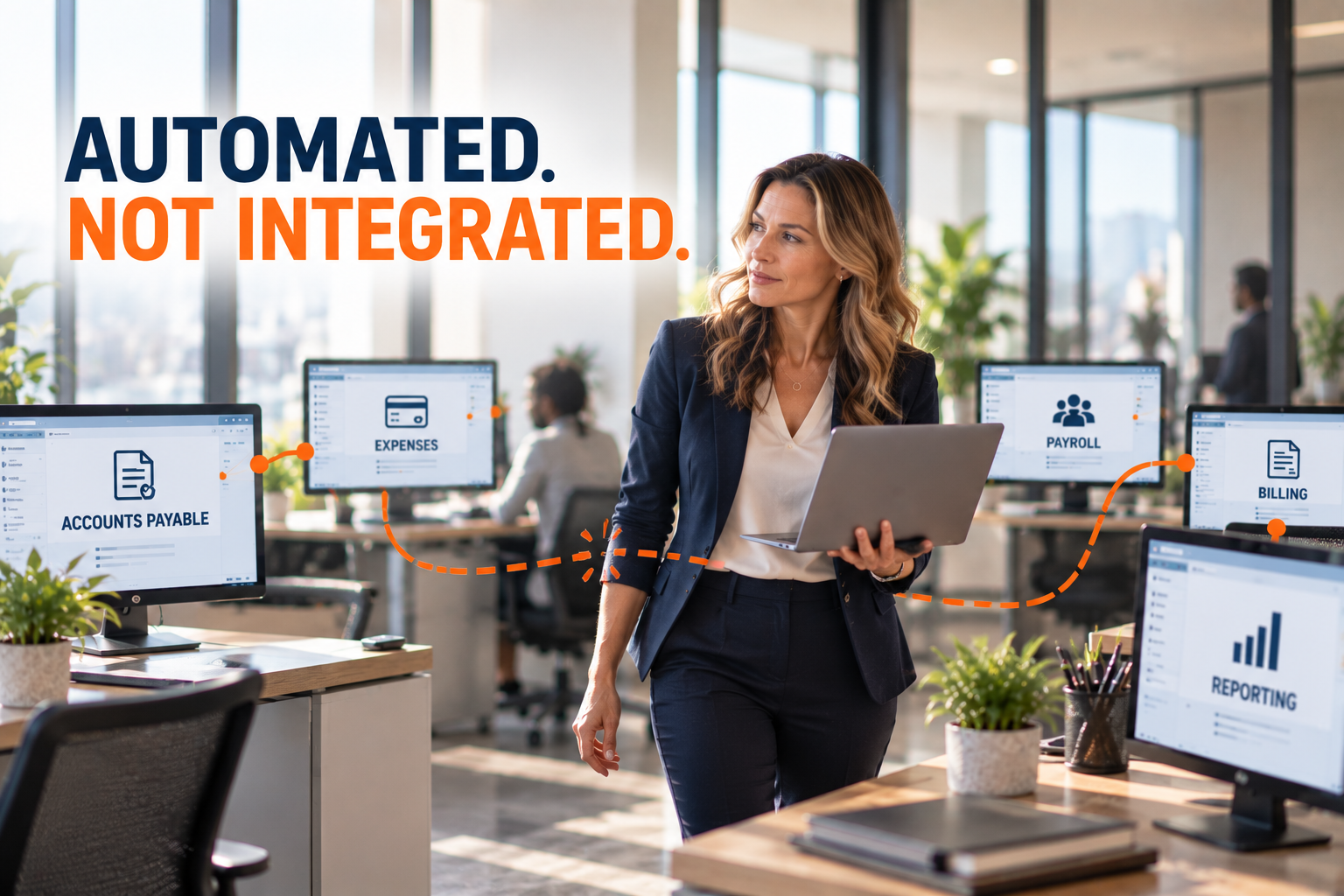
This is the part that surprises people. You can be heavily automated and still have a finance function held together by manual labor, because all the labor has migrated to the spaces the tools do not cover. The islands got faster. The water between them did not.
You can automate your way into more manual work
Here is why this matters more every year, and why I would not treat it as a someday project.
Right now, being automated still feels modern. That feeling has a short shelf life. Real integration, and the AI that runs on top of it, are becoming the baseline that finance functions are measured against. By 2030, an integrated finance function will not be an advantage. It will be the ordinary expectation, the way automated accounts payable is ordinary today. The companies still running automated-but-disconnected stacks then will be as far behind as manual shops are now.
The AI part deserves a direct word, because it raises the stakes. AI is only as good as the data underneath it, and that data has to be integrated to be useful. Layer AI on top of disconnected systems and you do not get intelligence. You get the same fragmented, conflicting data, processed faster and trusted less. Automation on fragile, disconnected infrastructure does not fix fragility. It accelerates it. The integration work you do now is the prerequisite for everything that is coming, not a separate track from it.
Close the gap before it becomes the standard
The fix for an integration problem is not another point tool. Adding a tool to a disconnected stack makes the stack more disconnected. The fix is to connect the finance function into one system with a single source of truth, so the data flows through instead of being carried across by hand.
Most companies do not assemble that integration tool by tool, on their own, and the ones that try tend to spend years and a great deal of money building something that is out of date by the time it is finished. Integrated infrastructure can be brought in as a connected system far faster than it can be stitched together internally. That is increasingly the difference between a finance function that is ready for what is coming and one that is still maintaining bridges by hand.
Finance rarely fails at one size. It fails at the transition between sizes. The move from a pile of automated tools to a single integrated system is one of those transitions, and it is the one that determines whether all the automation you have already paid for actually adds up to anything.
The question worth asking now
The question is not whether your finance function is automated. It probably is, in pieces. The question is whether those pieces are integrated, or whether your team is spending its time as the manual bridges between tools that were each sold as a solution.
If most of your finance effort goes into moving and reconciling data between systems, you do not have a modern finance function yet. You have automated islands and a lot of manual water between them. And that gap is worth closing now, before integration stops being an edge and becomes the price of admission.
That is what our Financial System Readiness Assessment is built to surface. It gives you an accurate read on where your financial infrastructure stands today, across the five areas that determine whether your systems work as one: Structural Foundation, Systems Architecture, Operational Discipline, Financial Intelligence, and Strategic Enablement. Not a guess. A baseline.
Download our FSRA digital asset to learn more, and see whether your finance function is truly integrated, or just automated in pieces.

Ted Rose
In 1994 Ted Rose founded Rose Financial Solutions (ROSE), the Premier U.S. Based Finance and Accounting Outsourcing Firm. In 2010, the Blackbook of Outsourcing named ROSE the #1 FAO firm in the world based on client satisfaction. As the president and CEO of ROSE, he provides executives with financial clarity. Ted has also acted as the CFO for a number of growth companies and assisted with various rounds of financing and M&A transactions.
Share this article:
Visit Us On: